
The Blue Band in the Cliff
Mila's father, whose name was Tomasz and who was long accustomed to his daughter leading him into situations more interesting than the one he had anticipated, listened to the whole account over a hastily eaten lunch at the field station and then stood up and got his camera bag without another word.
He was a lean, quiet man in his forties with a methodical mind and the particular patience of someone who worked with long timescales for a living. He asked Aleksei three precise questions about the geology of the deposit on the walk back to the beach, listened to the answers carefully, and said, "All right. We document in layers: first the cliff face in context, then the exposed band in detail, then the surface of the band, then any accessible inclusions. We don't disturb the matrix unless something is already loose. We record everything before we touch anything."
Aleksei looked at Mila. She gave him the expression that meant I told you.
The cliff section with the exposed band was still unvisited by other collectors when they arrived.
The morning's foot traffic had been at the southern end of the beach, further from the town, and this section was quiet. The fresh cliff fall had left a raw, pale face below the dark band, and the band itself was perhaps twenty centimetres thick and ran for about eight metres horizontally before disappearing back into the cliff at either end.
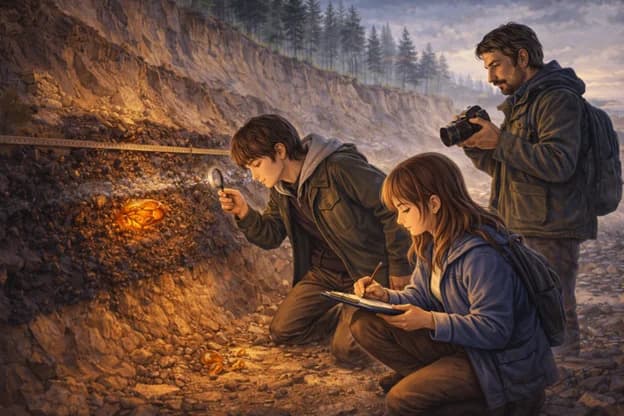
Tomasz photographed the whole cliff face first, establishing context, then moved to the band with a measuring tape and photographed it in sections from as close as the slope would allow.
Aleksei found a stable spot from which to examine the band's surface with a small hand lens.
Mila worked along the base of the cliff fall, going through the freshly deposited material carefully, looking for pieces that had come from the band.
She found seven pieces of amber in forty minutes. Four were small and unremarkable. One was medium-sized with a fragment of what appeared to be plant material. One was a clear golden piece about the size of a walnut, unbroken. And one was a piece of the red amber, smaller than Aleksei's find but the same unusual colour, and inside it, clearly visible, was a fragment of something that looked like a leg, jointed, with small scales.
She called the others over.
Aleksei looked at the leg fragment. "Same deposit," he said. "Same type of organism."
"The colour of the amber alone puts it with yours," said Mila's father. "I've not seen that red colour in beach finds before. It's consistent with a distinct formation layer." He photographed the piece from every angle. "This deposit is unusual. The colour of Baltic amber is typically determined by the conditions under which the resin was deposited and fossilised, air bubbles,
organic content, burial conditions. This red colouration suggests specific and distinctive formation conditions. If there are multiple specimens with associated fauna and consistent colour, this is scientifically significant."
"Scientifically significant enough for a university palaeontology team to take over the survey,"
said Mila.
"Which is what needs to happen," said her father. "With the permit holder's involvement."
"We go to see Professor Volkov tomorrow," said Aleksei.
They spent the rest of the afternoon at the cliff. Tomasz sketched the deposit in plan and section, noting the geological context: the layers above and below the amber band, the texture of the matrix, the angle of the cliff and the orientation. Mila catalogued each found piece with a number, a photograph, and a location note. Aleksei worked the cliff face above the deposit with a small probe, testing the matrix above the band to understand how deep the overburden was and how stable the exposed section was likely to remain.
Towards the end of the afternoon, a man appeared on the beach. He was not a collector, or did not look like one. He was wearing a hard hat and a high-visibility vest, and he was walking the cliff base looking upward with the assessing gaze of someone who knows what they are looking at. He stopped at the deposit section and looked at it for a long time. Then he looked at Mila and Tomasz and Aleksei.
"You found this this morning?" he said, in Russian.
Aleksei answered in Russian and Mila's father listened with the partial comprehension of someone with moderate Russian vocabulary and asked Mila what was said.
"Aleksei told him yes, and that he is here with his grandfather's research permit." Mila watched the man. "The man is asking who his grandfather is."
The man's expression when Aleksei said the professor's name was interesting. It moved through surprise to something more guarded.
He said something further and walked away along the beach.
"What did he say?" Mila asked.
Aleksei watched the man go. "He is from the mining authority," he said. "He said they will send a geological team to assess the deposit within the week."
The three of them looked at the deposit. Then at each other.
"Within the week," said Mila's father.
"The permit expires in twelve days," said Aleksei.
Mila did the arithmetic. It was not comfortable arithmetic. "We need Professor Volkov to file an emergency research claim against his permit," she said. "That requires him to formally notify the scientific committee of a significant find and request priority survey status. His doctor said excitement is to be managed carefully." She looked at Aleksei. "Do you think he can manage it?"
Aleksei looked at the amber piece in his hand, the red one with the lizard, which he had not put down all afternoon. "My grandfather," he said, "has been waiting fifteen years for this. I do not think managing his excitement is going to be the problem." He paused. "The problem will be stopping him from coming to the beach himself."