
The Station That Time Forgot
Fourteen-year-old Kwame Asante-Briggs had a very specific idea of what a holiday should look like, and it involved a beach, warm water, and at a minimum one functioning ice cream vendor within walking distance. What it did not involve was a rusted railway carriage sitting in two feet of Norwegian undergrowth, a grandmother who kept saying things like "it is just around the next corner" when it demonstrably was not, and a map that had been printed in 1987 and treated subsequent decades of landscape change with complete indifference.
They were somewhere in the Troms region of northern Norway, which his grandmother had explained was beautiful and remote and full of history, and which Kwame was prepared to concede was two of those three things. The beauty was not in question. The mountains came down to the fjords in grey and purple masses, and the sky above them was the particular shade of blue that only seems to exist this far north, and the light at this latitude in July did something strange and wonderful, lasting until nearly midnight and returning before three in the morning, filling the days with a golden quality that made everything feel slightly unreal.
But remote was an understatement. They had not seen another person in four hours.
His grandmother, Nana Adwoa, was seventy years old and walked faster uphill than Kwame did on the flat, which he found both impressive and faintly embarrassing. She had grown up in Ghana, trained as a railway engineer in Germany in the 1970s, and spent twenty years working on the Norwegian railway network before retiring to Oslo. She returned to this particular region every few years, she said, because she had worked here in the 1980s on a line maintenance project and had never quite let go of it.
The line she had worked on was no longer a line. It had been decommissioned in 1992, the track largely removed, the infrastructure left to manage on its own against the Norwegian weather, which was not a fair contest.
"There," said Nana Adwoa, stopping on the crest of a low ridge and pointing downhill.
Kwame looked.
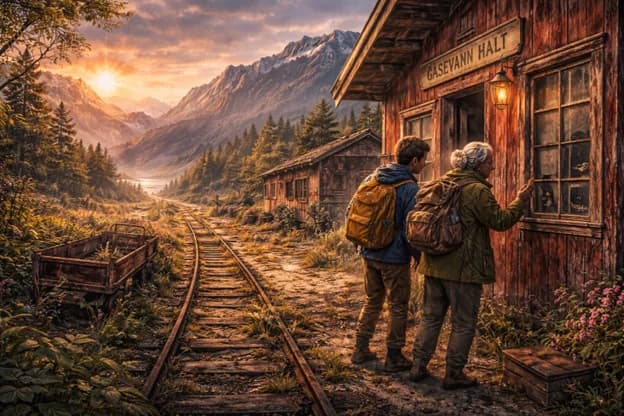
Below them, in a shallow valley where a small river ran alongside what had once been a railway cutting, was a station. Or the remains of one: a low timber building, painted red in the Norwegian tradition though the paint was long faded to a dull pink, with a platform of timber boards in varying states of decay running along its front, and behind it a wooden goods shed with a collapsed roof. And on the track bed, which was still visible as a slightly lower stripe of ground running through the valley, sat two railway wagons, side by side, their frames rusted to a deep orange and their wooden bodies largely gone, leaving only the underframes and bogies like the skeletons of large animals.
"Gåsevann Halt," said Nana Adwoa. "Goose Lake Halt. Named for that lake." She pointed further down the valley where a grey glimmer of water was visible through the birch trees. "It was a request halt on the line, very small, serving two or three farms and a forestry operation. It closed before the whole line was decommissioned."
"When did you last come here?" Kwame asked.
"Nineteen eighty-nine. The line was still running then, just barely." She looked at the station with an expression he recognised as the one she used when something meant more than she was saying. "I stopped here on a maintenance inspection. The stationmaster was still in residence, an old man named Harald Skjold. He made me coffee and told me the history of the place." She paused. "He gave me something to keep for him. Something he was worried about losing when the station closed."
Kwame looked at her. "What did he give you?"
Nana Adwoa reached into her jacket and produced, from an inner pocket, a small key. It was old but not ancient, the kind used for a simple lock, with a number stamped on its head: 7.
"He said there was a box in the station building, in the office, in the cabinet numbered seven. He said the box contained his log of the station's history, which he had kept for thirty-two years, and records that he felt were important and should not be lost." She looked at the key. "He asked me to come back and retrieve it when the station closed. And then the line closed and I was transferred to a different project and the years went past." She turned the key over. "Harald died in 2003. I found out by chance from an old colleague. By then, I had been telling myself I would go back every year for a decade."
"And now you're going," said Kwame.
"Now we are going," Nana Adwoa said, and started down the hill.
The station building was in better condition than it looked from above. The timber construction had weathered hard but held, and the main room, which had been the waiting room, was structurally sound, its floor soft in places but not collapsed. Nana Adwoa moved through it with the familiarity of someone returning to a place they have carried in memory for thirty years, touching the window frame, the ticket window, the old iron stove in the corner.
The office was behind the ticket window, separated by a wooden partition. A desk, a chair in pieces on the floor, a shelf of empty ledgers, and along one wall, a row of small wooden cabinets, each with a brass number plate. Most of the number plates were missing, but the seventh cabinet still had its plate, slightly tarnished and slightly loose, and in its lock the keyhole was exactly the right size.
Nana Adwoa put the key in. It turned.
Inside the cabinet was a metal box, the kind used for document storage, about the size of a large book. Inside the box, in very good condition because the cabinet had kept it dry, was a hardbound ledger, a bundle of envelopes tied with string, and a folded piece of paper that turned out to be a hand-drawn map of the railway line and its surroundings, annotated in a neat Norwegian hand.
Kwame watched his grandmother lift the ledger out and hold it, and her face did something complicated and quiet.
"Thirty-four years," she said. Not to him. To the ledger, or to the absent Harald.
"What's in it?" Kwame asked.
"Thirty-two years of station records," she said, opening it carefully. The pages were dense with entries, dates and times and arrivals and departures and the small accountings of a small station's life. "And, I think, something else." She turned to the back of the ledger, where the entries stopped and a final section of pages began, covered in closer, smaller writing. She read for a moment in silence, her Norwegian moving silently on her lips.
Then she looked up. "Harald found something," she said. "In the valley. Years before the station closed."
She read more. Kwame waited with the patience of someone who has learned that waiting for his grandmother to reach the important part is always worthwhile.
"There was an older railway here," she said at last. "Before the modern line. A narrow-gauge industrial railway, built in the 1920s to serve a mining operation in the mountains to the north. It was abandoned when the mine closed in 1934, and the modern line was built on a different alignment in the 1950s. Harald says the old narrow-gauge track is still up there. All of it. In the mountains. He says he walked it in 1979 and the rails were still in place and the infrastructure was intact, because no one had ever had a reason to remove it."
Kwame looked at the map on the table, at the annotated line running north into the mountains.
"And no one knows it's there," he said.
"Harald knew. And now we know." Nana Adwoa looked at the map. "He marked the access point. The start of the old narrow-gauge line, in the birch forest two kilometres north of this station." She looked at her grandson. "I think we should go and find it."
Kwame looked out of the station window at the valley and the mountains beyond, and the long golden Norwegian evening light lying across all of it.
"Tomorrow," he said, because it was already eight o'clock even though the light said three in the afternoon. "We go tomorrow."
"Tomorrow," his grandmother agreed.
****