
The Hidden Observatory
The morning fog clung low over the rooftops of Prague, curling around spires and chimneys like the wisps of a secret. Emil awoke before dawn, unable to stop thinking about the bronze box and the parchment they had found by the river. Its delicate sketches of celestial bodies and hidden mechanisms had danced in his mind all night. Today, he knew, the real journey would begin.
Master Karel was already in the workshop when Emil arrived, organizing tools and sketches with meticulous care. “Ready, Emil?” he asked, looking up. His hands were steady, his eyes sharp, but the faint lines on his face hinted at anticipation.
“I think so, Master Karel,” Emil replied, trying to steady the nervous flutter in his chest. “I’ve been reviewing the chart. The symbols seem to point toward the old observatory near the castle.”
Karel nodded. “Good. That is the first location. Remember, the secrets we seek were hidden for a reason. Curiosity is not enough, you must observe carefully, respect the mechanisms, and think beyond what your eyes tell you.”
Emil grabbed his satchel, which held small tools, notebooks, and spare gears, and they set off through the narrow, twisting streets. The city was waking: merchants shouted for attention, the scent of fresh bread and roasting chestnuts filled the air, and church bells tolled softly in the distance. Yet Emil barely noticed, focused entirely on the journey ahead.
The observatory was perched on a hill, its tall dome rising above the city like a silent sentinel. The entrance was guarded by a rusted iron gate, overgrown with ivy, and the doors were weathered from decades of wind and rain. Emil felt a thrill of apprehension as Karel pushed the heavy doors open. Inside, the air was cool and smelled of dust, old wood, and stone. The dome above revealed a wide-open sky, and the telescope, though covered in layers of grime, still reflected the first rays of sunlight.
“This place has not been used for years,” Emil whispered. “It’s incredible that it’s still standing.”
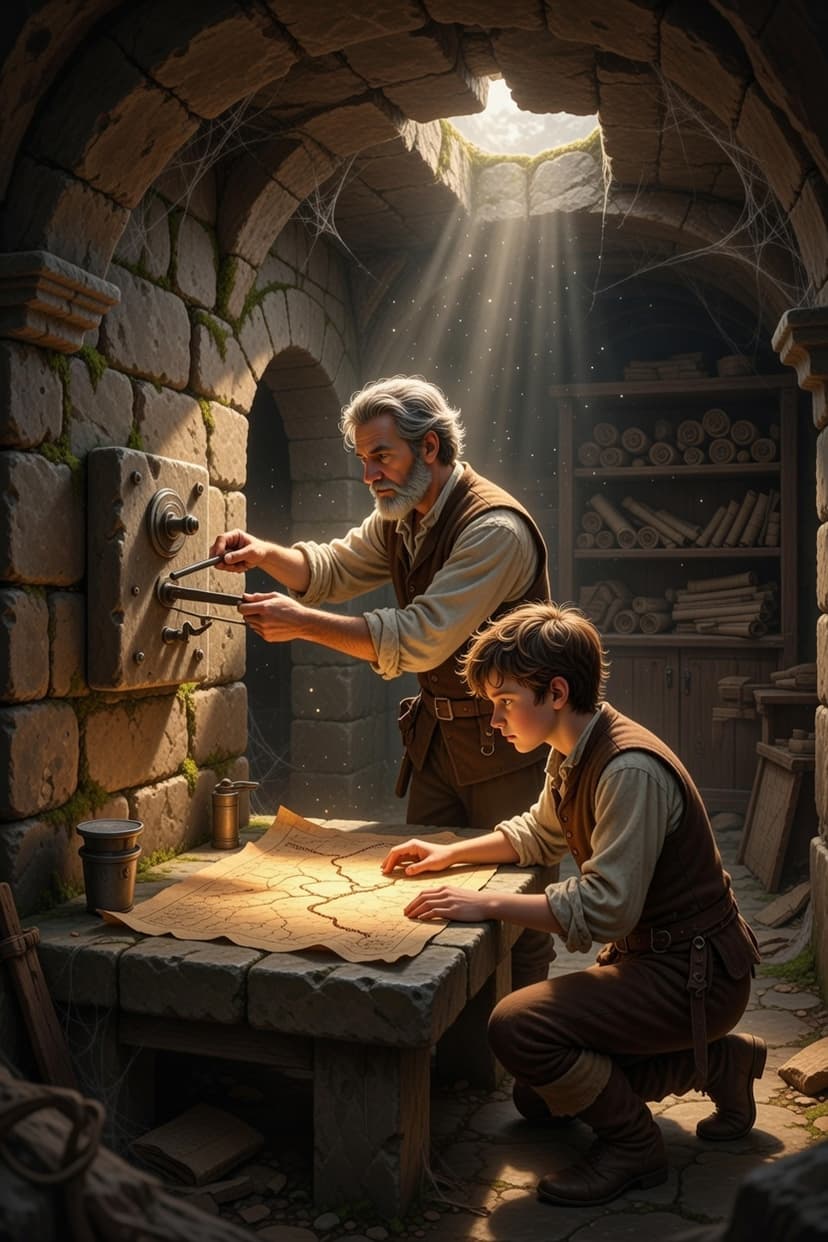
Karel led him toward a pedestal near the center of the observatory. On it lay a small bronze plate, etched with symbols identical to those on the river parchment. “This is where the clues converge,” Karel said. “The city’s architects and astronomers hid their knowledge here. Look carefully, patterns that seem decorative may hold meaning. Shadows, light, and angles will guide your understanding.”
Emil knelt and studied the plate. The symbols formed a pattern reminiscent of the gears in Karel’s workshop, yet also mirrored constellations. He realized that the observatory itself was part of the puzzle. Tiny openings in the walls and ceiling allowed sunlight to fall on the bronze plate at precise angles during specific hours. The chart had marked a particular alignment, and Emil understood that today, at this hour, the sun would reveal the next clue.
“Now,” Karel said, “observe and act carefully.”
Emil adjusted a small lens on the pedestal to focus the sunlight, causing the beams to fall directly on a hidden notch. The bronze plate shifted slightly, revealing a hidden compartment underneath. His heart pounded as he lifted the lid, finding a small, folded scroll. It was fragile, yellowed with age, and smelled faintly of herbs and ink. Unfolding it carefully, Emil saw a diagram of the city from a bird’s-eye view, annotated with streets, towers, and bridges. Tiny marks indicated doors, hidden stairways, and symbols corresponding to mechanisms throughout Prague.
One mark, in particular, drew his attention: a small square near the castle’s western gate. It was annotated with a miniature gear and a star, identical to the ones on the bronze box. “This must be the next location,” Emil whispered. “The pattern continues, just like Karel said.”
“Indeed,” Karel said, examining the scroll. “But be mindful. The hidden paths are rarely safe. Some have traps or puzzles meant to protect the knowledge within. We proceed carefully, step by step. Observation and understanding are your greatest tools, not force.”
As they prepared to leave, Emil noticed a faint draft from a crack near the dome. He leaned closer and saw a narrow staircase, almost hidden, leading upward to a small balcony. Sunlight poured in through the opening, illuminating a tiny mechanism embedded in the floor. Emil’s curiosity tugged at him. “Master Karel,” he said, pointing, “this staircase… it looks like it leads somewhere, and the light seems to highlight something important.”
Karel studied the mechanism, then nodded slowly. “Very good, Emil. You see what others overlook. That staircase is indeed part of the puzzle. It leads to a hidden chamber above the observatory, where previous apprentices and scholars recorded their discoveries. Clues from the past often lie above us, as well as below. We must ascend.”
The narrow staircase creaked under their weight as they climbed. At the top, a small wooden door led to a tiny chamber. Inside, they found shelves lined with rolled parchments, half-finished star charts, and small, intricate clock mechanisms designed to record celestial movements. Emil’s eyes widened. “This… this is like a library for clockmakers and astronomers,” he said. “They documented everything, the city, the stars, the mechanisms. It’s incredible.”
Karel smiled faintly. “It is. But your lesson here is twofold, Emil. First, to see that knowledge can be hidden in plain sight. And second, to understand that patience, observation, and careful reasoning are more valuable than brute strength or haste. Those who fail to respect these principles are lost, even when surrounded by knowledge.”
Emil nodded, feeling a mixture of pride and humility. He carefully examined the parchments and mechanisms, sketching notes and diagrams in his own notebook. Each detail seemed to connect to the bronze box, the river, and the chart, forming a network of hidden knowledge across the city. Suddenly, a soft creak from the door made them pause. Emil’s heart raced. Was it a person? Or was it simply the old building settling? He listened carefully. The sound repeated, closer this time. He motioned to Karel, who nodded, and together they moved toward the door.
A small figure stepped inside, a young boy, not much older than Emil, holding a folded parchment. “I… I found this,” the boy said nervously. “I think it belongs to you.”
Emil took the parchment and unrolled it. It was a set of instructions, carefully written, indicating a hidden compartment beneath the city walls near the western gate, the very location the scroll above had marked. Symbols showed that a mechanism had been hidden there, possibly containing the next clue.
“This confirms it,” Emil whispered. “The puzzle continues.”
Karel studied the new parchment. “Excellent work, Emil. You have seen, observed, and interpreted correctly. The next step will not be easy, but it is vital. Knowledge, like a clock, moves forward only when each piece functions as it should. One mistake could delay or obscure the truth for years.”
The sun had begun to dip toward the horizon as they descended from the observatory, casting long shadows across the city. Emil felt the thrill of discovery surge through him once more. Every step seemed significant, every street corner held potential secrets, and every mechanism and chart was a piece of the city’s hidden history.
As they approached the western gate, Emil whispered to himself, “I understand now… every detail matters. The city, the stars, the clocks, they’re all connected. And it’s up to us to follow the clues carefully.”
Karel glanced at him with approval. “Good. Your mind is ready. And your hands, if steady, will carry the work forward. Tomorrow, we begin at the gate. The secrets beneath Prague await, and your apprenticeship, Emil, now extends into history itself.”
And with that, the river of Prague glimmered in the fading light, reflecting the city, the towers, and the beginning of an adventure that would test courage, intelligence, and the patience of a young clockmaker’s apprentice.