

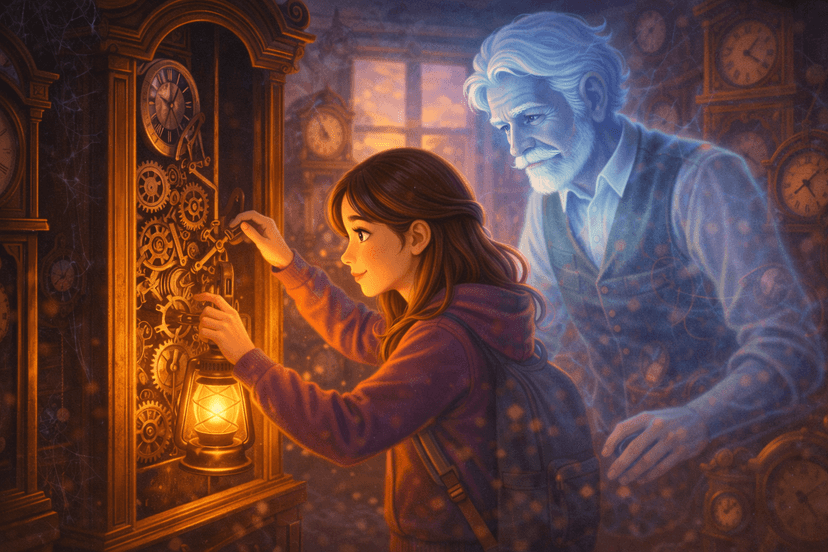
The Clockmaker
At the end of Maple Street, hidden behind iron gates and ivy-covered walls, stood an old house that everyone in town avoided. People said it belonged to a clockmaker who had disappeared years ago, leaving hundreds of clocks behind. The house was silent during the day, but at night, faint ticking could be heard from within, echoing through the empty street. Thirteen-year-old Mia had always been curious about it, despite the warnings from friends and neighbors.
She had passed the house many times on her way home from school, each time catching glimpses of the tall windows and crooked roof. Something about it drew her in. Perhaps it was the mystery, the idea that someone had once lived there surrounded by hundreds of clocks, or the stories that whispered of strange happenings inside. Whatever it was, Mia decided she had to see it for herself.
One late afternoon, she waited until the street was quiet. Carrying a small flashlight, a notebook, and a camera, she slipped through the rusted gate. The house loomed above her, its walls dark and cracked, ivy curling over the windows like green fingers. The front door was slightly ajar, creaking gently as if inviting her inside.
Mia took a deep breath and stepped through the doorway. Dust hung thick in the air, and the smell of aged wood and oil filled her nose. Sunlight streamed weakly through the dirty windows, illuminating hundreds of clocks of all shapes and sizes. Grandfather clocks, wall clocks, mantel clocks, and pocket watches covered every surface. Some ticked softly, others were silent, their hands frozen in time.
As she walked deeper into the hallway, the ticking grew louder. It wasn’t just one clock; it sounded like dozens, all beating in unison, like a giant, mechanical heart. Mia shivered but pressed on. She reached the main workshop at the back of the house. The room was filled with tools, gears, and unfinished projects. In the center stood a massive grandfather clock, taller than any she had ever seen. Its face was dark, and its hands were made of gold, pointing to midnight.
Mia approached it cautiously. As she reached out to touch the glass, a sudden chill swept through the room. The heavy pendulum inside the clock began to swing. Tick. Tock. Tick. Tock. The sound was deafening. Mia stumbled back, her heart racing.
Suddenly, a voice echoed through the room. “Who disturbs the time?”
Mia spun around, her flashlight beam cutting through the gloom. There was no one there. Only the clocks stared back at her, their faces pale and unmoving.
“I… I’m just looking,” she whispered, her voice trembling.
The voice came again, softer this time, like the rustle of dry leaves. “Looking for what? Time waits for no one.”
Mia swallowed hard. She realized the voice was coming from the massive clock itself. “I wanted to see the clockmaker’s work,” she said, trying to sound brave.
The pendulum slowed. The voice sighed, a sound like gears grinding together. “The work is never finished. Time is a wheel, turning and turning, but it never stops.”
Mia noticed something on the workbench nearby—a small, silver pocket watch. It was open, and inside, a tiny inscription read: “To my apprentice, who holds the future.”
She picked it up. As soon as her fingers touched the metal, a vision flashed before her eyes. She saw an old man, bent over a workbench, teaching a young boy how to assemble a clock. The boy laughed, his eyes bright with curiosity. Then the vision shifted. The boy was gone, and the old man sat alone, weeping, surrounded by clocks that ticked away the empty hours.
Mia gasped and dropped the watch. The vision faded.
“He left,” the voice whispered sadly. “He left, and time stopped for me.”
Mia understood then. The clockmaker hadn’t disappeared; he had become part of his creations, trapped by his own grief and obsession with time. The house wasn’t haunted by a ghost, but by a memory, a moment of loss that repeated itself endlessly.
“He didn’t leave because he wanted to,” Mia said softly, speaking to the room. “People grow up. Time moves forward. It’s not meant to stand still.”
The ticking stopped. The room fell into a heavy silence.
“Forward…” the voice echoed, sounding thoughtful.
Mia stepped toward the grandfather clock. She reached up and gently pushed the minute hand forward, moving it past midnight.
“It’s time to let go,” she whispered.
A warm light filled the room, soft and golden. The heavy feeling in the air lifted. The clocks began to chime, one by one, a beautiful, harmonious sound that filled the house. It wasn’t a scary sound anymore; it was a melody of release.
Mia smiled. She knew the spirit of the clockmaker was finally at peace. She turned and walked out of the room, leaving the house behind. As she stepped back onto Maple Street, the sun was setting, casting long shadows across the pavement. The house looked different now—quiet, empty, but no longer menacing.
Mia knew she would never forget the clockmaker or the lesson he had taught her. Time was precious, not because it could be stopped, but because it moved forward, carrying memories and hope along with it. She walked home, the sound of the evening breeze rustling the leaves, feeling grateful for every ticking second.