

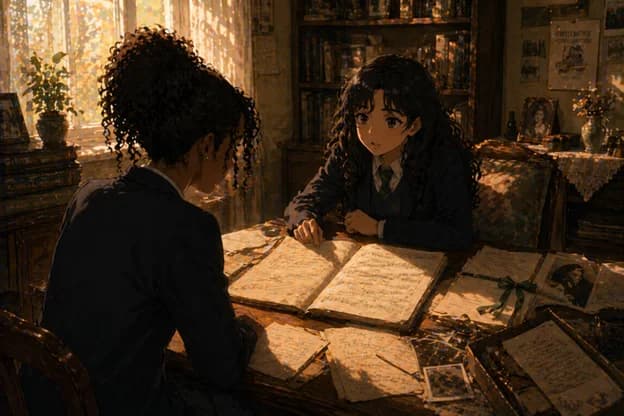
A. Prentiss
She asked around carefully. A. Prentiss at Greywell Academy turned out to be Asha Prentiss, Year Ten, fifteen years old, who was known to the music department primarily as someone who did not play an instrument but attended every concert and had once written a fifteen-page essay on twentieth century British music composition for a history project when five pages had been required.
Nina found her in the library on Monday lunchtime and introduced herself.
Asha Prentiss was small, dark-haired, with the particular energy of someone who spent a lot of time thinking and not enough time sleeping. She looked at Nina when she introduced herself and said: "You found the notes I left."
"You left them," Nina said, sitting down across from her.
"Yes," Asha said, without apparent discomfort about this. "I'm sorry for the mystery of it. I wasn't sure who to trust and I wanted to see if you were the right person before I said more."
"How did you decide I was the right person?"
"You play the music I left," Asha said. "Really play it. I've heard you through the practice room wall. And Mr Yeboah said once in a lesson I was observing that you had an ear for unusual harmonic language. And Miriam Alderton needs someone with exactly that."
"Tell me what you know," Nina said.
Asha had found out about Miriam Alderton the previous summer, she said, through a complete accident. She had been helping her grandmother sort through a storage unit, and among the things in the storage unit had been a box belonging to her grandmother's sister, who had died twenty years ago and whose belongings had been stored and never sorted.
The box had contained, among other things, a bundle of handwritten music manuscript paper, forty-seven pages, held together with a faded green ribbon.
"Your great-great-aunt," Nina said.
"She was a music teacher," Asha said. "At the Conservatoire, from the 1970s until it closed. Her name was Patricia Voss."
Dr P. Voss. Nina said nothing.
"She accessed the Alderton papers in 1987," Asha said. "I found the archive record. And I think she took the manuscript at some point. I don't know when or exactly why." She paused. "I don't think she was trying to steal it. From the letters in the box, she was trying to protect it."
"Protect it from what?"
"I don't know yet," Asha said. "That's what I haven't been able to work out."
She showed Nina the manuscript that afternoon, at her grandmother's house.
It was extraordinary. Forty-seven pages of Miriam Alderton's handwriting: musical notation, careful and precise, with annotations in the margins, dynamic markings, occasional words in German that suggested the period she had spent studying in Vienna. The paper was fragile, slightly brown at the edges, the pencil marks clear.
Nina read through it slowly, following the music with her inner ear the way she had followed the fragments Asha had left under the door. The two themes she had been given were both there, in the first ten pages: the opening melody with its unusual harmonic choices, the second theme that followed it. The manuscript went on from there, developing and varying both themes, building toward something.
"It's forty-seven pages," Nina said, looking at the final page. "Does it finish?"
"No," Asha said. "The last page is incomplete. It stops mid-bar."
Just as Miriam had died. The music stopped where she had stopped.
Nina looked at the annotations in the margins. On the fifteenth page, Miriam had written, in small precise writing: The resolution requires the return of the first theme, but inverted. This is the only way.
On the twenty-third page: Each voice must be heard separately before the convergence. This is not impatience. This is the condition of the ending.
On the final page, above the last complete bar: Nearly there.
Nina sat with the manuscript for a long time.
She thought about a woman composing in 1942 or 1943, working toward a piece she had been planning for thirty years. Writing nearly there above what would turn out to be almost her last bar of music.
She thought about Patricia Voss, finding this manuscript at the archive in 1987 and taking it home. Keeping it in a box for twenty years. Never returning it.
"What does your grandmother know about this?" she asked.
"Very little," Asha said. "Patricia was private about her work. Gran knew she was involved with the Conservatoire and interested in local music history, but not the details." She paused. "I found some letters in the box. Patricia wrote to someone, I think another musician or music scholar, about the manuscript. The letters are drafts, not sent ones. She was trying to work out what to do."
"Show me the letters," Nina said.