

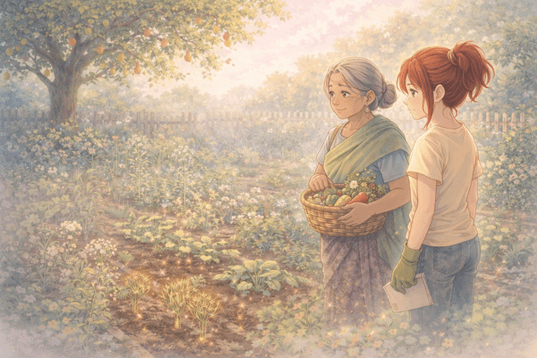
The Older Garden
It was unnerving but immediately provable. She planted more of the old seeds from the tin.
The *Calendula, from Mrs Hooper's garden, 1987*, sprouted with ferocious orange force. Around the base of their brilliant flowers, the soil began to contain crushed limestone path gravel, which Pip had not put there.
The sweet peas (*Original stock from the rectory garden, 1962*) climbed fiercely up the bamboo canes she had provided. Around the roots, the earth changed. It became slightly powdery, very fine and intensely black, a different loam altogether. When Pip crumbled it between her fingers during a humid afternoon, it briefly smelled of expensive, old-fashioned pipe tobacco and horse manure, distinct from the municipal compost smell of the modern gardens on either side.
Most surprisingly, her tools started finding things at the exact spots she planted the older items.
She found a rusted, Victorian-looking trowel head near the *Runner bean, climbing, Thomas's strain*. Around the root zone, the soil turned suddenly red, a heavy, iron-rich clay completely unlike the dark alluvial soil of the Rowan Street allotments. The smell changed; it smelled of damp wool, and perhaps a faint, persistent scent of woodsmoke.
In her notebook, Pip wrote: *The seeds aren't just seeds. They are save points. When they grow, the roots alter the surrounding soil to match the soil they originally grew in.*
She felt a thrill of discovery mixed with pure strangeness.
She looked up Mrs Hooper in the library records that weekend. The 1987 electoral register confirmed a Mrs Hooper lived at 45 Station Road. Pip cycled past on Sunday. The front garden of 45 Station Road was mostly concrete now, occupied by a Toyota Yaris. But peeking through a crack in the pavement near the drive, there was crushed limestone path gravel, identical to the mysterious gravel suddenly appearing around the calendula.
The Rectory, obviously, was long gone, demolished in the 1970s for a housing estate. Pip cycled there too. It was all neatly manicured lawns and block paving now. But standing near where the old rectory garden had probably been, she could almost smell the pipe tobacco of the 1960s.
And Alderton's plot?
She checked old maps in the town archives. 'Alderton's Land' was marked on a 1950s map, a strip of market garden land near the railway line. The council had compulsory-purchased it in 1958 to build the bypass.
The broad beans she was growing, the thick-stemmed ones that smelled of coal smoke and river mud, were the exact ones grown before the bypass existed.
Pip went back to the shed. She opened the tin with its forty-seven packets. None of them were just plants anymore. They were coordinates of places that didn't exist.
She selected the oldest-looking packet.
The handwriting was upright, stiff, the black ink sepia-tinged. It read: *Carrots, early. The lower field, pre-enclosure. 1845.*
Pip held the packet reverently in her dirt-ingrained hands. 1845. This was the oldest seed she had. Pre-enclosure meant before the land of the common was divided up and fenced off by the private landowners. A time before the modern map of the fields existed.
She took the packet, marked out a straight row at the very end of the plot, right near the gigantic old pear tree, and sowed the tiny, dust-like seeds.
She watered them carefully.
She sat back and watched the wet earth soak.
A week later, delicate fern-like shoots appeared. And with them, the ground around the carrots began to change dramatically.
The soil darkened intensely, losing the crumbly texture of cultivated earth, becoming instead a deep, matted turf-like substance. When she pushed her finger in, it smelled violently, staggeringly green—a scent of massive, uncut, rolling fields of wildflowers and coarse grass, untrammelled by hedges.
Pip felt dizzy as the smell hit her. It was intensely historical, physically disorientating.
She looked up. And the pear tree was suddenly different.