

Going Round the Lake
His dad, to his credit, took it all seriously. He read Felix's notes, looked at the sketch of the footprints, and was quiet for a while.
"Right," he said eventually. "So. Options. We pack up and go home."
"No," Felix said.
"We stay and ignore it."
"No."
"Or we stay and you investigate it, which I suspect is what you've already decided."
Felix said nothing, which was its own answer.
His dad sighed and then smiled. "All right. What do you need?"
"I want to walk around the lake. The whole circuit. In the daylight while we still have it. I want to see the path on the far side."
"The one the light was walking last night."
"Yes."
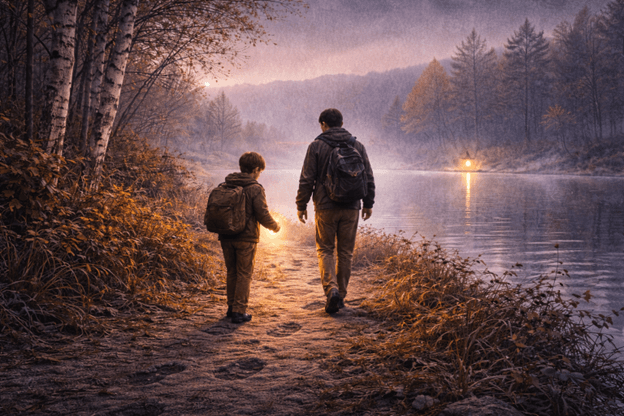
They set off after breakfast, following the path that led from the campsite through the birch trees and along the near shore of the lake. It was a cold, clear morning, the mist largely burned off by ten o'clock, and the lake was beautiful in the way of places that don't particularly care whether anyone is watching them. Dark, still water, rimmed with reeds and pale stones. Birch and alder trees leaning over the edges. Hills rising on the far side, heather brown and gold.
The near path was well-maintained, wide enough for two people to walk side by side. The far path, which they reached by crossing a stone bridge at the top of the lake, was narrower and older-looking, a single track worn into the bank, in places very close to the water's edge.
Here, the ground changed. Felix noticed it immediately. In several places the bank was undercut, the soil eaten away beneath the surface, leaving a thin crust of grass over nothing. He tested one spot with his foot and felt it give in an alarming way, pulling back quickly. A couple of metres below was the water, dark and very cold-looking.
"That is a genuine hazard," his dad said, steering them both well clear.
"This is where the light walked," Felix said. "Right along here."
He looked at the path. And then he noticed something odd. At regular intervals, spaced perhaps fifteen metres apart, there were stones at the edge of the path. Small ones, but deliberately placed, not fallen there naturally. Each one sat at the inland edge of the path, not the water edge, as though marking where it was safe to walk.
They weren't new. They were weathered, half-sunk into the ground, dark with age. But they were deliberate.
"Someone put these here," Felix said.
His dad crouched beside one. "A long time ago, by the look of it. Trail markers of some kind."
"The lantern does the same thing," Felix said slowly. "It walks this path. In the dark, in the mist, when you can't see the ground." He stood up and looked back across the lake at the campsite, almost invisible through the trees. "If you were following the light, you'd be following the safe route."
His dad was quiet for a moment. "The second story," he said. "What Pat told you. A guide."
"Yes."
"But guides are usually, you know. People."
"Usually," Felix agreed.
He spent the afternoon reading. His dad had thought to bring two of the local history books from the village library, borrowed that morning with Pat's assistance and a library card she'd issued on the spot with impressive efficiency. Felix sat in the tent with a head torch and went through them methodically.
The lake had a long history. It had been used for centuries, primarily for fishing and as a water source. There were records of communities around it going back to the medieval period. The dangerous section of the far bank had been noted in documents going back to the eighteenth century: a surveyor's report from 1768 described the eastern shore as "treacherous for those unfamiliar with its character" and recommended that any path be kept to the inland side.
The Lantern Boy appeared in written records for the first time in a local journal from 1887, in an entry that read: Crossing the far path last evening in poor weather, I was guided by a light I took at first to be a fellow traveller. Upon catching it up I found no fellow traveller but continued to follow the light as it seemed to know the path and I did not. I arrived home safely.
No other details. No mention of a figure. Just the light.
Felix kept reading.
The drowned boy story appeared in a collection of local folklore published in 1934. The author, a local schoolteacher named Harold Graves, recorded it as follows: The light is said to be carried by the ghost of a young boy, name not known, who drowned in the lake in the latter years of the nineteenth century. He had been sent to fetch water and misjudged the bank in the dark. It is said that in his death he learned where every danger on the shore lay, and that he walks the path still, lighting the way so that others will not suffer as he did.
Felix sat back and thought about this for a long time.
If it was true, it was possibly the saddest thing he'd ever read.
And if the boy had been walking that path for over a century, guiding people safely around the water's edge in the dark, then he had been doing it completely alone, completely unacknowledged, for all of that time.
Felix picked up his notebook and began writing.