
What He Left Behind
In the morning, Felix went back to Pat.
She listened to everything he told her without interrupting, her hands around her ginger mug, her expression unreadable. When he'd finished, she was quiet for a while.
"You're not making this up," she said finally. It wasn't a question.
"No."
"No, I don't think you are." She looked out of the window at the lake, which was grey and still in the morning cloud. "I've been thinking about him for fifty years, on and off. Never knew what to do about it."
"I'm not sure there's anything to do," Felix said carefully. "I'm not sure he needs to be fixed or freed or anything like that. I think maybe he just needed to be seen. Properly seen, not just glimpsed and run away from."
Pat looked at him for a moment. "That's a very mature thought for a thirteen-year-old."
"I've had a very strange forty-eight hours."
She almost smiled. "What are you going to do with what you know?"
Felix opened his notebook to the pages he'd filled the night before. "I'm going to write it down properly. Everything. The history, the sightings, what he's been doing all this time. The markers on the far bank, the path, the purpose of it." He paused. "Someone should make sure the far bank markers are maintained, too. They've been there a long time but some of them were sinking. Another few years and they might not be visible."
"I can do something about that," Pat said, straightening slightly. "That's within my remit as site manager."
"Good." Felix looked down at his notebook. "I was also thinking there should be a sign, maybe. At the start of the far path. Something that acknowledges it. That says the path has been kept safe by someone, and that his work matters."
Pat was quiet for a moment. "Doesn't have to say ghost," she said.
"No," Felix agreed. "Doesn't have to say that. Could just say: This path has been tended and kept safe for over a century. Those who walk it safely do so thanks to care that began long before them. Or something like that."
Pat looked at him steadily. "I'll speak to the parish council," she said. "It may take a while. Councils always take a while. But I'll make the case."
Felix nodded. He felt something settle in his chest, quiet and certain. It wasn't solved, exactly. Nothing was solved. The boy would probably still walk the path tonight, and the night after, and the night after that. Felix didn't know enough about how any of this worked to say whether knowing made a difference to whatever kept him there. But he thought it might. He thought that a hundred years of invisibility was a long time, and that being seen, even once, even by a single thirteen-year-old with a notebook and a head torch, was at minimum a small improvement on that.
He went back to the campsite and found his dad breaking down the tent with the cheerful competence of someone who had done it many times.
"Well?" his dad asked.
Felix told him everything, this time with all the details. His dad listened, asked three excellent questions, and said nothing unnecessary.
"Are you all right?" he asked, when Felix had finished.
"Yes," Felix said, and meant it. "I think so. Mostly I feel sad for him. But also — I don't know. Like maybe it helped? Telling him I knew."
His dad looked at the lake. It was morning now, properly bright, the grey cloud thinning, the water catching pale silver light. "You know what I think?" his dad said. "I think most people, if you really get down to it, mostly want to be seen. Noticed. Acknowledged." He folded the tent into its bag with more precision than usual. "Alive or otherwise."
Felix looked at the lake for a long time.
On the far shore, just visible through the birch trees, the path wound along the bank. He could see the place where the ground dropped away, the undercut edges, the cold dark water below. And he could see, just at the inland edge of the path, the small dark stones set at regular intervals, weathered and patient, marking the safe way.
"I'm going to come back," Felix said. "Next year, maybe. I want to see if Pat got the sign sorted."
"I'm sure she will," his dad said. "She seems like someone who gets things sorted."
"Yes," Felix agreed. "She does."
He took one last look at the lake, at the far path, at the stones. Then he shouldered his pack and turned away.
That evening, back at home, he typed up everything from his notebook into a proper document. He included all of it: the history, the sightings, the explanation, the footprints that went nowhere, the brightening of the lantern light. He sent it to Pat, who had given him her email address with the practicality of someone who had been waiting for exactly this correspondence.
Thank you, she replied, twenty minutes later. I'll keep this safe. And I've already ordered the new markers for the far bank. They'll be in before the winter.
Felix read the message twice and then closed his laptop.
Outside his window, the city hummed and glittered in the way it always did, full of noise and colour and the absolute certainty of other people nearby. He had not appreciated it enough before. He appreciated it now, with the particular clarity of someone who had spent two nights by a cold lake and understood, more than he had before, what it meant to be present and acknowledged in the world.
He opened his notebook to a new page.
At the top, he wrote: Things I know about the Lantern Boy of Greymoor Lake.
Underneath, he wrote: He was real. He suffered. He chose to help instead of haunt. For over one hundred years he has kept the dangerous path safe for strangers who never knew his name.
He paused, pen above the page.
Then he added: His name is still not known. But his work is known now. That is not nothing. It is, in fact, quite a lot.
He closed the notebook and went downstairs for dinner.
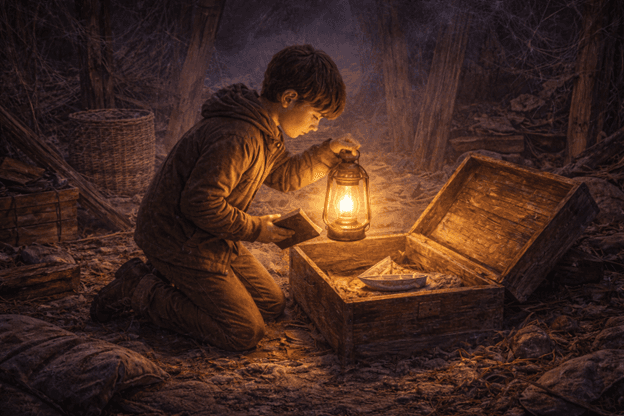
Behind him, on the desk, the notebook sat quiet in the lamplight. Outside, somewhere much further north, in the cold and the dark and the mist that rolled off a still lake in November, a lantern moved steadily along a path, unhurried, careful, warm against the dark.
Still walking. Still watching. Still keeping the way safe for whoever might need it.
As it had always done.
As it would do, perhaps, for a good while yet.