

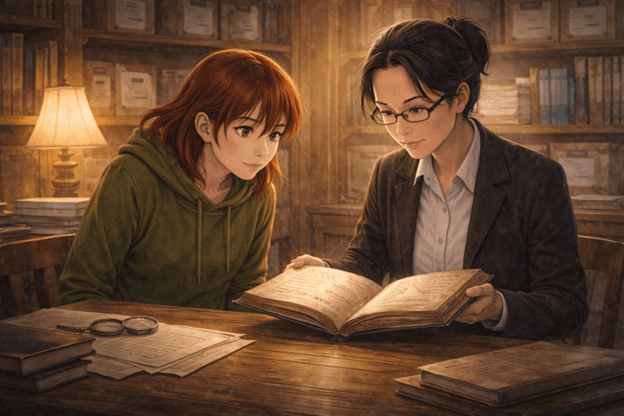
The Archive and the Professor
Her parents were not as difficult to talk to about this as she'd expected.
She chose her moment carefully: Sunday morning, both of them at the kitchen table, no particular plans, the relaxed atmosphere of a day that hadn't committed itself to anything yet. She put the photographed pages on the table, explained about William Crane and the village hall records and the local history book, and then, after a pause, explained about the boy at the end of the garden.
Her mum looked at the photographs of the records. Her dad looked at the local history section she'd bookmarked on her phone.
"You think the boy you've been seeing is William Crane," her mum said, carefully, in the tone of a parent who had decided to take something seriously.
"Yes," Asha said.
"Why?"
"He appears in storms and only in storms. He stands in the same position in the field where William died. He looks at the sky the way someone looks at something they've spent years studying. And he disappeared when I said his name and told him I'd found his records." She paused. "Also, I recognise the way he watches. He watches the same way I do."
Her parents exchanged a look. Not a dismissive look. A thoughtful one.
"The records are real," her dad said, tapping the photographs. "Whatever else is going on, these are genuine historical documents and they should be in proper care."
"That's what I thought," Asha said.
"I can make some enquiries," her mum said. She was a librarian, which Asha had always considered an extremely useful profession in a parent. "There are meteorological archives, historical societies. Someone will know what to do with these."
"There's also a professor," Asha said. She had spent the previous two days researching and had found, through a combination of meteorological history journals available online and a great deal of patience, a paper published five years ago that referenced early amateur weather observation in the west country. The paper mentioned, in a footnote, that records from this period remained largely uncatalogued and that significant contributions to early meteorology had likely been lost. The professor who had written the paper was based at a university in Bristol, which was where William had been due to study. "She wrote about early amateur meteorologists. She'd want to know about these."
Her mum looked at the records again. "You've done a lot of work."
"He deserves to be known," Asha said simply. "He figured things out that mattered, and he died before anyone could know, and then the records sat in a box for a hundred years. That's a lot of not being known."
Her dad put down the phone. He looked at her in the way that meant he was going to say something that had been forming for a while. "You know what strikes me about those records? Not just that they're good. It's that they were clearly made with the intention of being used. He was building toward something. Collecting evidence for an argument he was going to make."
"And he never got to make it," Asha said.
"No," her dad said. "He never did."
They were all quiet for a moment.
"I'll contact the professor tomorrow," her mum said, with the decisive tone she used when she had moved from considering something to doing it. "And the county archive."
The professor's name was Dr Yuen. She replied to the email within a day, which Asha's mum said was unusually fast for an academic and probably meant the records were significant. The reply was long and detailed and contained the phrase potentially of considerable historical interest in the second paragraph and I would very much like to see the originals in the third.
She came to Crendle three weeks later, at the end of August, and sat in the village hall with Derek looking alternately delighted and overwhelmed and examined William Crane's weather records with the careful reverence of a person handling something fragile and important.
"This is remarkable," she said, and said it several more times over the course of the afternoon, which Asha had attended with her mum's permission and Derek's enthusiastic approval. "The predictive methodology here, working out the pre-storm charge indicators from visual observation alone, this is genuinely original thinking. Not formal science, obviously, but intuitive scientific reasoning of a very high order."
"He was sixteen," Asha said.
"Yes," Dr Yuen said, looking at the final entry. "I know." She was quiet for a moment. "There was a student enrolled at Bristol in the autumn of 1914 who never arrived. No record of why, just an absence. I always wondered about those absences." She closed the folder carefully. "I'd like to write about him, if I have permission. A paper placing his work in its historical context."
"He'd have wanted that," Asha said, and felt the complete confidence of someone saying something they knew to be true.