

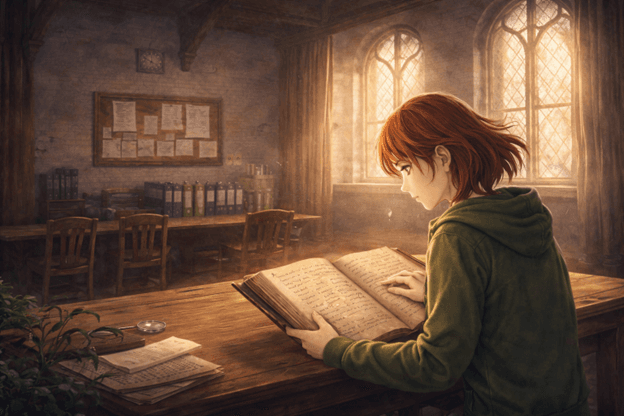
The Book in the Village Hall
Every village had a local history book. Asha had never had reason to read Crendle's until now. It was kept in the village hall, in a glass-fronted bookcase along with various other records and documents, and it was available for anyone to read during the hall's opening hours. Asha went on a Monday morning, during the summer holiday, and signed herself in with the caretaker, a retired man named Derek who seemed pleased to have a visitor.
The book was called Crendle: A History, published in 1982, written by a local teacher. It covered the village from its medieval origins through to the late twentieth century, in the slightly breathless style of someone who found their subject considerably more exciting than they could make it sound to others.
Asha read it systematically, starting with the index, looking for anything relevant. Lightning, storms, weather. She found a section on the agricultural history of the area and a reference to the frequency of storms across the valley, which apparently sat in a geographical position that made it prone to electrical storm activity.
Then she found a section called Local Figures of Note, and in that section she found a name.
William Crane. Born 1898, Crendle. A local boy who had, according to the book, developed an intense interest in meteorology from a young age and had, by the age of fifteen, been keeping detailed weather records of a quality that attracted the attention of a professor at a university in Bristol. He had corresponded with several eminent scientists of the time. He had been accepted to study natural sciences and had been due to begin in the autumn of 1914.
He had died in the summer of 1914, aged sixteen.
Struck by lightning, in the field behind the house on the eastern edge of the village.
Asha looked up from the book. The house on the eastern edge of the village. She thought about this for a moment, going through the layout of Crendle in her head, working out which direction was east.
Her house was on the eastern edge of the village.
She went home and found her mum in the kitchen and asked, casually, how old the house was.
"Victorian, I think," her mum said, without looking up from her laptop. "Your dad would know. Why?"
"Just curious," Asha said.
Her dad, when she found him, said the house had been built in the 1880s and they were, as far as he knew, the fourth family to have lived in it. "There might have been five," he added, "I can't remember if the estate agent said three previous families or four."
"Do you know anything about the family who lived here in 1914?" she asked.
Her dad blinked. "That's specific. Why 1914?"
"Local history," Asha said. "I was reading about the village."
He didn't know. She went back upstairs and opened her storm notebook to a new page.
William Crane, she wrote. Born 1898, Crendle. Died 1914, aged 16, struck by lightning. In the field behind the house on the eastern edge of the village. He was interested in storms. He was interested in weather. He was accepted to study natural sciences.
She looked at what she'd written.
Then she added: He appears in storms and looks at the sky. He is still watching them.