Seven Mornings
Over the next seven mornings, five more paintings appeared.
Juno documented each one carefully in a notebook she had repurposed from school. She described the subject, the composition, the colours, the quality of light, the specific time she found it. She photographed each one before Mrs Tregenna came down, so she had her own record.
The paintings were:
The third: the cove at what must have been high tide, the water reaching the base of the path, the surface agitated by a light wind, the reflections fragmented.
The fourth: the eastern rock pool in close-up, the pools themselves almost abstract in the painting, shapes and colours rather than objects, but perfectly accurate when you knew what you were looking at.
The fifth: the horizon in early morning, just the edge of the sea meeting the edge of the sky, a thin line of colour where they met.
The sixth: a storm over the cove, clearly painted from memory or imagination or both, the water dark and violent, the cliff face wet and gleaming, the sky an extraordinary layered grey.
The seventh, on the final morning, was different from all the others.
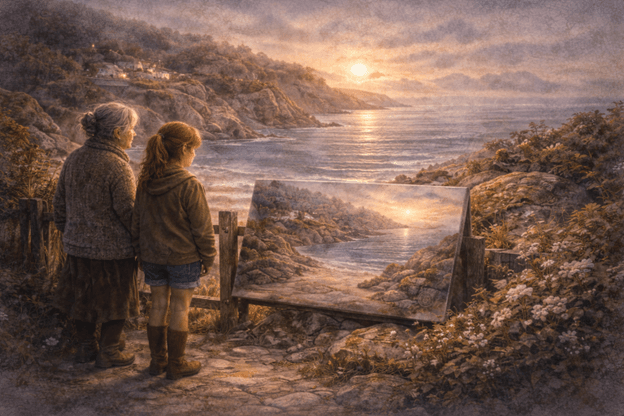
It was larger than the rest. And it was not painted from a fixed position, not the view from one specific spot, but a kind of composite, the whole cove held in a single image, every angle present simultaneously in a way that should not have worked and somehow did. The path down from the cottage was in it, and the rock pools at both ends, and the open sea, and the cliffs, and the morning light. Every feature of the cove was present, rendered with the precision and care of someone who knew every centimetre of it intimately.
And in the bottom right corner, for the first time on any of the paintings, there was a mark.
Not a signature exactly. More like a symbol: a small spiral, the kind that appeared in old Celtic stonework, drawn in the same paint as the rest of the image.
Juno photographed it from every angle and went to find Mrs Tregenna.
Mrs Tregenna looked at the final painting for a long time without speaking. She crouched down in front of it, examined the spiral, stood up again.
"She never signed her work with a spiral before," Juno said.
"No," Mrs Tregenna agreed.
"But you recognise the mark?"
Mrs Tregenna was quiet for another moment. "It was on a piece of jewellery she wore," she said finally. "A small brooch, a family piece. My mother described it. It was lost when Lowenna died, nobody could find it. A silver spiral." She paused. "I never told anyone that. It's not in any record I know of."
They both looked at the painting.
"She's signing it," Juno said. "This one specifically. All the others were unsigned, but this one she signed."
"Why this one?" Mrs Tregenna said, not quite to Juno.
Juno looked at the painting, at the whole cove held simultaneously, every angle at once. "Because it's finished," she said slowly. "The others are studies. Specific moments, specific views, specific conditions. But this one is the whole thing. This is the complete painting she's been working toward." She paused. "This is the one she wanted someone to keep."
Mrs Tregenna looked at her for a long moment.
"How old are you?" she asked.
"Twelve," Juno said.
"Twelve," Mrs Tregenna repeated, in a tone that was not dismissive but thoughtful, as though revising an estimate. She looked back at the painting. "My great-aunt would have liked you," she said. "She always said the right way to look at something was to look until you understood it."
"I haven't understood it fully," Juno said. "I just understood that part."
"That's usually how it goes," Mrs Tregenna said.