The Last Morning
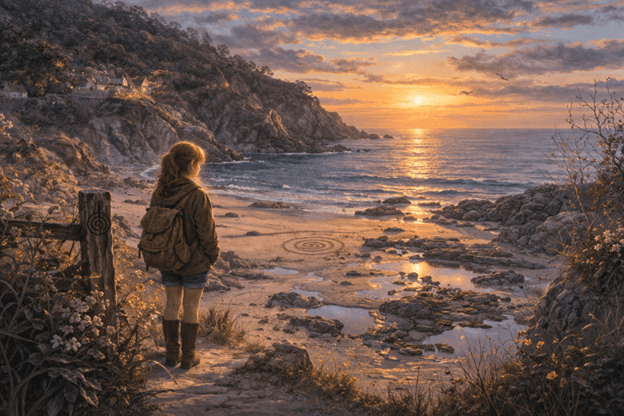
On the final morning of the holiday, Juno went down to the cove at just past six.
The beach was empty. The tide was low, the rock pools exposed, the dark sand unmarked by footprints. The morning light came in at its low gold angle, turning the wet stones bright, making the water in the pools look lit from beneath.
There was no painting against the rock.
She had half expected this, though she couldn't have said why. She sat on the rock and watched the light for her forty minutes, all the mornings of the holiday concertinaed into this last one, the gold fading as the sun climbed.
She thought about Lowenna Tregenna, born in this village in 1901, standing in this cove in every season for sixty years, looking at this water and this light and these particular stones, making something out of the looking. She thought about what it meant to love a place that much, to know it that completely. She thought about the seven paintings and the final one with the spiral, signed and intended, a gift from someone who had nothing left to give except the thing she had always given: her attention, her craft, her careful and devoted seeing.
She thought about Mrs Tregenna upstairs in the cottage, sleeping late for once, the final painting now in a frame she had produced from somewhere with the practicality of a person who had been meaning to do this for years. The gallery had already expressed interest. The painting would be shown in the spring exhibition.
She thought: Lowenna wanted it to be seen. Now it will be.
When the gold light was fully gone and the morning had become ordinary bright November daylight, she stood up and put her hands in her coat pockets and looked out at the water.
"Thank you," she said, to the cove, or to the quality of attention the cove had been given, or to the person who had given it. "For letting me see."
The water moved against the stones in its patient, continuous way. The rock pools glittered. A bird crossed the sky above the cliff, wings at an angle she recognised from a painting.
She went back up the path to the cottage.
Her dad was making scrambled eggs and talking about the drive home. Her mum was packing with the systematic efficiency of someone who had packed many holiday bags. Her younger sister was still in bed and would remain there until physically extracted.
Normal. Ordinary. The last morning of a holiday, the same as last mornings of holidays everywhere.
Except that Juno Marsh, twelve years old, sat down to scrambled eggs with the particular feeling of someone who had been trusted with something. Not a secret, not a task, but something more like a way of seeing. A demonstration of what it meant to look at a thing with complete attention, over a long time, and find it inexhaustible.
She ate her eggs. She helped pack the car. She said goodbye to Mrs Tregenna, who shook her hand with a firmness that said something more than goodbye.
"Come back," Mrs Tregenna said. "If you're ever passing."
"I will," Juno said. And meant it.
In the car, pulling away from the village, she turned and looked back through the rear window until the cottage disappeared around a bend and then looked forward at the road ahead.
She opened her holiday notebook, the repurposed school one, and turned to a fresh page.
At the top she wrote: Things I have learned about looking.
She looked at that for a while.
Then she began to write, and kept writing for most of the way home, while the autumn landscape passed outside the window and her sister slept on her shoulder and the road unrolled itself steadily northward, away from the cove and the light and the paintings left on rocks by someone who had never quite stopped loving the particular, unrepeatable, inexhaustible world.
Outside, the clouds moved across the hills in their own slow patterns.
Inside, a girl wrote in a notebook, paying attention.
Both of these things were, in their own ways, a kind of painting.
Both of them mattered.