

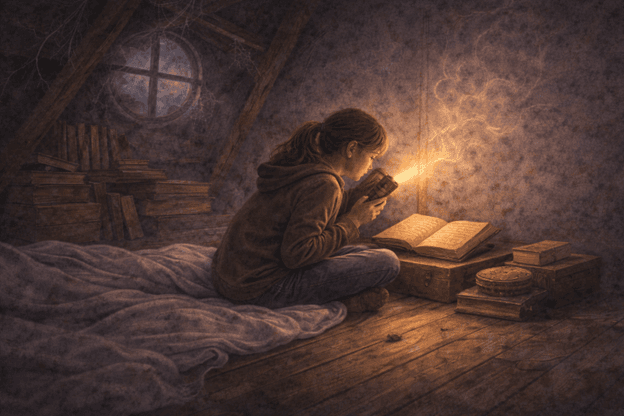
The Girl in the Journal
Priya found out who Elara Voss was through the local library, which was small but extremely well-organised, run by a man named Mr Osei who had strong opinions about the Dewey decimal system and offered to help her find anything she needed with the kind of enthusiasm that suggested he didn't get many visitors.
She had three days before school started. She spent the first one unpacking her room, the second one reading the rest of Elara's journal, and the third one in the library.
The journal had become extraordinary by its later entries.
Elara had, over the course of eleven months, done an impressive amount of research. She'd gone through local records, spoken to neighbours, and found references to the house in two of the local history books , the same ones Priya had spotted on the third-floor shelf. She'd worked out that Willow House, which had been built in 1887, had been occupied almost continuously since then, except for a period of three years in the 1940s and a period of six months in 2003.
She'd also worked out that every family who had lived there for more than a few months had reported hearing sounds in the walls. Not all of them had written it down, but Elara had found a letter from 1923 in the local archive, written by a woman named Constance Ashby, who had described hearing "a congress of voices, as though in debate, emanating from the plasterwork of the upper storey." A newspaper article from 1971 mentioned a family who had moved out after nine months citing "unexplained disturbances." A planning document from 2003 included a note from the previous owners describing "acoustic anomalies throughout the property."
What Elara had not been able to work out, right up until the second-to-last entry, was what the voices were saying or why they were there. Her last entry, entry ninety-three, read:
We're leaving next week. Mum's job. I don't want to go, which is strange because I wanted to leave so badly at the beginning. But I haven't finished. I think I'm close. I found something under the floorboard in the locked room , we finally got it open. There's a box. Inside the box is something I don't have words for yet. I'm leaving the journal for whoever comes next. The box is still there, under the third board from the left, below the window. If you find this, finish what I started. Find out what they're saying. I think it matters.
Priya had read that entry four times.
At the library, she asked Mr Osei about Willow House.
He knew it immediately. "Interesting property," he said, pulling his chair closer with the air of someone who had been waiting for this conversation. "Quite a history. Pre-dates much of this end of Ashford, actually. Built by a man named Thomas Barrow , local landowner, amateur naturalist. Obsessed with cataloguing things. Plants, insects, weather patterns." He paused. "Local legends, too, as it happens."
"What kind of legends?"
"There are stories about that area of land going back further than the house," Mr Osei said. "Local folklore talks about a site of significance , a meeting place of some kind, historically used by communities in this area. Some accounts suggest the land itself has a kind of memory. Others are less poetic about it and just say it's haunted." He smiled. "I tend to prefer the first interpretation."
"A memory," Priya repeated. "Like, it records things?"
"That's one way to think about it." He went to the shelf and returned with one of the local history books , the thicker one, which she hadn't had a chance to look at properly. "There's a section in here about Barrow and his records. He wrote quite extensively about strange acoustic phenomena on the property. He was fascinated by it rather than frightened, which is probably why he built a house there instead of running away from it."
Priya took the book home and read it that evening. The section on Thomas Barrow was twelve pages long. He had spent years recording and measuring the sounds, and his conclusion, written in formal Victorian language that took some effort to parse, was essentially this: the land held echoes of the past. Not recordings, exactly. Something more like impressions , emotional residue left by events that had occurred on or near that spot over hundreds of years. He believed the sounds were fragments of real voices from real moments in the history of the land, compressed into the walls and earth like layers of sediment, occasionally rising to the surface.
They are not ghosts, he had written. They are memories. The distinction matters.
Priya sat with that for a long time.
Then she got up, took a torch, and went to the third floor.