
What the Voices Were Trying to Say
Sorcha came on Saturday morning with a bag full of snacks and an energy that suggested she'd been thinking about this all week. Which, as she freely admitted, she had.
"I asked my nan," she said, settling onto Priya's bed with the ease of someone who had known her considerably longer than five days. "She knows the history of this town better than anyone. She said the area where your house is built was called the Common Ground. Not the specific land, just the idea of it. It was a shared meeting space for the communities that lived here before the town was properly established. She said there were gatherings there every autumn for a hundred years, maybe more. People would come together, share news, settle disputes, celebrate things. She said the tradition died out when the house was built and the land was bought up, and people were very sad about it."
"So it's literally a place where people met," Priya said. "For generations."
"That's what she said."
Priya had already laid out her notes on the desk. She showed Sorcha the journal, the history book, her own diagrams. Sorcha read quickly and thoroughly, pausing to ask good questions. She picked up the stone disc and held it, and her eyes went slightly wide.
"I can hear it," she whispered.
"I know," Priya said.
"It's like , it's like a room full of people talking at a party. All at once."
"Can you make out any words?"
Sorcha listened for a long time, very still. Then she said: "Something about a harvest. And , somebody's name, I think. Mary? No. Mira." She opened her eyes. "And the thing you heard. We are still here."
She put the disc down carefully.
"They're not haunting the house," Priya said. It was a conclusion she'd been building toward all week, and saying it out loud made it feel solid and true. "They're just , still there. Like the land kept a record of everyone who ever met there, every important thing that was said or shared. And the house was built on top of it, so the walls carry it."
"They're not trying to scare anyone," Sorcha said slowly.
"I don't think they ever were. I think the families who left , they didn't understand what it was, so it frightened them. But if you understand it, "
"It's just history," Sorcha said. "Talking."
Priya nodded.
They sat quietly for a moment, both of them thinking.
"So what does it want?" Sorcha asked. "If it's just memories , what does we are still here mean? Why that phrase?"
This was the question Priya had been turning over for days. "I think," she said carefully, "it might not be a message. Not like someone is deliberately sending it. I think it might just be , the most consistent thing. The thing that's most embedded in the place. Hundreds of years of people gathering there and saying, in different ways, in different words: we are here. We are together. This matters."
Sorcha looked at the box on the desk. "And when you hold the disc, you hear it more clearly because it's a , what, a receiver?"
"Something like that. Thomas Barrow thought it was found on the land. Maybe it was already there, from before the house was built. Something people used at those gatherings, maybe."
"So the question is what to do about it," Sorcha said.
"I don't know if we need to do anything," Priya said slowly. "I think , I think maybe the point is just to know. To understand. All the families who left, they didn't know. Elara came closest, but she had to move before she finished. And maybe that's all that was needed. Just someone to actually listen and understand what they were hearing."
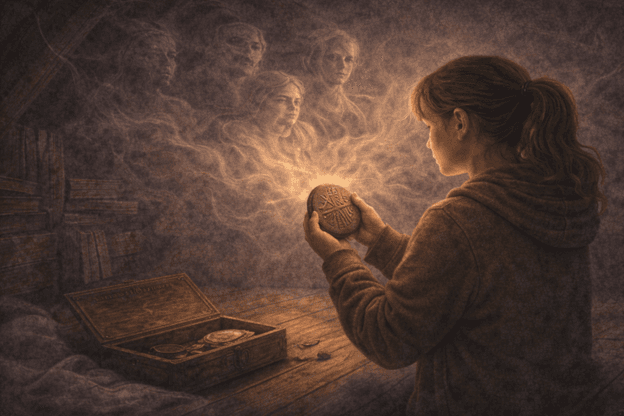
She picked up the stone disc one more time. She held it in her palm and closed her eyes and listened.
It was as vivid as ever. The layered voices, the rise and fall of speech, the occasional bright thread of something comprehensible. A child laughing. Someone describing the weather. A group of voices rising together in what might have been a song, or an argument, or a cheer , it was impossible to tell from here, from this distance of years, but the emotion in it was unmistakable: warmth, connection, the particular pleasure of people who are glad to be together.
And then, threading through it all, quiet and steady, like a note held beneath all the others: we are still here.
Priya opened her eyes. She realised, somewhat to her own surprise, that she was smiling.
"I know," she said quietly, to the room, to the walls, to whatever had been held in this ground for longer than the house had stood. "I can hear you."
She wasn't sure if it made a difference. She wasn't sure if the land could hear her back. But something in the quality of the sound seemed to shift , not quieter, exactly, but settled. Like a question that had been asked for a very long time had received, finally, an answer.
Later, she and Sorcha sat in the back garden under the wide sky of a cold November afternoon and Priya told her friend everything, from the moment the car had pulled up outside the house to right now. Sorcha listened, asked questions, offered theories. Dev appeared at one point and they let him join them, and he took the news of the whispering house with the absolute equanimity of a nine-year-old who had seen too much television to be surprised by anything.
"So it's a memory house," he said.
"That's a good way of putting it," Priya said.
"Cool." He went back inside for more crisps.
That evening, after dinner, Priya started a new journal. She wrote the date at the top of the first page, and below it she wrote:
My name is Priya Sharma. I moved into Willow House on Elm Close three weeks ago. This is a record of what I've found and what I've worked out, for whoever comes after me. The house is not haunted. The house is a keeper of memories , hundreds of years of them, held in the ground and the walls. If you hear whispering in the night, don't be frightened. Press your hand against the wall and listen carefully.
They are just still here. That's all. They were here, and they mattered, and the land remembers.
So should you.
She paused, chewing her pen, and then added one more line:
Also, the key to the third-floor room is on the key ring in the kitchen drawer, second from the left. You're welcome.
She closed the journal and set it on the shelf next to Elara Voss's. Two records now, for the next person who needed to know. Outside, the November wind moved through the oak tree, and the house made its low, contented sounds around her, and Priya Sharma, who had not wanted to come here, who had compiled a fourteen-point list of grievances against the move, sat in her new bedroom and felt something she hadn't expected to feel for a very long time.
At home.