

Five nights, five disasters
The plan had been simple.
Mum and Dad had been invited to a friend's wedding in the Scottish Highlands and had decided to turn it into a road trip, driving up over five days through the most scenic parts of Britain and staying at a different place each night. They had booked everything in advance. They had a printed itinerary. Dad had a folder.
Dad always had a folder on family trips. The folder had tabs.
What Dad had not accounted for, because nobody could have accounted for it, was that three days before the trip Mum's sister would call with a family emergency requiring Mum and Dad to fly to Cork immediately, leaving behind two children, one car, one folder with tabs, and a series of five non-refundable accommodation bookings stretching from the English Midlands to the Scottish Highlands.
"We are going to complete the trip," said Jess, who was fourteen and had immediately decided this.
"We are twelve and fourteen," said her brother Marcus, who was twelve. "We cannot drive."
"Aunt Wendy will drive," Jess said.
Aunt Wendy was their mother's younger sister who lived twenty minutes away and had, when called, agreed to the plan with the enthusiasm of someone who had not fully processed what the plan involved.
"How bad can it be?" Aunt Wendy said, arriving at the house with a overnight bag and the optimism of a person who had not yet seen the folder.
Marcus showed her the folder.
Aunt Wendy looked at the folder for a long time.
The folder had five sections, one per night, each containing a printed confirmation email, a map with the destination marked, a list of local attractions, and a sheet of notes in Dad's handwriting about things to do and see on the way. Dad's notes were thorough in the way that only someone who had been planning this trip for four months could be thorough.
Aunt Wendy looked at the notes for Night One. She turned to Marcus. "Does your father always write this much?"
"He made a spreadsheet as well," Marcus said. "The folder is just the printed version."
Aunt Wendy breathed in slowly through her nose.
"Right," she said. "We leave at eight."
Night One: The Farmhouse.
The farmhouse had looked charming on the booking website. A working farm in Derbyshire, the listing said. Authentic countryside experience. Views over the valley. Hearty breakfast included.
What the listing had not mentioned was that the authentic countryside experience included a cockerel that began its day at four thirty in the morning directly outside the bedroom window, that the hearty breakfast was served at six because the farm was working and the farmer had already been up for two hours, and that the views over the valley were accessed via a field that contained a goat called Gerald who had strong opinions about people crossing his field and expressed them physically.
The farmhouse breakfast was extremely good. Eggs from the farm's own chickens, bread from the village bakery, jam the farmer's wife had made herself. They ate in a kitchen that smelled of woodsmoke and coffee and the particular warmth of a house that had been a home for a long time.
"He headbutted me," Marcus said, at breakfast, which they had arrived at ten minutes late because of Gerald.
"He headbutted all of us," Aunt Wendy said, with a slightly distant expression.
"Gerald is a good name for a goat," Jess said. She had her notebook out and was writing things down. She had started a log of the trip, which she called The Disaster Diary, on the grounds that something should be recorded for posterity.
"Please stop calling it the Disaster Diary," Aunt Wendy said.
"It is accurate," Jess said.
"We have four more nights," Aunt Wendy said. "Let us not assume they will all be disasters."
The cockerel crowed again from outside. Somewhere in the field Gerald made a sound.
Marcus turned a page in the folder. "Night Two is a canal boat," he said.
Aunt Wendy looked at the ceiling.
Night Two: The Canal Boat.
Jess had looked up canal boats the previous evening and had read three articles about them and was confident she understood the basic principles. This confidence lasted until the first lock, which operated according to principles that the articles had described accurately but which behaved, in practice, rather differently from how Jess had imagined.
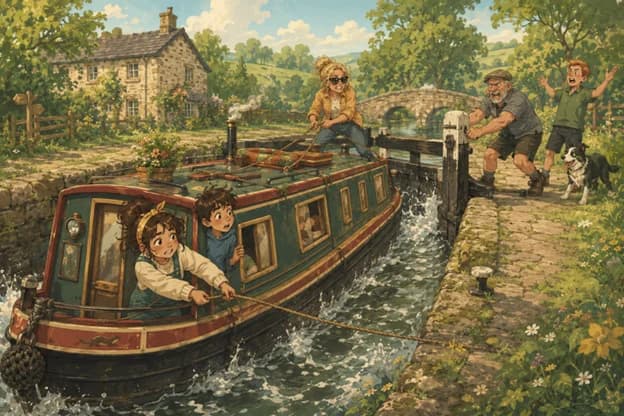
The canal boat was called The Dreaming Otter and it was, in fairness, genuinely lovely. Low ceilinged and narrow and painted in the traditional canal boat colours of red and green and yellow, with tiny windows and a woodburning stove that made the whole thing feel like a particularly cosy shoebox.
The problem was not The Dreaming Otter itself. The problem was that none of them had operated a canal boat before, and the man who handed over the keys had explained the lock system in considerable detail, and the detail had seemed clear at the time, and had become considerably less clear at the first actual lock, which was a double lock on a slight bend with a narrowboat coming the other way whose skipper had Views about how the situation should be handled.
"He is still talking," Marcus said, twenty minutes later, watching the other skipper from the towpath.
"Let him finish," Aunt Wendy said, through her teeth.
"I think he is actually enjoying himself," Jess said.
The skipper finished at minute twenty-three and went on his way, shaking his head. They got through the lock on the fourth attempt. Jess wrote three pages in the Disaster Diary.
They got through the lock eventually. Jess captured the whole thing on her phone, including the bit where the boat went slightly sideways and Aunt Wendy said something that she then looked at the children and apologised for. The other skipper was long gone. They were alone on the canal in the late afternoon, the water reflecting the sky, the fields going yellow in the low light.
The rest of the evening was genuinely peaceful. They moored in a quiet spot and ate sandwiches on the roof of the boat and watched the sun go down over the canal and a family of ducks went past in a row and it was, Marcus privately thought, one of the nicer evenings he had had in a while.
He did not say this in front of Jess because she would put it in the Disaster Diary.
"Night Three is a converted lighthouse," Jess said, reading the folder.
"A lighthouse," Aunt Wendy said.
"Converted. On the Yorkshire coast."
"How converted?"
"The listing says fully modernised."
"The farmhouse listing said authentic countryside experience," Marcus said.
Nobody replied to this.
Night Three: The Lighthouse.
They arrived at the lighthouse in the early evening and stood at the bottom looking up at it and Jess said: ninety-four stairs. She had counted them on the booking website's virtual tour. Marcus said: how many? and Jess said: ninety-four, and Marcus said: going up or total? and Jess said: one way, so one hundred and eighty-eight for a round trip, and Aunt Wendy said: right, and picked up her bag.
The lighthouse was fully modernised in the sense that it had electricity and running water and a bed at the top that required climbing ninety-four stairs to reach, which Jess counted on the way up and counted again on the way down and confirmed was ninety-four both times. The lighthouse was also on a headland that was, as lighthouses traditionally were, exposed to whatever the sea decided to do with the weather, and what the sea had decided to do on this particular Wednesday in August was to produce a wind that made the windows flex slightly in their frames and a sound from somewhere in the structure that Aunt Wendy described as character and Marcus described as haunted.
"It is not haunted," Jess said.
"Something made that noise," Marcus said.
"It is the wind in an old building," Jess said.
"The wind does not go oooooh," Marcus said.
"That is exactly what the wind does," Jess said.
"Children," Aunt Wendy said, from under her pillow.
The noise stopped. The interior sound had apparently made its point and moved on.
"Thank you," Aunt Wendy said, still under the pillow.
The view from the top in the morning was extraordinary. The whole coast laid out, the sea grey-green and restless, a cargo ship on the horizon, and the light itself still turning, automated now, no longer needing a keeper. Jess took seventeen photographs. Marcus, who had been sceptical the night before, took eleven.
"That was actually great," Marcus said, on the way down the ninety-four stairs.
"Do not tell Jess," Aunt Wendy said.
"I can hear you," Jess said, from below them on the stairs. "I am putting it in the Disaster Diary as an exception."
The drive north on Day Two was three hours and Marcus kept score of every road sign they passed, a habit he had developed on long journeys when he was seven and had not stopped, and Jess read from the folder and told them things about the places they were passing that she had looked up on her phone, and Aunt Wendy drove and occasionally said: really? when Jess mentioned something interesting, which Jess took as encouragement and Marcus took as politeness but which was actually genuine.
At a service station they ate sandwiches from the shop and Marcus accidentally sat on his and Jess documented this in the Disaster Diary under the heading: collateral damage.
"I am not collateral damage," Marcus said.
"Your sandwich was," Jess said.
Aunt Wendy had called Mum from outside the lighthouse on Night Three, standing in the wind on the headland while Marcus and Jess argued inside about the noise. Mum had asked: is everything all right? and Aunt Wendy had said: everything is fine, we are in a lighthouse, there is a noise that may or may not be the wind, everyone is healthy, nobody has been seriously injured. Mum had been quiet for a moment and then said: seriously injured? and Aunt Wendy had said: Gerald the goat headbutted Marcus. Mum had been quiet again and then said: Gerald is a very unfortunate name for a goat.
Night Four: The Glamping Pod.
The drive to Northumberland went through countryside so beautiful that Marcus stopped arguing with Jess about the music and just looked out the window for forty minutes, which Jess noticed and did not mention because some observations were better kept.
The glamping pod was in Northumberland and the booking had described it as a luxury woodland retreat with outdoor hot tub and private forest walks. All of this was true. The hot tub worked. The forest was real. The pod itself was extremely comfortable and smelled of cedar wood and had a skylight above the bed through which you could see stars if the sky was clear, which on Thursday it was not, because it rained.
It rained with the specific determination of Scottish-adjacent weather that had decided to make a point. The outdoor hot tub was technically still functional in the rain, which Aunt Wendy pointed out was possibly a selling feature, and Marcus agreed, and the two of them sat in the hot tub in the rain for forty-five minutes while Jess stood in the doorway of the pod in her waterproof jacket writing in the Disaster Diary and eating crisps.
"You should come in," Marcus said. "The rain is actually fine once you are already wet."
"I am documenting," Jess said.
"You can document from the hot tub."
"My notebook will get wet."
"You can remember things and write them down after," Marcus said. "That is also documentation."
Jess looked at the hot tub. She looked at the rain. She looked at her notebook.
She put the notebook inside and got in the hot tub.
She did not document this in the Disaster Diary. Some things, she decided, did not need to be disasters.
"Night Five is the wedding hotel," Marcus said that evening, reading the folder.
"Thank goodness," Aunt Wendy said. "A proper hotel."
"It says it is a historic castle conversion," Jess said.
"I am sure it will be fine," Aunt Wendy said.
Marcus and Jess looked at each other.
Marcus had been keeping his own private record, which was not a diary and did not have disaster in the title, just a notes app on his phone where he wrote brief entries. Night One: woke up at four thirty, goat, good eggs. Night Two: lock man, canal peaceful, ducks. Night Three: ninety-four stairs, noise, view worth it. He was not sure what he was going to do with the notes. He just wanted to have them.
They reached the castle at four in the afternoon and the sun was out over the loch and the castle looked exactly like a castle should look, which Jess said was suspicious, as though she expected another complication to present itself.
No complication presented itself.
"Are you waiting for something to go wrong?" Marcus asked.
"Statistically," Jess said.
"Jess,"
"I am just saying. Five nights in a row."
"Nothing went wrong on Night Five last year either," Marcus said. "Some nights are just fine."
Jess considered this. Then she got out of the car and looked at the castle.
"It is very good," she said.
Night Five: The Castle.
The castle was fine. More than fine. It was a genuine sixteenth-century castle on a loch with turrets and a great hall and a four-poster bed in Jess and Aunt Wendy's room and a room for Marcus with a view of the mountains that was so good he stood at the window for five minutes without saying anything.
There was a wedding in the castle that weekend, which their parents were arriving for the following day. The other wedding guests were already there, filling the corridors and the bar and the great hall with the festive noise of people celebrating something, and a ceilidh band was setting up in the ballroom, and the smell of dinner was coming from somewhere, and Jess wrote in the Disaster Diary: Night Five. The Castle. Not a disaster. Not even slightly.
Then she added: also nights two and three and four were not actually disasters. They were just unexpected. There is a difference.
At dinner Aunt Wendy ordered wine and the children ordered lemonade and they sat at a table in the great hall with the ceilidh band warming up in the next room and Aunt Wendy said: well. That was an adventure.
"Gerald the goat," Marcus said.
"The lock man," Jess said.
"The wind that went oooooh," Marcus said.
"The hot tub in the rain," Jess said.
"I regret nothing about the hot tub in the rain," Aunt Wendy said.
"Neither do I," Marcus said.
Jess looked at them. "You were both in it forty-five minutes while I stood in a waterproof jacket eating crisps."
"You came in eventually," Aunt Wendy said.
"Twenty minutes later," Marcus said.
"I was documenting," Jess said.
Aunt Wendy had been, Jess thought, unexpectedly brilliant at the whole thing. She had navigated the canal boat with eventual competence. She had not complained once about the ninety-four stairs. She had sat in a hot tub in the rain with genuine enjoyment. And she had, on Night One, after Gerald the goat, stood in the farmhouse kitchen drinking coffee with the farmer's wife for an hour and come out knowing the names of all the goats and several facts about Derbyshire cheese.
"You actually like travel disasters," Marcus said to her, at dinner.
"I like things that do not go according to plan," Aunt Wendy said. "Your father's folder is very thorough. But the folder does not know about the ducks on the canal or the view from the lighthouse or the rain in the hot tub."
"The folder knows about the local attractions," Marcus said.
"The folder is not the same as being there," Aunt Wendy said.
Jess looked at her Disaster Diary. Five nights, five entries, and the word disaster in the title was, she thought, probably not right. Things had gone wrong. Things had also gone unexpectedly right, in ways that a perfect trip would not have produced. Gerald had headbutted them, yes, but they had also eaten sandwiches on the roof of a canal boat while the ducks went past in a row. The lock man had lectured them, yes, but they had got through on the fourth attempt, which was four more than zero.
She crossed out Disaster in the title and wrote Adventure above it.
Then she looked at the five entries. Gerald. The lock. The stairs. The rain. The castle. Each one had started as a problem and had turned into something else. Not all problems did that, she thought. But these ones had.
The ceilidh band started up in the next room and Aunt Wendy said: do either of you know how to do a ceilidh? and Marcus said: no, and Jess said: no, and Aunt Wendy said: neither do I, and they went in anyway.
Aunt Wendy turned out to be surprisingly good at ceilidh dancing, or at least very willing, which in a ceilidh is most of what you need. Marcus stepped on three feet and apologised each time and was told not to worry. Jess got the footwork wrong on the first two dances and right on the third. By the fourth dance nobody cared about correctness because everyone was spinning and the band was very loud and it was the kind of noise you could not think inside of, only move.
Mum and Dad arrived the next morning and asked how the trip had been and Jess handed them the Adventure Diary and said: read it on the way home.
Dad opened the folder reflexively. Mum looked at him. He put it away.
Some things, he decided, did not need tabs.
Marcus showed Mum his notes app on the drive home. She read Night One and Night Two and then looked up at him.
"You liked it," she said.
"It was fine," Marcus said.
"You liked it."
Marcus looked out the window. "The ducks were good," he said.
The End