
The House on Hemlock Lane
The house had been empty for as long as anyone in the village could remember, which was saying something because Mrs. Caldwell at the post office claimed to remember everything and she said she could not recall a single person ever living there.
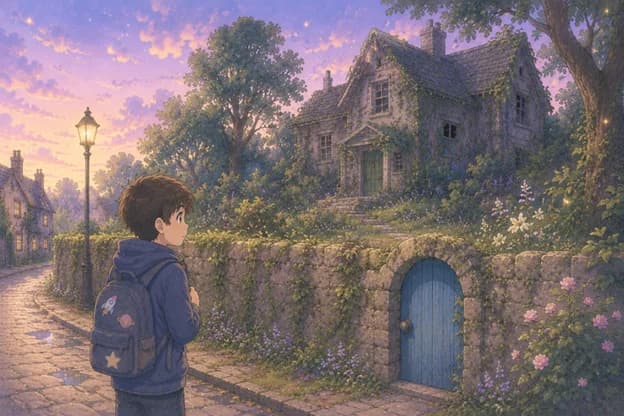
It sat at the end of Hemlock Lane, behind a stone wall covered in moss and a garden so overgrown that the trees had started growing into each other at the top, forming a kind of roof of tangled branches above the path. The front door was dark green, its paint peeling. The windows were dirty. The chimney had a crack in it from top to bottom.
Milo had walked past it every day for two years on his way to school and had never thought much about it beyond noticing it was there. It was just the empty house. Part of the lane the same way the lamp post was part of the lane, or the pothole that the council had been meaning to fix since last winter.
He thought about it a great deal more on the Tuesday morning he noticed the door.
Not the front door. The front door was the same as always, dark green and peeling. This was a different door, set into the stone wall on the left side of the garden, about halfway along. It was small, wooden, and painted a very particular shade of blue that Milo could not quite describe except to say that it was the colour of the sky at exactly the moment before it goes dark.
Milo stopped walking.
He was absolutely certain the door had not been there yesterday. He was certain because he had a habit of trailing his hand along the top of the stone wall as he walked past, and yesterday his hand had gone all the way along without finding any gap or frame or hinge. He would have noticed a door.
He looked up and down the lane. Nobody else was around. He was a little late already, having spent too long eating breakfast, and the sensible thing was to keep walking and get to school on time.
Milo was not always sensible.
He pushed open the gate in the stone wall and walked up to the blue door. Up close it was even more interesting. The wood was old and smooth, worn down by what must have been many years of hands touching it, even though the door had not existed yesterday. There was no keyhole. Just a small round handle made of something dark and heavy that was warm to the touch, warmer than it should have been given that it was October and the morning was cold.
There was one other thing. Around the edge of the door frame, carved into the stone, were words. Small ones, easy to miss. Milo had to lean in close to read them.
They said: "For those who are ready to be surprised."
Milo considered himself a person who was ready to be surprised. He had read enough books to know that doors in unexpected places were either the beginning of something extraordinary or the beginning of something he would regret. Either way, standing on the pavement staring at it was not going to tell him which.
He turned the handle and pushed the door open and went through.