
Three Days
They did not break the spell that day.
Or the next.
The second day was the hardest. It was a Saturday and they were both home all day and the silence between them was something you had to keep walking around, like furniture moved into the wrong place. Their mother noticed something was wrong by lunchtime and asked about it and they both said they were fine, which was technically true and also entirely untrue.
They communicated in notes and gestures and the particular language of siblings who have known each other their whole lives, the raised eyebrow that means really and the small head tilt that means I suppose so and the look that means please stop doing that.
Rowan slid a note under her door on Saturday evening. It said: I keep thinking of things I want to say to you.
She wrote back and slid it back under his door. It said: Me too.
On Sunday morning Asha sat at her desk and read the spell book properly, all the way through. It was extraordinary. Whoever had written it had a precise and careful mind, each spell explained not just in its words but in its intention, what it was for and what it was not for and what could go wrong. There were notes in the margins in a different hand, smaller and more hurried, which she thought were probably her grandmother's additions.
Next to the silence spell the margin note said: The hardest part is not the silence. The hardest part is what you understand during it.
Asha read that several times.
She thought about the pencils, which was silly, because the pencils were not the point. The pencils had never been the point. The point was that she and Rowan had been rubbing against each other all summer, small irritations building up like sand in a shoe, and instead of saying anything real about it she had snapped over the pencils and said things that were sharper than she meant.
And Rowan was nine. He was nine years old and she was twelve and she was supposed to be the patient one.
She was not always the patient one.
She sat with this for a long time, looking at the margin note.
The hardest part is what you understand during it.
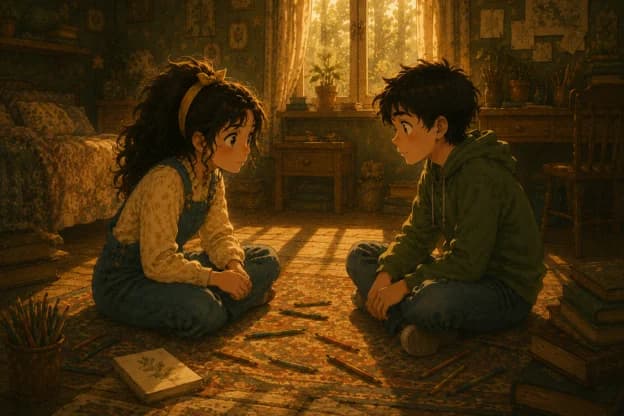
On Sunday afternoon she went and knocked on Rowan's door. He opened it. He had clearly been drawing, there were pencils everywhere, the good ones and the ordinary ones all mixed up together, and she looked at the mess of them and felt nothing except a small tired fondness.
She sat down on his floor. He sat down across from her.
They did not write anything. They just sat there in the quiet room with the pencils around them and the Sunday afternoon light coming through the window, long and golden, the kind of light that makes everything feel slightly more serious and also slightly more forgivable.
After a while Rowan reached over and picked up the red pencil, the missing one, from where it had rolled under his radiator. He held it out to her.
She took it.
And at the exact moment her fingers closed around it they both looked up at each other and she knew, the same way you know when you wake up that it has stopped raining overnight, that they were both ready.
"Asha," Rowan said. His voice came out slightly croaky from two days of not being used, at least not for this.
"I know," she said. Her own voice felt the same, a little rough, a little new. "Me too."
It was not a long conversation. But it was a real one.