

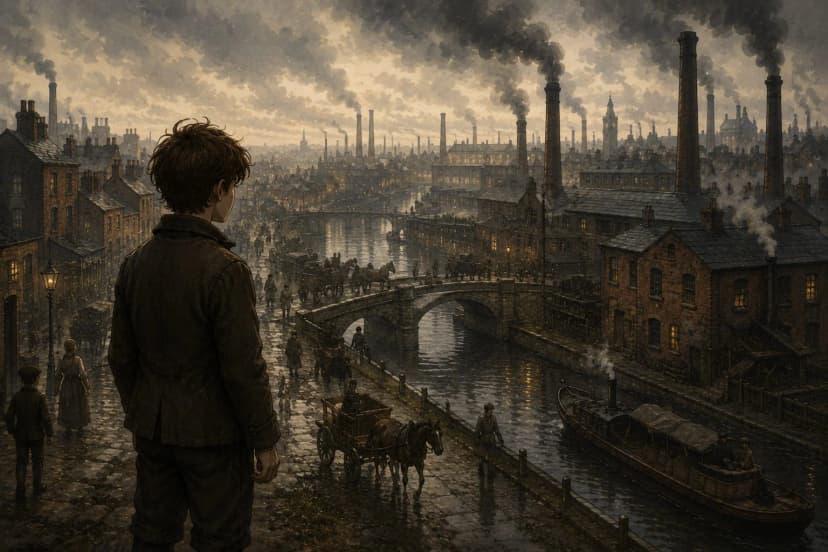
What The Smoke Hides
Edmund Hartley had lived in Manchester all his twelve years and had never once been to the mill.
This was not unusual for a boy of his position. His father owned three mills on the Irwell and a counting house on Deansgate and a house on the right side of the smoke, where the air was merely grey rather than black. Edmund had tutors and a good coat and boots that fitted properly and had never in his life thought very much about any of these things because they had always simply been there.
The visit to the mill was his father's idea, offered as an education. Edmund had thought of it as a day out, mildly interesting, the sort of thing he would describe to his tutor and forget by the following week. Edmund is twelve now, his father had said to his mother over dinner, time he understood where the money comes from. His mother had looked at her plate and said nothing, which Edmund now thought had been a more significant response than he had noticed at the time.
It was 1842. The mill was called Hartley's Number Two and it sat on the river bank behind a wall of black brick, and the noise of it reached Edmund before he could see it, a rhythmic mechanical thunder that he felt in his chest before he heard it with his ears.
The lane that ran along the mill wall was narrow and the brick was dark with years of soot and the river smell mixed with the coal smoke smell in a way that was entirely different from the street smell on the good side of the smoke, where Edmund lived. He noticed this. He noticed it specifically, as a fact about a place, rather than simply breathing it without attention the way you breathed air you were used to.
He stood outside the gate with his father and his father's mill manager, a thin man called Mr. Glover, and looked at the building and felt, for the first time in his comfortable life, a small cold thing in his stomach that he could not name.
* * *
The inside of the mill was nothing like what Edmund had imagined, which he realised, as he stepped through the door, was because he had never tried to imagine it at all.
The noise was the first thing. Not loud in the way that a crowd was loud or a storm was loud but loud in a way that seemed to come from inside your own body, a vibration that made it impossible to think in words. You could see people's mouths moving and hear nothing of what they said.
He had expected noise. He had not expected this particular quality of noise, which was not something you listened to but something you were inside. He stood just past the door and his father put a hand on his shoulder and said something he could not hear, and he nodded as though he had, and they walked into the room.
The second thing was the heat. The machines ran hot and the room trapped the heat and the workers moved through it with the accustomed efficiency of people who had long since stopped noticing what Edmund found nearly unbearable in the first five minutes.
The third thing was the children.
Edmund had known, in the abstract way that you knew things you had been told but never seen, that children worked in the mills. He had thought of this as a fact the same way he thought of other facts, things that were true and distant and did not particularly require feeling. He saw now that it was not distant at all.
They were everywhere. Younger than him, some of them, eight or nine years old, moving between the machines with the practiced smallness of people who had learned to fit themselves into tight spaces. They carried things, retrieved things, tied threads, cleared the waste cotton that collected around the bases of the frames. They moved constantly. None of them looked up.
Edmund stopped walking.
His father and Mr. Glover continued ahead, talking close to each other's ears to be heard. Edmund stood in the aisle between the spinning frames and looked at a girl about his own age who was threading a broken end back through a machine with quick fingers, her eyes entirely on the work, her face expressionless in the particular way of someone concentrating completely.
She looked up and saw him looking.
Her expression in that moment was not hostile and not friendly. It was neutral in the precise way of someone who had learned that expressions cost energy and neutrality was the most efficient state. She looked at him the way she might look at a machine that had stopped working, assessing, noting, moving on.
For a moment they simply looked at each other. Then she looked back at the machine and finished threading the end and moved on to the next frame.
Edmund followed his father.
* * *
The engine room was the loudest place Edmund had ever stood. The steam engine that drove the mill was the size of a large room itself, pistons moving with a regular enormous force, and the engineer who tended it worked in the noise with the same expressionless competence Edmund had seen everywhere in the building. He caught Edmund staring at the engine and nodded, once, in the way of a person who knew their work was impressive and had stopped being impressed by it themselves.
Mr. Glover showed them the counting room and the engine room and the loading yard and explained output figures and quarterly returns with the fluency of someone who found numbers more comfortable than people. Edmund's father asked questions and nodded and made notes in his small leather book. Edmund walked behind them and said nothing and looked at everything.
He saw a boy of perhaps nine sitting in a corner during what Mr. Glover called the meal break, eating something from a cloth with the focused attention of someone very hungry. He saw a woman whose hands moved to the machine even during the break, an unconscious repetition, as though her hands had forgotten how to be still. He saw the windows, high and small, letting in grey light that reached the floor in thin columns and illuminated the floating cotton dust that hung in the air like a permanent indoor weather.
He thought about the girl at the machine. Her name he did not know. Her age he was not certain of. He thought she was about twelve, his own age, which meant she had been here, probably, since she was eight or nine. He thought about what he had been doing at eight or nine. He thought about his tutor and his books and the garden and Sunday afternoons.
He thought about the cotton dust. He breathed it in and felt it and thought about breathing it every day, all day, for years.
On the way out, in the yard, he stopped beside Mr. Glover while his father spoke to the foreman.
"The children," Edmund said. "How long do they work?"
Mr. Glover looked at him with the careful expression of a man deciding how much to say to an employer's son. "Twelve hours," he said. "On the standard shift. Six in the morning to six in the evening, with half an hour at midday."
"How much do they earn?"
"The youngest, two shillings a week. The older ones, three to four."
Edmund thought about the coal for the fires at home, which cost more than that each week. He thought about the boots he had been given three months ago because the previous pair had been scuffed, not worn through, just scuffed.
"Is it legal?" he asked. "The hours."
Mr. Glover looked at him again. "The Factory Act of 1833 limits children under thirteen to nine hours," he said. "We are within the law."
"Nine hours," Edmund said.
"Yes."
"You said twelve."
Mr. Glover's expression did not change. "The Act is not always straightforwardly applied," he said, and went to stand with Edmund's father.
Edmund stood in the yard and looked at the black brick wall and the grey sky above it and the smoke from the engine chimney going up and up and disappearing into the cloud, and thought about what straightforwardly applied meant and what it did not mean.
* * *
He had learned the word reform from his tutor, who had mentioned it in the context of Parliament and voting, things that seemed abstract and far away. He thought about it now in the context of something concrete: a room full of noise and heat, children with quick hands and expressionless faces, cotton dust floating in thin columns of grey light.
Reform meant change. Change meant someone had decided to look.
There was a moment, during the counting room section of the tour, when Edmund looked out of the small window down onto the mill floor and saw the girl again. She was at a different frame now, further along the row, and she moved between machines with the same practiced efficiency, never stopping, never looking up. From above she was very small against the size of the machines.
He thought: she does not know I can see her. She does not know I am here.
He thought: that does not change anything about her day. Whether I see her or not, the machines run.
He thought about a thing his tutor had said once, about the difference between knowing something and understanding it. You could know a fact, his tutor had said, and carry it in your head for years without it ever becoming real. Understanding came from something else, from contact, from seeing, from the moment a fact stopped being a fact and became something you felt.
He had known about the mills for twelve years.
He had understood them for one afternoon.
He could not sleep that night.
He thought about the reformers again. He had not paid much attention when his tutor mentioned them. They had seemed like the sort of people who existed in history, not in the present, the sort of people in books rather than in the actual city where he actually lived. He thought now that they were in the actual city. Writing pamphlets in rooms not far from where he lay. Going before Parliament committees with facts and figures and testimonies from workers who had given their names to documents and trusted that something would come of it.
He thought that trusting something would come of it required a particular kind of courage when you could not afford to lose your place at the machine.
He lay in his bed, which was soft and warm and in a room that was quiet, and stared at the ceiling and thought about the girl threading the broken end through the machine. He thought about her hands, which had been quick and sure in the way of hands that had done the same thing many thousands of times. He thought about what she did after six o'clock. Whether she had a home that was quiet. Whether she had a bed that was soft. Whether she slept, or whether she lay awake.
He got up and went to the window. The street outside was dark and the gas lamps made pools of yellow light on the wet stones and somewhere further away, toward the river, the mills were still running because they ran through the night on the night shift, and he could see the faint glow of them against the low clouds and hear, if he was very still and the wind was right, the distant rhythmic sound that had vibrated in his chest that afternoon.
He thought about twelve years of his life and what they had contained and what they had not, and he thought about twelve years of a different life and what it contained instead.
His room that night felt different than it usually did. Not larger, not smaller, just more specific. The softness of the mattress was specific. The quietness was specific. The warmth from the banked fire in the grate was specific. He had slept in this room every night of his life and never once noticed these things as things, as conditions, as the ordinary facts of his particular existence and not someone else's.
He noticed them now.
The street below was empty at this hour and the gas lamps reflected in the puddles and the whole city was doing what it did at night, which was to rest the parts of itself that could rest while the other parts kept running. The mills kept running. The workers on the night shift were in them now, doing in darkness what he had watched being done in the thin grey light of afternoon.
He stood at the window for a long time.
He went back to bed. He did not sleep for a long time.
* * *
He came down to breakfast with the particular resolve of someone who has spent a night deciding something and arrived at morning still decided.
He spoke to his father at breakfast.
Not about everything, not about the girl or the broken end or the night he had spent not sleeping. About the hours. About Mr. Glover saying twelve hours and then citing a law that said nine.
His father listened. His father had a face that Edmund had always read as straightforward. He saw now it was more complicated, that there were things the face did not say, not from dishonesty but from careful arrangement.
His father was not a cruel man, Edmund thought. He was a man who had built something from nothing and was proud of it and had trained himself, as successful men sometimes did, not to look too closely at certain things. Not because he did not know they were there but because knowing and looking were different, and looking changed things.
"The Act is poorly enforced," his father said.
"I know," Edmund said. "Mr. Glover told me."
"It is an industry-wide practice."
"I know that too."
His father looked at him across the breakfast table. Edmund looked back. He was twelve years old and had been to the mill once and could not yet change very much. But he thought about the reformers his tutor had mentioned, men and women who wrote pamphlets and gave speeches and appeared before Parliament and moved things, slowly, by insisting on looking at what was there.
"I want to understand it properly," Edmund said. "I want to read the Act. And the reports. There have been Parliamentary reports."
"There have," his father said carefully.
"I want to read them."
His father was quiet for a moment. He looked at his coffee. He looked at Edmund.
"I will have them sent from the counting house," he said.
Edmund nodded. He thought about the girl and what she would do today and tomorrow and the day after. He thought that his reading Parliamentary reports would not change her day in any immediate way. He thought about the word immediate and what it implied about other timeframes.
He ate his breakfast. Outside the window the smoke from the mills moved across the grey Manchester sky the same as it always had and the same as it would for years yet. He knew that. One twelve-year-old boy reading Parliamentary reports was not going to change the mills of Manchester in 1842.
But he thought that not looking had not changed them either.
He thought that looking was where it started.
Outside, the smoke from the mills continued across the sky. It would continue tomorrow. He was not under any illusion that it would stop. But he thought there was a difference between smoke you looked at and smoke you did not, even if the smoke itself was the same.
He thought about the girl at the machine. He thought she would not know his name or that he had gone home and not slept and come down to breakfast and asked a question. She would not know and there was no particular reason she should.
But he thought that the least he could do, the very least, was to look properly at what was there and not pretend otherwise.
His mother, who had been at the far end of the table through all of this, reading a letter, set the letter down and looked at Edmund with an expression he could not entirely read. Then she looked at his father. Then she looked back at her letter.
Edmund thought about her silence at dinner, the night his father had proposed the visit.
He thought she had been waiting, in her own way, for someone in the family to look.
He finished his breakfast and went to find his tutor and asked to begin with the Factory Acts.
He spent the morning reading and did not stop at the usual lesson time because his tutor, who had a particular expression he used when a student was genuinely absorbed, sat quietly and let him continue. By midday Edmund had read two reports and made eight pages of notes in his own handwriting, facts and figures and testimonies from workers and factory inspectors.
The facts were not new to the world. They had been written down, presented to Parliament, argued over, and largely not acted upon for a decade. Edmund read them and thought about the difference between facts existing in the world and facts being known by a specific person, which were apparently different things and had apparently different effects.
He thought it was an insufficient excuse that he had not known.
He thought it was also true.
He thought that both of those things could be true at the same time. He thought that holding two true things at once, even when they pointed in different directions, was perhaps part of what it meant to look properly at something.
The End