

D. Calloway
The Bristol address turned out to be real, which Sera had not entirely expected. She found it by searching the name and the city and cross-referencing with a public boat registry, which listed a D. Calloway as the registered owner of a sailing vessel called the Grey Lady, last port of record: Portishead, Bristol.
She showed this to her father that evening. He looked at it for a long time.
"You did this yourself?" he said.
"Ned helped," Sera said. "Dad. Does the name Calloway mean anything to you?"
Her father was quiet. The quiet was not a thinking quiet. It was a knowing quiet, the kind where the person already has the answer and is deciding what to do with it.
"Dad," Ned said.
"David Calloway," their father said. "He and your grandfather had a dispute. A long time ago. Before either of you were born."
"What kind of dispute?" Sera asked.
"About the Marianne," their father said. "Your grandfather bought it in 1987. Calloway claimed he had agreed to buy it first. That your grandfather had known about his offer and bought it anyway." He looked at the table. "Your grandfather always said it was not true. That Calloway's offer had fallen through before he made his own. That it was all legal."
"Was it?" Ned asked.
"As far as I know," their father said. "But Calloway never accepted that. He wrote letters for years. Your grandfather stopped replying eventually. I thought it had all gone quiet."
"He has been waiting," Sera said slowly. "For the right moment. For when we were here and the boat was accessible and he had enough time to plan it."
"This is not something children should be investigating," her father said. But he said it without force, the way you said something you knew was already beside the point.
"We already have," Ned said. "And the police have a name, a boat registration, a Bristol address, and a connection to a seventeen-year-old who unwittingly provided harbour camera information. That is considerably more than they had yesterday."
Their father looked at his ten-year-old son for a long moment. Then he picked up his phone.
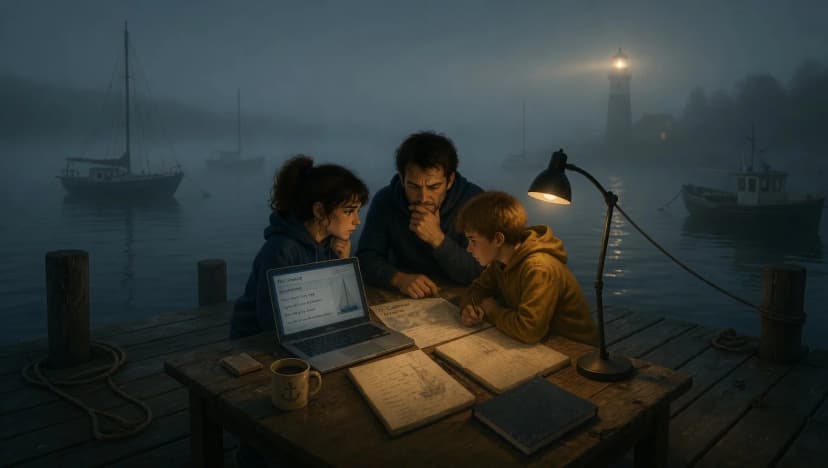
Her father was on the phone for a long time. They sat in the kitchen and listened to his voice, low and careful, and Ned drew small diagrams of boats in his notebook and Sera looked out the window at the harbour lights coming on in the dusk.
"Ned," she said that night, when they were both in the upstairs room they shared in the holiday cottage, Ned already in his sleeping bag with his notebook on his knees. "Do you think Dad knew? About Calloway, I mean. That he might come back someday."
"I think he might have wondered," Ned said. "But wondering and knowing are different things."
"If he had told us about the dispute earlier we might have noticed Calloway sooner," Sera said.
"Possibly," Ned said. "Or we might not have been looking at all. Sometimes not knowing makes you look harder."
Sera thought about this. She thought it was probably true. She thought it was the kind of thing that was annoying to admit but true nonetheless.
"Go to sleep," she said.
"I am thinking," Ned said.
"Think with your eyes closed," Sera said.
He did not argue, which meant he was tired. Sera lay in the dark and listened to the harbour sounds that came through the window at night, the creak of mooring ropes and the gentle knock of hulls and the water against the stone of the jetty, and thought about a man who had been waiting for thirty years and had finally decided to stop waiting.
The police found the Grey Lady three days later at a mooring in Dartmouth, with the Marianne tied alongside. David Calloway was on board. He did not resist. He had been, the police said, apparently waiting to be found, which was either confidence or something more complicated that Sera did not entirely understand.
The Marianne came home on a Saturday with their father at the helm and Sera and Ned sitting on the foredeck watching the harbour get closer.
"How did you know to look at the camera timing?" Ned asked her, not for the first time.
"I did not know," Sera said. "I just thought five hours and thirty-five minutes was too specific for an accident."
"It was," Ned said.
"It was," Sera agreed.
The harbour came closer, the familiar jetty and the familiar smell of salt and diesel and the particular light of late summer afternoons on the water. Their grandfather had sailed in here every summer for thirty years. Their father had sailed in every summer since.
She thought about David Calloway waiting to be found. About a dispute that had started before she was born and had not ended, quietly, all those years, just gone underground and waited. She thought about her grandfather writing in the logbook in the cabin, his handwriting still there after all this time.
Sera thought that some things were worth the trouble of getting back.
She thought the Marianne was one of them.
Ned was already writing in his notebook. She did not ask what he was writing. She looked at the water and let the harbour come closer and thought that next summer they would be back, and the Marianne would be at its mooring, and the rope would be properly tied.