What She Left
On Friday she did something she had not planned to do.
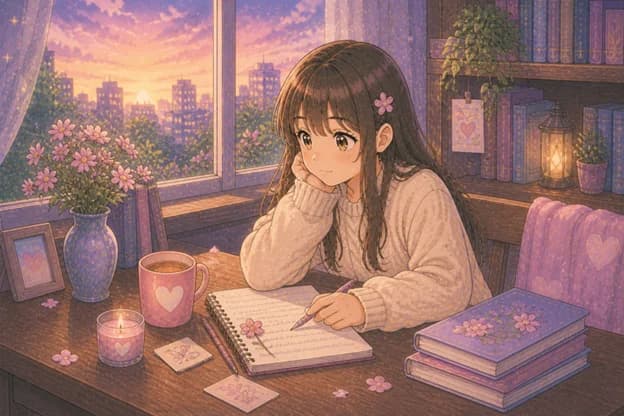
She tore a page from the back of her notebook, one of the older poems, one she had written when she was ten about the way autumn smelled different every year but always like the same thing. It was not her best poem. It was not her worst. It was one that felt, when she read it back, like something she would not be destroyed by someone else reading.
She folded it in half and put it in the small front pocket of her bag and went to school and spent most of the day not thinking about it, which meant she thought about it constantly.
She had spent Friday morning deciding which poem. She had gone through six candidates and rejected them all before settling on the autumn one. Too personal felt wrong. Not personal enough felt like it was not actually the thing. The autumn one was personal enough to mean something and not so personal that she would need to leave the country.
She had folded it four times before unfolding it and refolding it twice. She was aware this was not her most dignified morning.
At lunch she went to the library, where Marcus sometimes ate, and he was there at the table by the window with his sketchbook open and his sandwich ignored beside him.
She sat down across from him. He looked up. His expression did the small shift it had started doing around her, the one that was not quite a smile but was adjacent to one, like a door that was not open but was no longer entirely closed.
"Hey," he said.
"Hey," she said. She put the folded poem on the table between them without saying anything.
He looked at it. He looked at her.
"You do not have to read it now," she said. "Or ever. I just thought." She stopped. "I do not know what I thought."
"Okay," he said. He picked it up carefully and put it in the front pocket of his own bag without unfolding it. "Thank you."
She nodded. She took out her own lunch. They ate in the quiet library with the sound of the school going on around them outside the windows, and Lena thought that the poem was in his bag now and that was a thing that had happened and that it was, surprisingly, fine. Frightening in a small distant way, the way heights are frightening when you are on solid ground, but fine.
He read it that evening. She did not know this for certain but she thought he probably had because on Thursday he was quiet in a particular way, a thoughtful quiet rather than an ordinary one, and once she caught him looking at her and he looked back at the board without saying anything.
She did not ask. She thought not asking was part of the arrangement they had, unspoken, between people who understood about private things.
On Monday he was at her desk again before she arrived and there was a folded piece of paper on top of her books. She sat down and looked at it.
"You do not have to look at it now," he said, exactly as she had said it. "Or ever."
She unfolded it.
It was a drawing. Small, done in pencil, careful and very precise, the kind of precision that comes from looking at something for a long time before you draw it. It was the allotment wall where they had sat on Wednesday, the long afternoon light through the trees, two figures sitting a little way apart. You could not see their faces. But you could tell, from the way they were sitting, that they were comfortable. That they were in the middle of something.
Lena looked at it for a long time. Long enough that the classroom filled up around her and someone knocked into her desk and she did not notice.
"This is good," she said. Her voice came out quieter than she intended.
"You said the poetry was since you were nine," he said. He was looking at the front of the room. "The drawing in the same year?"
"When I was nine," she said. "Yes."
He nodded once. Then the lesson started and they both faced forward.
Under the desk Lena folded the drawing carefully along its original fold and put it in the inside pocket of her bag, next to the notebook. It fit exactly.
She did not add a fourth rule. She thought three was probably enough. Some things did not need rules. Some things you just let happen slowly and carefully and see where they went.
She thought that standing near something warm was a very good place to be.
She thought about the drawing on the walk home. She thought about the two figures on the wall, no faces, just the light and the space between them and the way it was possible to tell from posture alone that something was happening. That something was beginning.
She thought Marcus Osei was a very good artist. She thought he had drawn something true.
She thought about the poem she had given him, the autumn one, and wondered if he had recognised anything in it, any feeling he knew, any moment that felt like his own. That was the thing about poetry she could never explain to anyone, how it was personal and also not personal, how it was yours when you wrote it and then became something different when someone else read it, something shared.
She turned the corner onto her street.
She thought about the inside pocket of her bag and the notebook and the drawing sitting next to it now, the pencilled afternoon light, two figures on a wall.
She thought she would paint a cover for the drawing. Something to protect it. Blue and green, maybe, smudged at the edges.
She thought she might write a poem about it later.
She thought she probably would.
She already knew the first line.
***The End***