
The Fountain, Examined
They went to the fountain at lunch on the fourth Tuesday.
Bea had explained the situation to Tomasz and Wren for the fourth time that morning with the practiced efficiency of someone who has told the same story many times and has learned to cut out the parts that make people ask unnecessary questions. Wren had filled a new section of her notebook. Tomasz had said something about how at least Bea always knew what the history teacher was going to say before she said it, which was admittedly true and mildly useful.
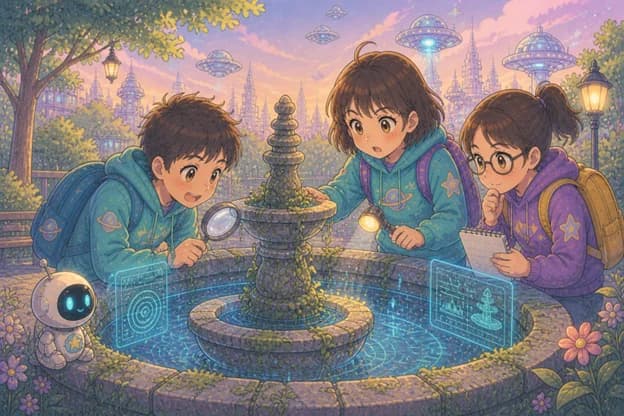
The fountain was in the middle of the park, surrounded by a low stone edge. The flowers planted in the basin were bright yellow and slightly overgrown. The stone was old and grey and had the look of something that had been there much longer than anyone remembered.
They stood around it and looked at it.
"It looks like a fountain," Tomasz said.
"Thank you," Bea said. "That is very helpful."
"I am just saying it looks normal," he said. "There are no buttons or levers or mysterious symbols. It is a stone fountain with flowers in it."
Wren was crouching down looking at the base. "There is something carved here," she said. "Around the bottom edge. Numbers."
Bea and Tomasz crouched down beside her. The numbers were small and worn but readable once you knew to look for them. They ran all the way around the base of the fountain in a single line.
"A date," Bea said. "Look. That is a year. And those are days and months."
"There are several dates," Wren said, tracing along the line with her finger without touching it. "Six of them. All carved in the same style."
Tomasz read them out while Wren wrote them down. Six dates, each one different, spread across a range of about forty years. The most recent one was from eleven years ago.
"What do the dates mean?" Tomasz asked.
"I do not know," Wren said. "But I think they might be the dates when the loop happened before. Someone carved the date each time."
Bea stared at the dates. "This has happened before," she said. "To other people."
"Six other times," Wren said. "At least."
"Did they break the loop?" Tomasz asked.
"They must have," Bea said. "Otherwise they would still be looping." She paused. "Presumably."
"Maybe they are still looping somewhere," Tomasz said thoughtfully. "Maybe there are loads of people all stuck in different Tuesdays and they just cannot communicate because they are in different loops."
"That is an extremely unhelpful thing to say," Bea told him.
"I thought it was quite interesting," he said.
Wren stood up and looked at the fountain from above. "There has to be a pattern," she said. "Six times the same thing has happened and six times someone has carved the date. That means six times someone figured it out. Which means we can figure it out too."
"How?" Bea asked.
"We think about what all six dates have in common," Wren said. She was already flipping back through her notebook. "I am going to look up what happened on each of these dates. Can you two see if there is anything else written on this fountain that we have missed?"
Bea and Tomasz went around the fountain very carefully, inch by inch. On the inner edge of the basin, almost completely hidden by the soil the flowers were planted in, Tomasz found something.
"There is a word here," he said. "Under the soil."
They scraped the soil away carefully with a stick. The word was carved deeper than the dates, older-looking, the stone around it weathered to a different colour.
The word was: RETURN.
"Return," Bea said.
"Return," Tomasz agreed.
They looked at each other.
"I think," Bea said slowly, "that we might need to put the flowers back."