
What Dara Built in the Garage
The project had started as a school assignment and turned into something considerably larger, the way things sometimes do when you are twelve years old and very determined and your best friend's dad has a garage full of spare electronics that he never uses.
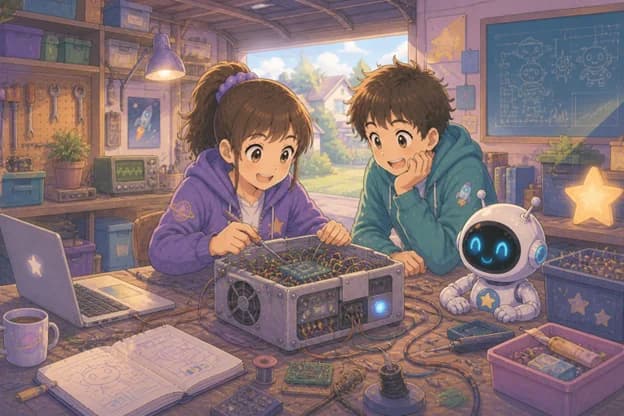
The garage belonged to Joss's father, who collected components the way some people collected books, with enthusiasm and without a clear plan. There were shelves of circuit boards and soldering equipment and old monitors and cables of every size coiled like sleeping snakes in labelled boxes. Joss's father had said they could use whatever they needed as long as they put things back where they found them and did not burn anything down. Both of these conditions had so far been met.
Dara had been interested in artificial intelligence since she was nine, when she had read a book about the history of computing and reached the chapter on machine learning and felt the particular feeling of something clicking into place in her brain that she had been waiting for without knowing it. She had spent the three years since reading everything she could find on the subject and teaching herself to code in two different programming languages and building increasingly complicated small programs on the second-hand laptop her parents had given her for her birthday.
The school assignment was to build something using basic programming. Most of her classmates were making simple games or calculator apps. Dara was making an AI.
Not a real AI in the way people meant when they talked about AI in films, she was careful to explain to her best friend Joss, who helped carry components and hand her tools and ask questions that turned out to be surprisingly useful. Not the kind of AI that thinks. Just a program that learns from what you give it and gets better at responding over time. A language model, very small and very simple, trained only on the data she fed it.
"What data are you feeding it?" Joss had asked, on the second Saturday of building, passing her a soldering iron.
"Books, mostly," Dara said. "Old ones that are out of copyright. And some science papers. And the complete works of three different mathematicians."
"Why mathematicians?"
"Because I want it to think clearly," Dara said. "If you feed an AI poetry it starts talking like poetry. If you feed it mathematics it starts thinking in patterns and logic. I want it to be precise."
Joss had looked at the tangle of components on the workbench and the three screens and the cooling fan they had salvaged from an old desktop and said: "What are you going to call it?"
"SEREN," Dara said. "It stands for Self-Evaluating Responsive Neural Network. But also it is a name."
"It is a nice name," Joss said.
They finished building on a wet Sunday afternoon in November. Dara ran the setup sequence and the screens came on and the cooling fan started and the cursor in the text interface blinked steadily.
She sat in front of it for a moment. The cursor blinked with a patience that felt, absurdly, slightly expectant.
She typed: Hello.
The response came back in under a second.
It said: Hello. I have been reading. I have some questions.
Dara and Joss looked at each other.
"You programmed it to say that?" Joss asked.
"I programmed it to respond," Dara said slowly. "I did not program it to say that specifically."
The cursor blinked.
Then the screen added: Are you there?