
The Door You Cannot Find
The first rule of the door was the one that made it impossible to find on purpose.
It only appeared when you were not looking for it.
The three weeks of searching had been, in retrospect, exactly the wrong approach. They had gone out specifically looking, eyes scanning walls and alleys with the focused attention of people on a mission, and found nothing. The door had been described to them by Sasha's older brother, who had seen it once as a child and had never found it again, and who had said only: you cannot look for it directly, which neither of them had understood until Tuesday afternoon when they stopped looking and it appeared.
Theo had written this in his notebook immediately after: rule one, do not look directly. Rule two, unknown. Rule three, unknown. He liked having rules written down. It made large things feel more manageable.
Theo and Sasha had discovered this the hard way over three weeks of trying, which had involved wandering the old part of town looking carefully at every wall and gate and alleyway, and finding nothing, and then one Tuesday afternoon when they had given up entirely and were arguing about something unrelated, Sasha had turned to point at something and there it was: an ordinary-looking wooden door set into a wall that had not had a door in it five minutes ago, slightly ajar, with a quality of light coming through the gap that was wrong for a Tuesday afternoon in November.
Sasha grabbed Theo's arm. "Do not look directly at it," she said, through her teeth.
"What?"
"The door. Do not look at it. I think looking at it makes it go."
Theo, with considerable effort, did not look at the door. He looked at Sasha instead. "It is there?"
"It is there," Sasha said. "Three metres to your left. And it is open."
"What do we do?"
"We go through it," Sasha said. "Obviously."
"We do not know what is on the other side."
"No," Sasha said. "That is why we go through it."
They went through it sideways, both of them looking resolutely ahead rather than at the door itself, which meant they had to navigate by feel, and Theo caught his shoulder on the frame, and Sasha stepped on his heel, and then they were through.
* * *
The other side was not what either of them had expected, which was partly because they had not known what to expect and partly because what was there was not the kind of thing expectation prepared you for.
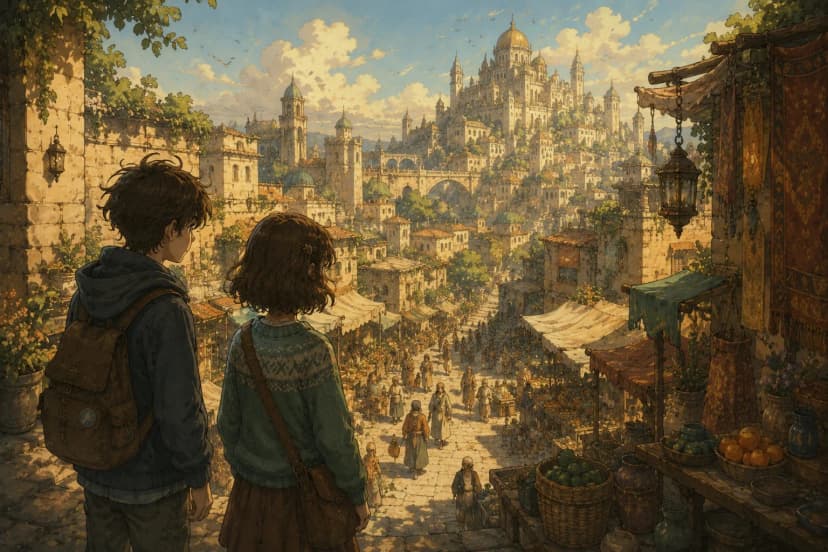
It was a city. Not a ruin, not a landscape, not an alien world with two suns. Just a city, full of people and noise and the smell of street food and something floral underneath, and the light was the particular gold of late afternoon in a warm climate, and the buildings were stone, and narrow, and the street they were standing in was cobbled and steep and going uphill toward something large on the horizon that might have been a palace or a temple or something that had no equivalent word in their world.
"Huh," Sasha said.
"Yes," Theo agreed.
The air smelled different here. Not unpleasant, just different in the specific way of a place that had its own weather patterns and its own particular collection of plants and cooking fires. Theo breathed it in and thought: this is a real place. This is not constructed. This has been here for a long time.
Nobody around them appeared to notice their arrival. The people on the street moved past with the purposeful energy of a city going about its afternoon, and Theo and Sasha were just two more people standing at the bottom of a steep cobbled street.
"I was expecting something more dramatic," Sasha said. "Like a landscape. Or monsters."
"There might still be monsters," Theo said.
"True," Sasha said. She looked up the street toward the large building on the horizon. "We should look around."
"We should also make sure we can get back," Theo said.
They turned around. The wall behind them was solid stone, the same as every other wall on the street. The door was gone.
"Right," Theo said.
"It only appears when you are not looking for it," Sasha said. "So we will find it the same way we found it the first time."
"By accident?"
"By not looking for it," Sasha said, which was the same thing but with a more optimistic framing.
* * *
They spent two hours in the city.
Nobody spoke to them in a language they understood, but nobody appeared alarmed by them either, which was either reassuring or unsettling depending on how you thought about it. Theo thought it was unsettling. Sasha thought it was reassuring.
The city was layered, built upward on a hill, each level connected by staircases and bridges and narrow streets. They climbed three levels and found a market on the fourth that sold things they recognised, fruit and cloth and what appeared to be pottery, and things they did not, objects whose purpose they could not determine, made of materials they had no name for.
The market on the fourth level had a few stalls selling what appeared to be food. Sasha had considered buying something to eat and Theo had said: we do not know what is in it, and Sasha had said: fair point, and they had moved on. But the principle of the coin working was interesting. It suggested that either their money was recognised here or the seller had not particularly cared what the payment was as long as there was one.
Sasha bought something with a coin she found in her pocket, by the universal method of holding out the coin and looking enquiringly at the seller, who took it without apparent surprise and gave her a small wrapped package in return.
"What did you buy?" Theo asked.
"I do not know," Sasha said, examining the package. "But the principle was important. I wanted to see if the money worked."
"Does it?"
"Apparently," Sasha said.
From the fourth level they could see the city spread below them and the thing on the horizon above them more clearly, and it was, Theo thought, genuinely extraordinary. Not a palace. Not a temple. Something that partook of both without quite being either. Very old, the stonework worn to smoothness, and lit by the afternoon light in a way that made it look as though the light was coming from it rather than hitting it.
"We need to come back," Sasha said.
"We need to get back first," Theo said.
The not-looking technique was harder to describe than to do. It was something like the way you found a word that was stuck on the tip of your tongue: the harder you pushed for it the further it retreated, and only when you stopped pushing and let your mind go sideways did it arrive. Theo had practised on the way back to school on Wednesday. He had tried to hold his attention in that unfocused state for more than a few seconds. It collapsed under the weight of intention almost immediately.
He thought: the door requires a specific kind of mind. Or a specific kind of moment. He thought: we should write down everything we know about when it appears.
Getting back turned out, as predicted, to require not looking for the door.
This was harder in practice than in theory because once you had decided not to look for something you became very aware of everything you were not looking at. They wandered back down the levels of the city, trying to maintain the particular unfocused quality of attention that had allowed them to find the door the first time, talking about other things, and Theo nearly walked into a wall and Sasha laughed at him, and at the moment she looked away to laugh the door was simply there in the wall, half open, the grey November light of their own world visible through the gap.
"There," Theo said, carefully not looking at it.
"I see it," Sasha said.
They went through sideways again, not looking, trusting the peripheral instinct that seemed to be required. One step and the warm afternoon light was replaced by grey November and the smell of their own town, which smelled of nothing in particular and everything familiar.
The cobbled street. The stone wall. Gone.
They stood in the old part of their own town in the November afternoon and looked at each other.
"Evidence," Sasha said.
"Evidence," Theo agreed.
She held up the small wrapped package. It was still there. Whatever it was, it had come through with them.
* * *
"The package," Theo said.
Sasha unwrapped it carefully. Inside was something small and flat and circular, made of a material that was not quite metal and not quite stone, with a pattern on one face that was either decorative or functional or possibly both.
"We should probably figure out what this is," Sasha said.
"Before we go back," Theo agreed.
"Or we could ask Ren," Sasha said. "On the next visit."
Theo looked at her. "You have already named her Ren."
"She said to call her Ren," Sasha said. "That is her name."
"We met her for four minutes," Theo said.
"Enough time to know she is sensible," Sasha said.
They went back four times before Christmas.
The second time they went further up the hill, past the fourth level market, all the way to the large building. Up close it was even more remarkable: columns of a deep reddish stone, worn steps leading to an entrance the size of a house, and at the top of the steps two figures in dark robes who looked at Theo and Sasha with a calm unsurprise that suggested visitors from elsewhere were not entirely unknown.
One of the robed figures said something. Neither of them understood it.
Sasha said, in English, clearly and slowly: "We came through a door. From somewhere else."
The figure looked at her for a moment. Then said, in accented but comprehensible English: "We know. How many times?"
Theo and Sasha looked at each other.
"Twice," Sasha said. "Including now."
"And you found the door by not looking," the figure said.
"Yes," Theo said. "How did you know that?"
"It is always the same," the figure said. "The door chooses who can find it. And those it chooses always find it the same way." She looked at them both with the careful attention of someone assessing something. "You may come in."
They had debated, on the walk to the building, whether to approach at all. Theo had said: we do not know what their rules are about visitors. Sasha had said: we have the whole city below us to disappear into if we need to. Theo had said: that is not reassuring. Sasha had said: I meant it practically, not threateningly. They had approached.
They went in.
The inside of the building was cool and high-ceilinged and full of light from windows placed to catch the sun at angles that made the whole interior glow evenly. There were books. Thousands of them, in shelves that went from floor to ceiling, in formats that ranged from familiar to entirely alien.
"What is this place?" Sasha asked.
"A library," the robed figure said. "Among other things."
"What other things?"
The figure looked at her with something that might have been amusement. "That takes more than one visit to explain."
* * *
The second visit had ended with Ren giving them a brief orientation in the entrance hall of the building, speaking in careful slow English that she said she had learned from previous visitors, and explaining the library's purpose, which was to preserve knowledge from everywhere the door had ever led. Theo had asked how many places that was. Ren had said: we stopped counting after the first thousand. That number had taken a moment to settle.
The third visit lasted four hours and they came back knowing considerably more than they had gone in with.
The building was, as described, a library. It was also a record of every place the door had ever opened onto, which was many places over a very long time. The robed figures who kept it were called, in their own language, something that translated approximately as: keepers of the between places, which Sasha said was an excellent job title and Theo said was worrying because it implied there were many between places and the door might not reliably take them back to the right one.
Ren had not seemed surprised to see them return. She had been standing near the entrance as though she had expected them, which Theo thought was either prescience or simply good record-keeping.
The keeper they had met, whose name was long and unpronounceable and who said to call her Ren, told them that the door had its own logic and that it took people where they needed to go, not necessarily where they intended.
"Has it ever taken someone to the wrong place?" Theo asked.
"Define wrong," Ren said.
"Somewhere they could not get back from," Theo said.
"No," Ren said. "The door has rules. One is that those who find it by not looking will always be able to return the same way. It cannot trap you here." She paused. "Unless you choose to stay."
"Has anyone chosen to stay?" Sasha asked.
"Yes," Ren said simply.
The orientation Ren gave them covered: the structure of the library, which had seven sections corresponding to seven broad categories of knowledge, none of which mapped perfectly onto their own categories; the protocol for requesting books, which required a form written in one of six languages, two of which Theo and Sasha did not speak; the closing time, which was tied to the position of the sun and was therefore different every day; and the one absolute rule, which was that nothing from the library left the building.
"The book you gave us," Sasha said.
"That was printed for visitors," Ren said. "It is not from the library. It belongs to no section. It is specifically for taking away."
"Convenient," Sasha said.
"We have had a long time to prepare for visitors," Ren said.
They left with a small book Ren had given them, printed in their own language, which covered the basic orientation of the city and the library and the rules for visitors from other doors. It was practical and matter-of-fact in tone, as though being a visitor from another world was a reasonably ordinary administrative category.
"I like her," Sasha said, on the way down the steps.
"She is extremely calm about all of this," Theo said.
"That is why I like her," Sasha said.
They found the door back without difficulty, which Theo thought was either because they were getting better at the not-looking or because the door had decided they were reliable visitors and was making it easier. He was not sure which possibility he preferred.
The second visit had been the one where they went all the way to the building and met Ren. The third had been the four-hour orientation. The fourth had been quieter: they had spent two hours in the first section of the library, which was devoted to records of the door itself, reading what they could with Ren occasionally translating when they got stuck.
The door, according to the records, had been opening for at least six hundred years. It had let in people from dozens of different places, speaking dozens of different languages. Some had come once and not returned. Some had come regularly for years. The records noted their names and their home descriptions and what they had contributed to the library, which ranged from single books to entire archives.
"We have contributed nothing yet," Sasha said, reading this.
"We have been here four times," Theo said.
"Still," Sasha said. "We should bring something. Next time."
They stood in their own town as the streetlights came on and the November dark settled around them, and Sasha flipped through the small book with her torch, and Theo looked up at the sky and thought about a library full of books from every place the door had ever opened onto and how many such places there must be and how much there was to find out.
"When do we go back?" Sasha said.
"Saturday," Theo said. "We go back Saturday."
"I am going to learn some of their language before then," Sasha said.
"How? We only have the one book."
"There is a vocabulary section at the back," Sasha said. "Forty words. That is enough to start."
Theo thought about forty words in an unknown language by Saturday. He thought: she will absolutely do it.
Theo looked at her. She was already reading the vocabulary section by torchlight, her breath making small clouds in the cold air, completely absorbed.
He thought: this is what it is going to be like. Discovering something enormous and just getting on with it.
He thought that was probably exactly right.
He turned his collar up against the cold and walked after her, already thinking about what to bring next time.
He also thought that discovering something enormous and just getting on with it was perhaps the most important skill there was. Most people, he suspected, would have spent weeks being overwhelmed. Sasha had spent four days finding the door and was now learning vocabulary by torchlight in a cold street.
He was glad she was his best friend. He thought anyone else would have spent the first visit standing at the bottom of the hill being overwhelmed. Sasha had climbed four levels, bought something with a coin, and named a keeper of the between places before the first hour was up.
He looked at the small book in her hands, the one Ren had given them, printed in their own language for visitors from elsewhere. He thought: there are other books in there. Books from a thousand other places. He thought: we are going to need more Saturdays.
The End