
The Ones Who Came Before
The first memory that did not belong to her arrived on a Tuesday in October.
Mira was sitting in geography and Mr. Webb was talking about river systems and she was half listening, half looking out the window at the grey autumn sky, and then without warning she was somewhere else entirely.
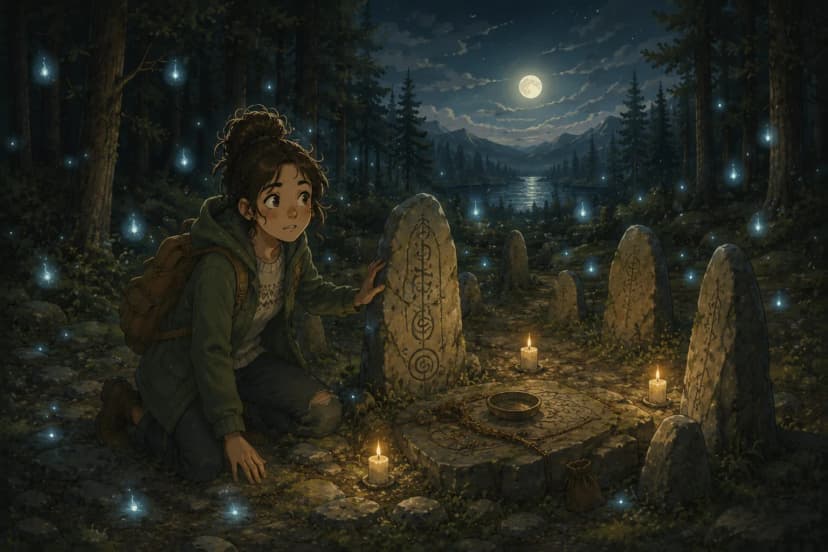
Not a daydream. Not the gentle drift of an unfocused mind. Something sharper, more complete: a forest at night, the smell of pine resin and cold water, a stone path under her feet that she knew she had walked a thousand times. She could feel the temperature. She could feel the particular weight of her own body moving through the dark, sure-footed, unafraid.
Then Mr. Webb said her name and she was back in geography, her hands flat on the desk, her heart doing something complicated.
"Mira. The question."
She answered the question about river systems. Her voice came out calm and level. She answered it correctly. She had no idea how she knew the answer because she had not been listening.
She sat with what had happened for the rest of the day and told herself it was a vivid daydream, the kind that felt more real than usual, the kind that happened sometimes. She said this firmly and clearly to herself, in the internal voice she used for things she needed to believe. It did not fully work.
It happened again on Wednesday. And on Thursday. Each time the same forest, each time the stone path, each time the sure-footedness in the dark that felt like something she had always known.
By Friday she had stopped telling herself it was a daydream.
By Friday she had also started paying close attention to when the memories arrived and what she was doing when they did. Always still. Always when her attention had gone soft, not focused, the way it went in the few minutes before sleep or looking out windows or sitting in long assemblies. As though the memories needed a gap to come through.
* * *
She had a particular kind of memory, Mira. She remembered things precisely, in detail, with the kind of clarity that meant she could close her eyes and walk through any room she had ever been in. Her teachers called it a good memory. Her mother called it useful. She had never thought much about it except as a feature, like being good at maths or able to draw.
Now she thought about it differently. Memory felt like retrieval, not invention. The forest had been retrieved. That was the only honest word for what it felt like.
Because the forest memories had that same quality. The same precision, the same textured realness. They felt remembered, not imagined. And she had never been in that forest. She was certain of it. She had grown up in a city. She had spent her whole twelve years in streets and schools and parks that looked nothing like a pine forest at night.
She searched for the forest. She could not find it precisely, but she found landscapes that matched the feeling: old growth forests in northern Europe, mixed pine and oak, the kind of terrain that had been forested since before maps.
She looked at photographs of stone paths through pine forests and her chest did something involuntary, a tightening that was not quite recognition and not quite grief.
She sat at her desk for a long time.
Then she went downstairs and asked her mother a question she had never thought to ask before.
"What do you know about your family? Further back. Before your grandparents."
Her mother looked up from her book. "Why?"
"I am interested," Mira said. Which was true, and also not the whole of it.
Her mother thought for a moment. "Not much," she said. "My grandmother's family came from somewhere in northern Europe. Sweden or Finland, maybe. I never found out exactly. The records were lost."
Mira went back to her room.
* * *
She had not talked about the memories to anyone. This was partly because she did not have the right words yet and partly because she understood, with the instinct that had always guided her in these things, that some things needed to be understood privately before they could be shared.
She had a friend at school called Orla who she trusted with most things. She had not told Orla. Not because she thought Orla would react badly, but because she needed to know what she thought first, before other people's reactions became part of it.
The log had thirty-one entries by the end of October. She read through them on the first of November and saw the pattern clearly for the first time: the memories were not random. They were sequential. Each one picked up from roughly where the last had left off. The path continuing. The clearing getting closer. The people in the memory getting more distinct without ever quite having faces.
It was a story being told in fragments, arriving in the gaps of her attention, patient as something that had been waiting a long time.
The memories shifted in the third week.
They had been, until then, benign. The forest. The path. Sometimes a clearing with a circle of stones, sometimes a river dark and swift through roots and rocks. Things that felt old and quiet and known.
In the third week she began to remember other people.
Not faces she recognised. Not people she could name. But people who felt familiar in the deep way that family felt familiar, people whose presence in the memory had the same weight and warmth as people you had known your whole life. An older woman who walked the path ahead of her, unhurried, whose silhouette against the dark trees felt like safety. A younger child at her side, keeping pace, whose hand she could feel the weight of.
She could not see their faces clearly. She was not sure she was supposed to. Some things in the memories were detailed beyond her capacity to have invented them, the texture of bark, the particular sound of wind through pine needles, the weight of cold air in lungs. Other things were deliberately vague, as though withheld, as though the memory knew what she was ready to receive.
She started keeping a record. Not a diary exactly, more a log, the kind she kept for science experiments: date, time, duration, content. Tuesday 14th: forest, stone path, clearing with river sound, duration approx. four minutes. Wednesday 15th: forest again, older woman, child, path continuing north.
North. She knew which direction north was in the memories without looking for it, without any landmark to navigate by. She simply knew, the way you knew which way was home.
She wrote that in the log and underlined it.
She thought about the word home and what it meant and whether it could apply to a place you had never been. She thought about how home was usually associated with where you had spent the most time, where you were safe, where you were known. She thought that the forest satisfied at least two of those three, which was unusual for a place she had never physically visited.
She wrote this in the log: forest feels like home. Two of three conditions met.
* * *
The geography memory had not been the only one. She thought about that now, in the fifth week. She had known the answer about river systems in a way that felt like remembering rather than knowing. She had been drawing a map in art class and her hand had moved to draw a particular kind of coastline before she had chosen it. She had sat in French class and heard the teacher say a word in passing, an old word, a word from a different register of the language, and understood it before it was translated.
Small things. Easy to explain away individually. Together, a pattern.
She looked things up carefully, over several evenings, in the way you looked things up when you were not entirely sure what you were looking for.
She found folklore. Stories about people with memories older than themselves, folk tales from the Norse and Finnish traditions about certain bloodlines that carried something extra through generations, not magic exactly, more like a long inheritance, a thread connecting back to something very old.
She read these things with the careful attention of a person reading something that might be about them.
Some of the accounts described people who knew things they should not know. Who felt drawn to certain landscapes. Who moved through darkness without fear, by instinct, as though guided by something internal. Some accounts said these people were not entirely like other people. Not in a frightening way. Just in the way that things that had been in the world for a very long time were different from things that had arrived recently.
She had tried to find the forest in her dreams. Not the memories, which arrived uninvited and complete, but actual dreamed versions, constructed by her sleeping mind. She could not find it. Dreams were soft and blurring and wrong in the way dreams were wrong. The memories were something else.
She thought that was one of the clearest distinctions she had found: the memories had a quality of factual accuracy, of having-been-there, that no dream she had ever had possessed.
She had always been good at being alone with her own thoughts. Some people found silence uncomfortable; she had always found it the opposite, a space where things became clearer. She thought this might be related to the memories. That the capacity to be still enough to receive them might be the same capacity that had always made her like quiet rooms and early mornings and sitting by windows.
She had read the folk tales twice. Some of them were clearly fantastical, embellished over centuries of retelling, and she applied the same critical attention to them that she applied to anything she was trying to understand. But underneath the embellishments there was a pattern she kept returning to: people with long memory, people who carried something through generations, people who were slightly more at home in old landscapes than in new ones.
Not monsters. Not magic in the dramatic sense. Just something old that persisted.
She looked up her mother's grandmother's family on the three websites she could find that handled old Scandinavian records. The name her mother had given her, which was all she had to go on, appeared in two places and then disappeared. A birth record. A record of emigration. And then nothing further in that country, which meant the person had left and whatever came after was somewhere else.
She followed the thread as far as it would go and it stopped in the 1940s, which was a decade that had swallowed a great many records and a great many people.
She thought: I will probably never know exactly. She thought: that is all right.
She thought that some knowledge came through records and some came through other channels. She thought she was learning to use the other channels.
She put her laptop down and looked at the ceiling.
She thought: I am twelve years old and I live in a city and I go to school and I am entirely normal in every way that matters for daily life.
She thought: I also remember a forest I have never been to so clearly that I can smell the pine resin and feel the cold of the stone path through the soles of my feet.
Both of these things were true.
She thought about her mother's grandmother's family from somewhere in northern Europe, records lost. She thought about what it meant for records to be lost. Whether lost meant gone or whether it meant somewhere, still, in a form that was not written down.
She thought that holding two true things that did not quite fit together was uncomfortable but not impossible. She thought that it was probably the most honest thing she had done in weeks.
* * *
Her mother had asked, the week after the initial question, whether Mira had found anything interesting about the family history. Mira had said: not yet. She was not lying exactly. What she had found was not yet something she could explain.
Her mother had looked at her with the particular expression she used when she thought Mira was working something out and needed to do it in her own time. It was a good expression. Mira was grateful for it.
She had told Orla, in the end, on a Thursday in late October, walking home after school. Not everything. Not the folk tale research or the pattern in the log. Just: I have been having very vivid memories of a place I have never been. Orla had said: like past life stuff? and Mira had said: I do not know exactly. And Orla had said: that sounds intense, are you all right? and Mira had said: yes, I think so, and Orla had said: okay, tell me more when you know more, and that had been exactly the right response.
The last memory came on a Saturday morning in November.
She had thought, in the week before it came, that the memories might be building toward something. The clearing with the circle of stones had appeared more frequently. The older woman had been present in four of the last five. Something was converging, in the patient way of things that did not need to hurry.
She was still half asleep, in the space between sleep and waking where the edges of things were less fixed, and the forest came as clearly as it ever had. The path. The trees. The cold air. And this time, for the first time, she was not walking. She was standing still, in the clearing with the circle of stones, and the older woman was facing her.
She could not see the woman's face. She was not sure the memory had faces to offer her. But she could feel the quality of the woman's attention, which was patient and careful and old in a way that had nothing to do with age.
The woman looked at her for a long time.
Then she put her hand on Mira's chest, over her heart, just for a moment, and said something in a language Mira did not know but understood anyway.
She woke up.
The woman's hand on her chest had felt real. That was what she kept coming back to. Not the look of it, not the sound of what was said, but the physical weight and warmth of that gesture, a hand placed over a heart. It had felt like being recognised. Not seen for the first time but seen again, by someone who had always known her.
She lay still for a long time after she woke, not wanting to lose the feeling of it.
She lay in her bed in the grey November morning and thought about what the woman had said, which she could not reproduce in words because the understanding had not come in words. It had come in the way of things you already knew.
She thought it had been something like: you have enough.
Or perhaps: this is enough for now.
Or perhaps, more precisely: you do not need the rest of it yet. But it will be there when you do.
She lay still for a while. Outside her window the city was waking up. Bins being collected. Someone's radio. A dog somewhere.
She thought about what the woman had said for a long time. She could not find words that fully held it. The closest she got was: you do not need to understand the whole of this now. You have what you need. The rest will come when the time is right.
She thought: I am not sure what I am, exactly.
She thought: but I am here, and that is a place to start.
She thought about telling someone. Her mother, maybe, or the school counsellor, or someone. But she could not find the words for it that would not sound like something else. I have been remembering a forest I have never been to. I think my family has an unusual inheritance. I think I might not be entirely like other people.
She thought about what it meant to be not entirely like other people. She did not think it meant she was dangerous or wrong or broken. She thought it meant she had an extra room, something most people did not have, something that was fully hers even if she had not built it herself.
She thought that most people probably had something like that in one form or another. An extra room. An inheritance they had not asked for and had not yet fully understood.
She thought that was probably all right.
She thought: I know what I know. I do not need to explain it right now.
She got up and made breakfast and went about her Saturday in the ordinary way. She made toast. She fed the cat. She looked out the kitchen window at the grey November garden and thought: I am here, and that is enough, and this is where I am right now.
She did not think too much about the woman in the clearing. She found that she did not need to.
The forest did not come again after that. Not as a sudden arriving thing. But sometimes at the edge of sleep she could feel the stone path under her feet, and the cold air on her face, and the sure-footedness in the dark that felt like something she had always carried.
She thought that might be what it was.
Something carried.
Something old and hers.
She fell asleep thinking about the stone path and the cold air and the sure-footedness in the dark.
In the morning she woke feeling completely at rest for the first time in weeks.
The End