

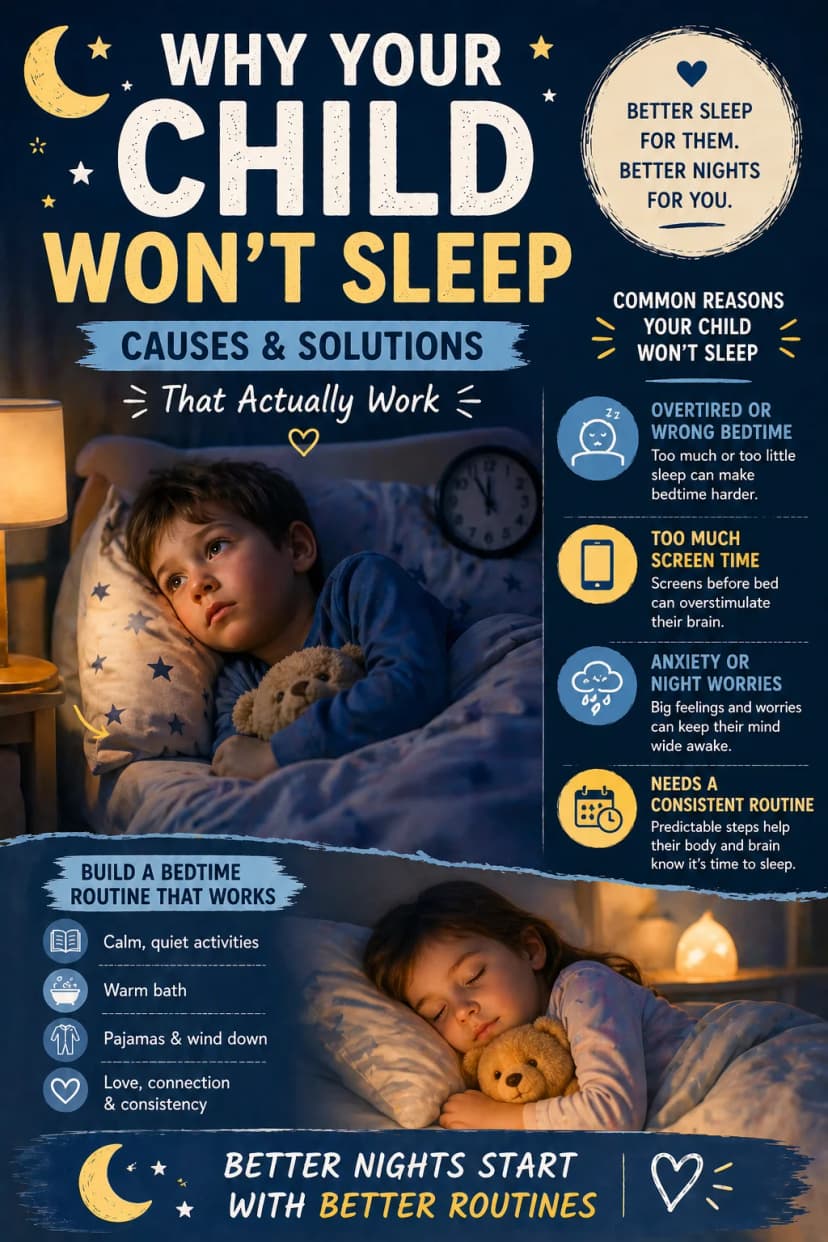
Why Your Child Won't Sleep: Causes & Solutions

Written by Nia Lark
Published
It is nine-thirty at night. Your child has asked for water, announced that their leg feels funny, remembered an urgent question about sharks, requested a fourth story, and appeared at your bedroom door twice already. You are tired in a way that has no adequate word for it. And tomorrow night it will happen again.
Children who will not sleep, or who wake repeatedly through the night, are one of the most common and most exhausting challenges in family life. The effects ripple outward: into your own health, your mood, your relationship, your capacity to parent well the following day. And yet the advice available is often either too rigid, too vague, or written by someone who has clearly never tried to reason with a determined four-year-old at half past ten.
This guide is a practical one. It covers how much sleep children genuinely need at different ages, the most common reasons sleep breaks down, how to build a routine that actually works, and what to do when specific problems like night waking, early rising, or relentless bedtime resistance are making your evenings feel like a battle you are losing. It will not promise miracles. But it will give you a clear map.
How Much Sleep Do Children Actually Need?
One of the first things worth establishing is whether your expectations are aligned with what your child's developing brain and body genuinely requires, because sleep needs change significantly across childhood and are often either over- or underestimated by parents.
Newborns sleep somewhere between fourteen and seventeen hours in every twenty-four-hour period, though this is distributed across multiple short stretches rather than one long overnight block. Expecting anything resembling a consolidated night at this stage is, unfortunately, a recipe for disappointment. By around three to six months, many babies begin to develop longer overnight stretches, though this varies enormously.
Toddlers between one and two years old typically need eleven to fourteen hours across the day, including one daytime nap. Between two and three years, many children begin to drop their nap, which often temporarily disrupts night sleep as their bodies adjust. Three to five year olds need roughly ten to thirteen hours overnight. Children aged six to twelve need between nine and eleven hours. Teenagers, contrary to popular assumption, need eight to ten hours and their biological sleep timing genuinely does shift later, meaning their difficulty falling asleep early is neurological rather than defiant.
If your child is consistently getting significantly less than these amounts and struggling during the day as a result, sleep is a priority worth addressing. If they are sleeping at the lower end of the range but seem well-rested, alert, and emotionally regulated during the day, they may simply need less than the average, which is also entirely normal.
Why Children's Sleep Matters More Than Tiredness
The effects of inadequate sleep on children extend well beyond the obvious tiredness that follows a difficult night. During sleep, and specifically during deep sleep stages, the brain does the majority of its critical housekeeping: consolidating memories, processing learning from the day, and clearing metabolic waste products that accumulate while the brain is active. Growth hormone is also primarily released during deep sleep, which is why the old idea that children grow in their sleep is not just a saying.
Chronically sleep-deprived children show measurably reduced attention, slower information processing, and weaker emotional regulation. They are more reactive, more prone to tantrums, less able to manage frustration, and more vulnerable to anxiety. Many children who present with apparent behaviour problems or attention difficulties at school are, at least in part, simply deeply tired. Improving their sleep often produces visible improvements in mood, behaviour, and learning without any other intervention.
For parents, the connection between your own sleep and your capacity to parent is equally real. Parenting on chronic sleep deprivation is genuinely hard in ways that are not a character failing. Addressing your child's sleep is, among other things, an act of self-preservation.
The Most Common Reasons Children Will Not Sleep
Sleep difficulties in children rarely have a single cause, and understanding what is driving the problem in your particular child is the first step toward solving it. These are the most frequently encountered reasons.
They Have Not Yet Learned to Fall Asleep Independently
This is the most common root cause of both bedtime resistance and night waking in young children. Falling asleep is a skill, and children who have always been fed, rocked, or held to sleep have learned to associate sleep onset with those conditions. When they reach a lighter sleep stage in the night, which all humans do multiple times, they cannot drift back to sleep without recreating the same conditions. So they call out, come in, or simply wake fully and need you again.
This is not a failure of parenting. Many of the things that help babies and young children feel safe enough to sleep in the early months, feeding, rocking, co-sleeping, are the same things that can later become obstacles to independent sleep. There is no single right approach, but if night waking or bedtime dependency is the problem you are dealing with, the solution almost always involves gradually shifting the conditions under which your child falls asleep in the first place.
Their Bedtime Is Too Late or Too Early
Both of these create sleep problems, though in different ways. A child who is put to bed too late is often overtired, and overtiredness in children produces cortisol, a stress hormone that makes it harder, not easier, to fall asleep. The result is a wired, restless child at the very moment you most need them to wind down. A child who is put to bed too early, before they are genuinely sleepy, simply lies awake, which creates frustration for everyone and can develop into a conditioned wakefulness around bedtime.
Finding the right sleep window for your individual child, the period when they are tired enough to fall asleep but not yet overtired, takes some observation and sometimes some trial and adjustment. Signs of the right window include slower movements, quieter play, eye rubbing, and a general softening of energy. Signs of overtiredness include a second wind of hyperactivity, irritability, and difficulty settling.
There Is Too Much Screen Time Before Bed
The blue light emitted by screens suppresses melatonin production, which is the hormone that signals to the body that it is time to sleep. Even thirty to sixty minutes of screen exposure close to bedtime can delay melatonin onset significantly, pushing back the point at which a child can realistically fall asleep. Beyond the light itself, the content of screens, particularly fast-paced, stimulating, or emotionally engaging content, activates the nervous system at precisely the point when it needs to be winding down.
A screen-free window of at least an hour before bed, and ideally ninety minutes, makes a meaningful difference for most children. This is one of the most consistently evidence-supported recommendations in paediatric sleep, and also, admittedly, one of the most contested at home.
They Are Anxious or Worried
Bedtime is the moment when the distractions of the day fall away and children are left alone with their thoughts. For anxious children, this is when worries surface with full force. The requests for one more story, one more glass of water, one more cuddle are often not manipulation. They are genuine attempts to delay the moment when they have to lie in the dark with whatever is worrying them.
School-related worries, friendship concerns, family changes, or a scary programme seen at a friend's house can all surface at bedtime. A brief, low-key check-in during the bedtime routine, not an interrogation but a simple open invitation, gives children a chance to voice worries before they take hold in the dark. \"Is there anything on your mind tonight?\" asked in a relaxed, genuinely curious way costs almost nothing and sometimes opens conversations that would never happen otherwise.
The Sleep Environment Is Not Conducive to Rest
Temperature, light, noise, and comfort all affect sleep quality significantly. The optimal sleep temperature for children is slightly cooler than most adults assume, around sixteen to eighteen degrees Celsius. A room that is too warm disrupts deep sleep stages and increases night waking. Light seeping under curtains can interfere with melatonin production and cause early waking. Noise that is intermittent and unpredictable is more disruptive than consistent background sound, which is why white noise or a quiet fan can actually improve sleep for some children by masking variable environmental noise.
It is also worth checking the basics: is the mattress comfortable, is the bedding appropriate for the season, is the room genuinely dark when the lights go off? Small environmental factors that adults adjust for automatically can have an outsized effect on children's sleep.
They Are Going Through a Developmental Leap or Life Change
Sleep often regresses during periods of significant development or life change. Starting school, the arrival of a sibling, moving house, a change in family structure, a new friendship difficulty, or even a developmental leap in cognitive ability can all temporarily disrupt established sleep patterns. These regressions are normal, almost always time-limited, and generally respond well to extra reassurance and consistency rather than significant changes to the routine.
How to Build a Bedtime Routine That Works
A consistent, predictable bedtime routine is the single most evidence-supported tool for improving children's sleep across all ages. The routine works because it acts as a series of biological and psychological cues, signalling to the brain and body that sleep is approaching. Over time, the routine itself triggers the physiological preparation for sleep: melatonin begins to rise, core body temperature begins to drop, and the nervous system begins to shift toward rest.
The most effective routines are roughly thirty to forty-five minutes long, consistent in sequence even if not always in timing, and end in the child's own sleep space rather than being carried or transferred after they have already fallen asleep elsewhere. They move from stimulating to calm, from communal to solitary, and from light to dark.
A routine that works well for many families runs something like this: a bath or wash to lower core body temperature and signal the transition from day to night; a change into pyjamas and a quiet, predictable activity like tidying toys or choosing tomorrow's clothes; moving to the bedroom for stories read in a calm voice by lamplight rather than overhead light; a brief check-in about the day or any worries; a consistent closing ritual such as a song, a particular phrase, or a simple breathing exercise; and then lights out with the parent leaving the room while the child is still awake but calm and settled.
That last part matters enormously. A child who falls asleep while you are still present has not learned to fall asleep independently. The routine should end with them awake but drowsy, so that the actual transition into sleep happens without you. This is the foundation from which everything else builds.
Addressing Specific Sleep Problems
Bedtime Resistance
Children who fight bedtime are usually either not tired enough, overtired, anxious, or have learned that resistance is effective because it results in more parental presence. The most useful responses are ensuring the bedtime is appropriately timed, keeping the routine consistent and calm without engaging in extended negotiation, and using a visual bedtime chart for younger children that makes the sequence of events predictable and non-negotiable. Giving children a limited degree of control within the routine, choosing which pyjamas, which two stories, which soft toy comes to bed, also reduces the power struggles that tend to cluster around bedtime.
Night Waking
Frequent night waking in children past infancy is almost always rooted in a sleep onset association, the need to recreate the conditions present when they first fell asleep. The solution, though it requires patience, is relatively consistent: teach independent sleep onset at the start of the night and the night wakings typically reduce or resolve on their own within a week or two. If night waking continues despite independent sleep onset, it is worth checking the sleep environment, ruling out physical causes such as sleep apnoea or restless legs, and ensuring daytime nap timing is not interfering with overnight sleep drive.
Early Rising
A child who consistently wakes before six in the morning is one of parenting's more brutal challenges. Early rising is often caused by one of a few things: the bedroom becoming light too early, which blackout blinds can resolve; the child going to bed too late, which counterintuitively results in earlier waking due to accumulated sleep pressure dysregulation; or the child simply being a natural early riser whose circadian rhythm runs ahead of the household. For genuine early risers, gradually shifting the entire sleep schedule fifteen minutes later every few days can help, as can using a visual clock that signals when it is acceptable to get up.
Nightmares and Night Terrors
These are often confused but are actually very different. Nightmares occur during REM sleep, typically in the second half of the night, and the child wakes from them distressed, remembers the dream, and needs comfort and reassurance before they can resettle. The appropriate response is calm, warm presence, brief reassurance, and a return to sleep. Night terrors occur during deep non-REM sleep, usually in the first few hours of the night. The child appears awake and may be screaming or agitated, but is actually still asleep, does not respond to comfort, and has no memory of the episode the following morning. The appropriate response to a night terror is to stay nearby to ensure safety, avoid trying to wake the child, and wait for it to pass, which usually takes between five and fifteen minutes.
What Not to Do When Children Will Not Sleep
A few common responses to children's sleep difficulties are understandable in the moment but tend to compound the problem over time. Engaging in extended bedtime negotiations teaches children that persistence is rewarded. Returning repeatedly to the room for brief interactions keeps the nervous system activated rather than allowing it to settle. Co-sleeping as a solution to night waking, while sometimes a reasonable choice made consciously and on the parents' terms, can become an inadvertent long-term sleep association when it happens reactively at two in the morning.
It is also worth being cautious about frequently varying the routine in an attempt to find something that works better. Consistency is the mechanism through which bedtime routines build the biological sleep cues that make them effective. A routine that is changed every few days never has the opportunity to become a genuine sleep trigger.
And, perhaps most importantly: avoid what sleep specialists sometimes call \"catastrophising the waking.\" When a parent responds to night waking with significant anxiety or frustration, children pick up on that state and their own nervous systems activate in response, making resettling harder. A calm, matter-of-fact response, \"It is sleep time, I love you, goodnight,\" delivered with confidence and warmth, is the most effective emotional tone even when it is the last thing you feel capable of at two in the morning.
Frequently Asked Questions
Is it okay to let my child cry it out?
Graduated extinction methods, which involve allowing children to settle with progressively longer intervals before parental check-ins, have been studied extensively and the research does not support concerns about long-term harm to attachment or emotional wellbeing when used appropriately. That said, there is no single right approach to sleep training, and any method that works for your family without leaving you or your child in significant sustained distress is a reasonable choice. What does not work, for most families, is doing nothing and hoping the problem resolves itself, because without some form of intervention, most sleep difficulties in children do not self-correct.
My child sleeps well at night but will not nap. Is that a problem?
It depends heavily on age. Most children naturally drop their daytime nap somewhere between two and a half and four years, with significant individual variation. A child who has dropped their nap but is getting sufficient overnight sleep and coping well during the day has simply reached that milestone. The transition period can be eased with a quiet rest time after lunch, lying down with books or calm activities, which helps manage the energy dip that persists even after the nap is gone.
Should I use melatonin supplements to help my child sleep?
Melatonin is available on prescription in the UK for children with certain conditions, particularly ADHD and autism spectrum disorder, where sleep difficulties are very common. It is not recommended as a general solution for typical childhood sleep problems, and should not be used without medical guidance. In most cases of typical childhood sleep difficulty, improving sleep hygiene, establishing a consistent routine, and addressing the underlying cause of the problem is both safer and more effective than supplementation.
How long will it take to see improvement once I start working on sleep?
Most families see meaningful improvement within one to three weeks of consistently applying a good bedtime routine and addressing the specific root cause of the problem. The first few nights are typically the hardest, as children test the new pattern against the old one. Consistency during this period is critical. Giving up after two or three difficult nights resets the process and teaches the child that persistence eventually returns things to how they were. If there is no meaningful improvement after three to four weeks of genuine consistency, it is worth speaking to your GP, who can rule out underlying causes and consider a referral to a paediatric sleep specialist.
The Bottom Line
Children's sleep problems are extraordinarily common, often solvable, and almost always feel worse than they are in the midst of them because you are dealing with them while exhausted. The combination of a well-timed, consistent bedtime routine, the right sleep environment, an understanding of what is driving the specific problem you are dealing with, and the patience to hold the new approach long enough for it to take effect is the framework that works for most families, most of the time.
It will not fix itself overnight. But it will get better. And on the night your child finally falls asleep quickly, stays asleep, and appears at breakfast rested rather than wrecked, it will feel like something genuinely remarkable, because it is.