

Seventeen Volumes
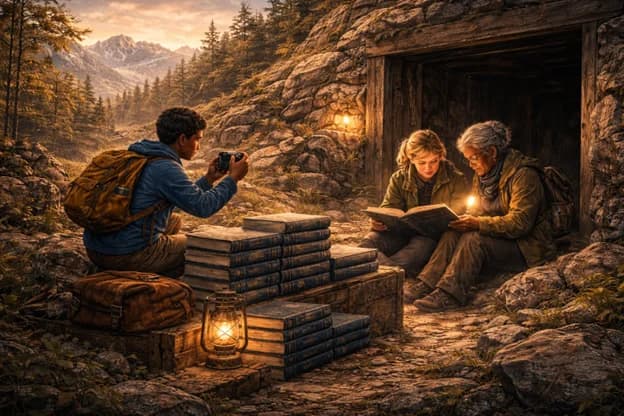
The seventeen survey volumes were each approximately two centimetres thick, bound in dark blue cloth with gilt lettering on the spine giving a volume number and date range. The geological survey of the Gåsevann ore body, prepared by the company's chief geologist between 1921 and 1934, was the most complete record of the mountain's underground structure that had ever been made, and it had been sitting in the dark for ninety years waiting for someone to open the door.
Nana Adwoa sat on a flat stone outside the store entrance and worked through the first volume with the focused concentration of an engineer reading technical documentation, while Ingrid sat beside her and translated the Norwegian passages that Nana Adwoa's own Norwegian did not fully cover, and Kwame organised the remaining volumes into order and photographed the covers and first pages of each.
The survey was comprehensive. It documented the ore body's extent in three dimensions through a combination of borehole records, underground mapping, and surface geological analysis. The ore body was not a small deposit. It was, according to the survey's final summary volume, which Kwame located by checking the spines, a significant iron ore body of high grade ore, extending through the mountain on a north-south axis for approximately four kilometres and reaching a depth of over three hundred metres at its southern end.
The mine had extracted ore from the northern, shallowest section only. The deeper, larger part had never been touched.
"He was right," said Ingrid, reading the summary volume over Kwame's shoulder. "The mine manager. He was right that the decision was made too early."
"In 1934 it probably would not have made a difference," said Nana Adwoa. "Iron ore prices at that point made most small operations uneconomic. But these records." She paused. "These records have scientific and historical value that is completely independent of the commercial question. This is a complete geological survey of a significant ore body, prepared with nineteenth-century precision, by hand, over thirteen years. This is an extraordinary scientific document."
"Who should have it?" Kwame asked.
"The Norwegian Geological Survey," said Nana Adwoa. "Norges geologiske undersøkelse. They maintain the national archive of geological records. This belongs there." She looked at the volumes. "And the railway and the mine site should be assessed for industrial heritage status.
This is a completely intact narrow-gauge industrial railway with its terminus mine preserved in working order. That is..." She looked around the site, at the headframe and the ore crusher and the silent track. "That is extraordinarily rare."
"My father will know who to contact," said Ingrid. "He is on the local cultural heritage committee. He has been trying for years to identify significant industrial heritage sites in this region." She looked at the buildings, the track, the sealed store. "I think he will find this quite significant."
"How did you know?" Kwame asked her. "About the ore crusher, the mine equipment. Your great-grandfather."
Ingrid was quiet for a moment. She was looking at the headframe, the tall timber structure above the main shaft. "He worked here," she said. "At this mine. I did not know until you started describing the location this morning. When you said the narrow-gauge railway two kilometres north of the old station, I began to think it might be. And when we found the rails." She paused.
"His name was Magnus Solberg. He was twenty-three when the mine closed. He went south and found work on the railway, which is how my family ended up in this region." She looked at the ledger. "His name might be in there."
Kwame opened the shift log and handed it to Ingrid.
She turned through the pages slowly, running her finger down the columns of worker names.
And then she stopped, and her finger rested on a line, and she was quiet for a moment.
"Third shift, ore processing," she said, very quietly. "Magnus Solberg." She looked at it. "He worked the third shift. All through 1932 and 1933 and into 1934."
Kwame said nothing. He thought about the right thing to do when someone finds their great-grandfather's name in a ninety-year-old document, and decided the right thing was to give them a moment.
Ingrid closed the ledger. She was very composed, in the way of someone who feels things deeply and has been brought up not to make a fuss about it.
"He never talked about this place specifically," she said at last. "Only about the mine in general.
The work, the cold, the comradeship. He said it was hard and good at the same time."
"The hard and good thing seems to happen a lot up here," said Kwame, thinking of his grandmother and the key she had carried for thirty-four years.
Ingrid almost smiled.
They stayed at the mine site until mid-afternoon, completing the documentation with Nana Adwoa's camera and Kwame's systematic listing, which was a skill he had not known he possessed until this trip and which his grandmother said was an engineering instinct and entirely hereditary. They did not remove any of the survey volumes from the store but photographed
every volume's cover and a selection of pages from the summary volume, and Nana Adwoa made notes that she said were sufficient for a preliminary report.
Before they closed the store, Ingrid stood in the entrance for a moment.
"He stood here," she said. "Or somewhere very near here. Doing his shift."
"Yes," said Kwame.
"I'm glad we found it," she said. "I'm glad someone will know about it properly now."
She stepped back and Kwame lowered the iron bar into its brackets, and they walked back down the mountain along the narrow-gauge rails in the long afternoon light, with the mountains around them and the valley below and the old track running faithful and straight underfoot.