

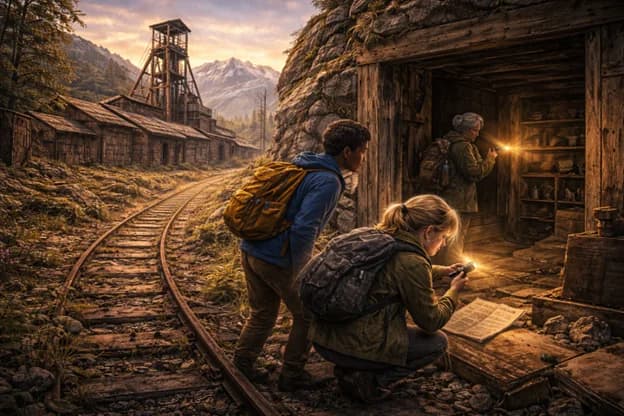
The Mine at the End of the Line
The old railway ran for approximately three kilometres from the boulder to the mine, gaining height steadily. The rails were intact throughout, though in one section near the top they had been partially buried by a small landslide and had to be dug out slightly to confirm continuity. Nana Adwoa photographed everything: the rails, the occasional surviving sleepers, a section of dry stone walling that had supported the track bed on a steep traverse, and the remains of a small intermediate structure, a passing loop where two trains could have crossed, its double track and buffer stops still in place and identifiable.
Kwame carried the equipment bag and walked at the back, and Ingrid moved between him and Nana Adwoa, watching the ground and the landscape with the alert attention of someone reading a text. She pointed out things Kwame would have missed: a row of anchor bolts in bare rock where a bridge had once carried the line across a gully, the remains of a wooden post that had been a gradient marker, a section of track where the rail had been bent slightly by a boulder fall and repaired with a fish plate, still in place.
"Someone maintained this well," she said. "The repairs are careful. They were proud of this line."
"Mine railways in this period were significant infrastructure," said Nana Adwoa. "For the communities that depended on them, this line was everything. It brought in supplies, it took out ore. When it closed it would have been a significant loss."
"What was the mine extracting?" Kwame asked.
Nana Adwoa looked at Harald's map. "Iron ore, primarily. There were a number of small iron ore operations in this region in the early twentieth century. Most of them proved uneconomic once larger operations began in Kiruna and Narvik and were able to undercut them."
"They closed because they became unnecessary," said Ingrid. "Not because the ore ran out."
"That is usually how it goes," said Nana Adwoa.
The mine appeared ahead of them around a long curve: first the grey waste heaps, slopes of broken rock spreading down the hillside in a fan, then the headframe of the main shaft, timber and iron, remarkably intact, and then the cluster of buildings around it, low and solid, built from stone and corrugated iron, some still roofed and some open to the sky.
They stopped at the edge of the site and looked.
It was not a large operation by any measure, four or five main structures and a network of smaller outbuildings, but the preservation was extraordinary. The dry mountain air and the
absence of any human interference for ninety years had kept it in a state that went beyond ruin and into something else, something closer to suspension. The headframe had lost several planks and the metalwork was deeply rusted but the structure was still upright. The largest building, which Nana Adwoa identified as the ore processing shed, still had most of its roof. The track ran directly into its ground floor through a wide opening, and inside, visible from the entrance, was a piece of mine equipment that Kwame could not immediately identify.
Ingrid identified it. "An ore crusher," she said. "For breaking the ore to a standard size before loading. That one is belt-driven." She pointed to a large flat wheel mounted on a shaft. "The belt would have run to a water wheel or a small engine."
Kwame looked at her. "How do you know that?"
"My great-grandfather worked in a mine not unlike this one," she said simply. "He talked about it."
Nana Adwoa was moving carefully around the site, photographing and making notes. She stopped at the main building and examined the doorway, which was still intact with its original door, a heavy plank construction on iron hinges that had swollen into its frame but was not locked.
"There will be records inside," she said. "Mine operations kept detailed records. Ore grades, shift logs, equipment lists. If the building is weathertight, they may have survived."
"Is it safe to go in?" said Kwame.
Nana Adwoa tested the doorway, the surrounding structure, the condition of the visible ceiling.
"The front section should be stable," she said. "We stay near the entrance and do not go further than we can see clearly."
Inside the main building it was cool and dim and smelled of rust and old wood and something mineral and clean. The ore crusher occupied most of the floor space, massive and still, its components perfectly in place as if waiting for someone to restart the engine. Against the far wall of the entrance section, on a shelf above a workbench, was a row of ledgers.
Kwame crossed to them carefully, testing each floorboard before stepping. The ledgers were water-stained on their outer edges but the pages inside, when he opened the first one, were legible. The handwriting was in Norwegian, a different hand from Harald's, and the entries were operational: dates, ore tonnage, shift workers, equipment maintenance.
He carried the ledger to the doorway where the light was better and Ingrid looked at it beside him.
"This is the mine manager's log," she said. "From 1929." She turned the pages forward. "The last entry is 1934. October. He writes..." She read carefully. "He writes that the operation is closing at the end of the month. That the decision was made by the company board in Oslo. That he disagrees with the decision but has no choice." She turned the page. "And then one more entry, a week later. He writes that he has sealed the equipment and the records. He writes that the ore body is still significant and that someone will come back for it." She paused. "He writes that he is leaving the railway in working order because he believes the mine will reopen within ten years."
"It never did," said Kwame.
"No," said Ingrid quietly. "It never did."
Nana Adwoa appeared in the doorway. "There is something else," she said. "Come outside."
She led them around the back of the main building to a section of the site they had not yet looked at, where the mountainside rose steeply behind the buildings. Cut into the rock face, sealed with a wooden door in far better condition than any other timber on the site, was a tunnel entrance about two metres high and wide enough to drive a small vehicle through. Mounted on the wall beside the door was a metal plate with words in Norwegian.
Ingrid read it. "It says, Materials and Equipment Store Number One. Access to authorised personnel only. In case of closure, refer to Mine Manager."
"A sealed equipment store," said Nana Adwoa. "Cut into the rock. That is why the timber is in good condition. It has been protected from the weather by the rock above and around it."
"And it has been sealed since 1934," said Kwame.
He looked at the door. Then at the ledger in his hands. He turned to the last entry again and read it, Ingrid translating in a murmur: sealing the equipment and the records, leaving the railway in working order, believes the mine will reopen.
"He left instructions," Kwame said slowly. "He said refer to the mine manager. Is there anything in this ledger about the store?"
Ingrid turned pages back through the final months. Near the very last operational entry, she found it: a paragraph in smaller writing, a list, and at the end of the list, a note.
"The store contains the survey records," she read. "The complete geological survey of the ore body, all seventeen volumes, prepared between 1921 and 1934. He says the survey documents a significantly larger ore body than was ever mined. He says the company board made their decision based on short-term economics and did not take the survey into account." She looked
up. "He says the survey proves the mine was closed too early. He says whoever finds this should know that."
Kwame looked at the sealed door. He looked at his grandmother.
"Can we open it?" he said.
Nana Adwoa examined the door closely. It was not locked, she found, but merely latched from the outside with an iron bar dropped into brackets. The iron was rusted, but it moved when she and Kwame lifted it together, and the door swung outward stiffly.
Inside was darkness and cold air and the smell of stone and dry timber, and when Kwame shone his torch in, the beam caught the edges of shelves, rows of them, and on the shelves, in wooden cases, a collection of documents that ninety years of sealed, dry mountain air had kept as perfectly as the amber had kept its lizard.