
What Remains
The manuscript was formally returned to the county archive in December and entered into the catalogue under its correct reference number, with a supplementary note documenting its history: the original donation in 1985, the removal by Patricia Voss in 1987 and her reasons for it, the period in storage, and its return in the current year.
The note was written by Mr Davies, but he asked Nina and Asha to review it for accuracy, which they did.
The rights question was referred to the archive's legal advisors, who established within three weeks that Meridian Music had been dissolved in 2003 and had not transferred its claimed rights to any successor company at dissolution. The claim, which had been of questionable legitimacy to begin with, had effectively lapsed. The manuscript was confirmed as belonging to the public domain.
Oscar's dad, who had been consulted informally, said this was the cleanest possible outcome and that Patricia Voss's instinct had been correct even if her method had been imperfect.
Nina heard all of this on a Tuesday evening in December, standing in the school music corridor after a late rehearsal, her violin case on her shoulder, the building quiet around her.
She thought about what came next.
She went to Mr Yeboah's room and knocked.
He was still there, which she had known he would be. He stayed late on Tuesdays.
"The manuscript is back in the archive," she said. "The rights question is resolved. The music is publicly accessible."
He looked at her for a moment. Then he said: "And?"
"I want to learn it," she said. "The forty-seven pages. I want to play it as Miriam wrote it."
"It's incomplete," he said.
"I know," she said. "I want to play it incomplete."
He looked at her steadily. "That is a specific artistic choice," he said.
"It's the right one," she said. "She wrote nearly there above the last bar. It feels wrong to finish something she stopped at."
He was quiet for a moment. "There are musicians who make careers of performing unfinished works as they stand," he said. "Schubert's Unfinished Symphony. Mozart's Requiem, in some versions. The incompleteness is part of the truth of the piece."
"Yes," Nina said. "That's exactly what I think."
He looked at the ceiling briefly, which was his thinking gesture. "I know a chamber group," he said. "Professional, but sympathetic to unusual projects. They've performed rediscovered works before. If we prepared the score properly, made a clean edition, they might be interested."
"Would you help?" she asked.
"Yes," he said, without hesitation. "This is exactly the kind of project I became a music teacher to be part of."
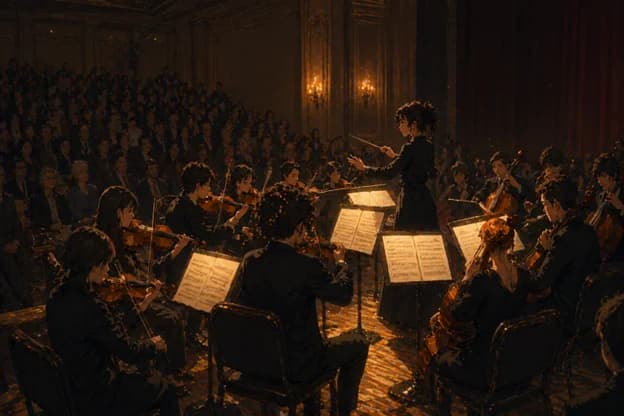
The concert happened in March, at the town's music centre.
Nina had spent three months working on the score with Mr Yeboah and the chamber group's director, a violinist named Sarah Chen who had brought both expertise and genuine enthusiasm to the project. The forty-seven pages had been transcribed into a clean printed score, with Miriam's annotations faithfully reproduced and the incompleteness left intact. The programme notes, written by Nina and Asha together, told the story of the manuscript: Miriam Alderton, her composing life, the unfinished piece, Patricia Voss's decades of keeping it safe, and its eventual return.
Nina sat in the front row of the audience and heard the music she had been hearing in her head since October played by a full string ensemble in a concert hall.
It was everything she had heard in that small practice room, multiplied. The unusual intervals that resolved into something right once you found the angle. The two themes she had been given under the practice room door, developed and transformed across forty-seven pages. The second theme, which Miriam had noted required each voice to be heard separately before the convergence.
And then the ending: not a conclusion, but a stopping. The music simply halted, in the middle of a phrase, on a note that pointed toward a resolution it did not reach.
The audience was silent for several seconds after the last note.
Then they applauded.
Nina looked along the row to where Asha was sitting. Asha was not applauding yet. She was looking at the stage with the specific expression of someone hearing something they had not expected to feel as much as they felt it.
Nina understood the expression. She had been feeling it for five months.
She thought about a fragment of music placed under a practice room door by someone who was not sure who to trust, and about the question written below it: Do you know what this is?
She had not known then. She knew now.
She thought: it was a beginning. A beginning placed in the hands of someone who would follow it to wherever it needed to go.
She thought about Miriam Alderton writing nearly there and never getting there, and about whether that mattered. She had written forty-seven pages of something genuine and extraordinary. The not-quite-arriving was part of it. The piece had arrived at exactly the place it had arrived at, which was its own kind of truth.
The applause was still going. The musicians stood at the front of the stage. Sarah Chen, who had given the project six months of serious attention, caught Nina's eye from across the hall and nodded once.
Nina nodded back.
Outside, the March evening was cold and clear. She would walk home and hear the music in her head all the way, the way good music sat with you after a performance. She would hear it for days, possibly.
She thought: this was why you paid attention. This was why you followed the small signal to wherever it led. Because sometimes it led here.
She stood and joined the applause.
The musicians took their bow.
The hall was full of the sound of people acknowledging something worth acknowledging.
And Miriam Alderton's music, nearly there and stopping there, hung in the air above it all, exactly as it was, exactly as it had always been, waiting for exactly this.