The Island Summer
The ferry to Carrow Island took twenty-two minutes from the mainland and ran four times a day in summer, twice a day in autumn, and once a day in winter when the weather permitted, which it frequently did not. Lena Vasic had made the crossing forty-three times in her life, which she knew because she had counted, beginning the summer she was six and her family had started renting the same cottage on the island every August.
She was fourteen now and the counting had become a habit rather than a necessity, the way habits did when you'd had them long enough.
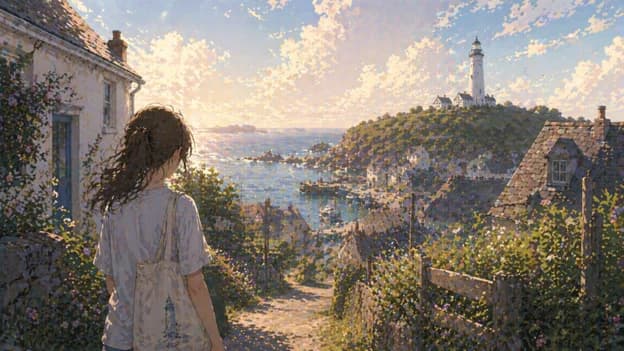
Carrow Island was two miles long and roughly one mile wide, with a village of about eighty permanent residents, a harbour, a post office that also sold groceries, a pub that tolerated children until eight o'clock, and a lighthouse at the northern tip that had been automated since 1987 and was now maintained by a heritage organisation that ran occasional tours in summer. The island had no secondary school, which meant the children of permanent residents took the ferry to the mainland every weekday during term time, a fact Lena had always found extraordinary and which the island children themselves treated as entirely unremarkable.
The lighthouse had always been at the edge of Lena's interest without quite being at the centre of it. She had done the tour twice, once with her parents when she was eight and once by herself at twelve. She knew its height and its light pattern and the basic facts of its operation. She had read the information boards and found them, as information boards generally were, informative rather than interesting.
What changed things was the logbook.
She found it on the fourth day of the August holiday, in the second-hand goods box outside the post office. The box was a permanent feature of the island's informal economy: residents left things they no longer needed and visitors and locals took what they wanted, no money changing hands, operating on the general principle that everything would balance out.
The logbook was at the bottom of the box, under a folded waterproof jacket and a jigsaw with a possibly incomplete piece count. It was a thick book, dark green cover, the word LIGHTHOUSE
embossed on the front in faded gilt letters. She opened it.
It was a keeper's log. Handwritten entries, daily, covering dates from March 1962 to November 1978. Each entry followed a standard format: date, weather conditions, sea state, visibility, light operation notes, and then a section headed Additional Observations that varied in length from a single line to several paragraphs.
She stood at the post office box reading the first ten entries while a light rain started and then stopped again, the way Carrow Island rain did, briefly and without commitment.
The writing was clear and specific. The keeper had been someone who paid close attention to everything. The weather observations were detailed far beyond what duty required. The sea state descriptions were precise, the kind that suggested genuine knowledge rather than box-ticking.
The additional observations ranged from practical notes about the lighthouse mechanism to observations about bird migration patterns, the behaviour of the harbour seals that gathered on the rocks below the lighthouse, occasional notes about the island community, and once, in July 1966, a careful three-paragraph description of a ship he had been unable to identify, behaving in a way he found puzzling.
She took the logbook back to the cottage.
She read it for the rest of the afternoon, stopping only when her mum called her for dinner. By the time she put it down she had read eight years of entries and developed a strong sense of the person who had written them: careful, observant, genuinely interested in the world, with a precise and unsentimental writing style that she found very appealing.
She had also found, somewhere in the middle of 1971, the beginning of something that was not part of the standard log format.
Something she could not quite explain.
She went back to the beginning of what she had noticed and read it again more carefully.
In June 1971, the keeper had begun noting, in the Additional Observations section, references to a ship he called the grey vessel. The entries were occasional at first, then more frequent. Each one described the same thing: a ship, seen in the early morning or at dusk, at the edge of the light's range, that did not respond to signals, did not maintain a consistent course, and on three occasions appeared to be in a position that would have meant grounding on the rocks below the headland, before moving away without apparent damage.
The entries were written with the same calm precision as everything else in the log, which made them, Lena thought, more rather than less striking. There was no suggestion of fear or superstition. The keeper was documenting an anomaly in the same way he documented weather patterns or seal behaviour: as a thing observed, requiring explanation.
By August 1971 the entries had accumulated enough that the keeper had apparently begun his own investigation. He wrote: I have checked the coastal traffic reports for the mornings in question. No vessel matching the description was scheduled to be in this area on any of the cited dates. I have spoken to two fishermen who use the northern route regularly. Neither has seen the
grey vessel, though one reports an unusually strong current in that area on what may be the same dates.
In September 1971: I have attempted to photograph the vessel. The photographs show nothing.
The vessel is visible to the eye but produces no image on film. I am recording this because it is what I observed and I do not believe a log should omit observations because they are inconvenient to explain.
Lena read this entry three times.
She thought about a person whose professional commitment to accurate observation was so strong that they would record something they couldn't explain rather than leave it out because it was strange.
She thought: I want to know who this person was.
She wrote in her own notebook: Find out who kept the Carrow Island lighthouse log from 1962
to 1978.