

The Record That Remained
There were practical things to attend to.
The lighthouse log, Lena agreed with Donald, should go to the island's small heritage archive rather than staying in the post office box. Donald arranged this with the efficiency of someone who considered it should always have been there. The log was catalogued, placed in a protective cover, and shelved alongside the other lighthouse records.
Marta kept the personal notebook. It was family, she said, and Lena agreed.
Lena spent the last week of the holiday writing an account of what she had found, in the way she had learned this summer was the right thing to do with an investigation: document it, source it, make it available for anyone who came after and wanted to understand.
She wrote about finding the log, about the grey vessel entries, about Alistair Fenn's optical hypothesis, about the identification of the Maren Castle and the crew list. She wrote about Thomas Fenn, and about his son who had watched the water for seventeen years without fully admitting what he was looking for.
She did not try to resolve what the grey vessel was. She presented Alistair's hypothesis and the evidence for it and noted that the wreck of the Maren Castle had never been found and that some things could not be definitively closed. She thought this was honest.
She gave a copy to Marta, who read it carefully and said it was accurate and that she was glad it existed.
She gave a copy to Donald for the heritage archive.
She sent a copy to Dr Henley at the maritime museum, who replied to say she would add it to the file relating to the Maren Castle and the correspondence from Alistair Fenn.
The August holiday ended on a Sunday. She packed the cottage with her parents and carried her bag down to the harbour in the early morning, the island still quiet, the water flat and grey-green in the thin light.
She had made the crossing forty-four times now.
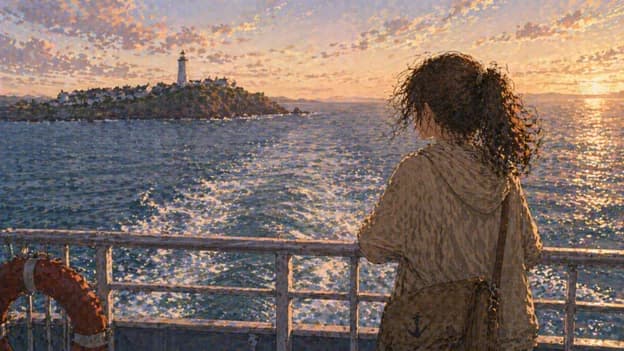
She sat on the ferry deck rather than going inside, which her parents accepted without comment because they had learned over fourteen years of August holidays that Lena leaving the island wanted to look at it from the water. The ferry pulled away from the harbour and the island receded, the lighthouse visible at the northern tip, its white tower catching the morning light.
She thought about Alistair Fenn standing in that tower at dusk and dawn for seventeen years, watching the water at the edge of the light's range. Patient, systematic, recording everything in precise professional language and everything else in a private notebook kept at the bottom of a wardrobe.
She thought about his father, Thomas Fenn, twenty-four years old in February 1932, going out on a winter morning in a steam trawler that did not come back.
She thought about light. About how it dispersed and scattered but did not cease to exist. About images formed in light and whether they persisted in some form, somewhere, in the atmosphere above the water where they had been made.
She thought: Alistair chose to believe it. That the light of that ship was still there. That he could see it, under specific conditions, from the lighthouse where he had chosen to spend his working life.
She thought: whether it was scientifically accurate or not, it was the truest thing available to him.
A way of keeping his father visible. A way of continuing to look.
The island was smaller now, the lighthouse a white point at its northern end. She watched it until the ferry rounded the headland and it disappeared from view.
She opened her notebook.
At the top of a new page she wrote: What I have learned this summer.
She looked at that for a moment.
Then she wrote: Accurate observation requires recording what you see even when you cannot explain it. The value of a record is not always immediate. Sometimes it waits decades to be read by the right person. Keep the record anyway.
She looked out at the water, which was open and wide and entirely itself, holding whatever it held.
She added: Some things are lost and not found. Some things are found in a form that is not the original thing but is still, in some way, the thing. The difference matters but it is not always clear which side of it you are on.
She closed the notebook.
The ferry moved steadily toward the mainland, across water that had been here long before anyone sailing it and would be here long after, patient and deep and full of its own history, most
of it never recorded, occasional pieces of it rising to the surface when conditions aligned and someone was watching carefully enough to see.
Lena Vasic, fourteen, going home from her forty-fourth crossing, watched the water all the way in.