

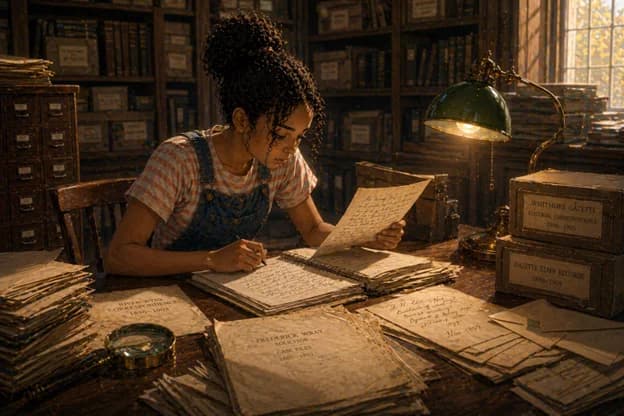
Frederick Wray's Last Letter
She went back to the archive the following weekend and asked specifically for records related to Frederick Wray, solicitor, active in Whitmore in the 1880s and 1890s.
There was a small collection. Wray had been a well-regarded local solicitor for thirty years. He had retired in 1910 and died in 1918. His professional records had been donated to the archive by his family in the 1960s and included correspondence, case files, and personal notes.
Iris went through the relevant period methodically.
She found what she was looking for in a file labelled River Wyne Correspondence 1896-1903.
Wray had not given up after his appeal was dismissed. He had spent seven years pursuing the matter through various channels: letters to the county council, correspondence with a member of parliament, an attempt to raise the issue in the local press. None of it had produced results.
The local press correspondence was particularly interesting. Wray had written to the editor of the Whitmore Gazette in 1899 with a detailed account of his allegations. The editor had replied, declining to publish on the grounds that the claims were unsubstantiated and potentially defamatory.
But attached to the editor's reply, in Wray's files, was a handwritten note in a different hand. It read: Mr Wray. I cannot publish this in the paper. But I believe you are correct, and I have evidence of my own which I have not known what to do with. Come and see me at the office after hours. Tell no one. J.H.
There was no further correspondence relating to J.H. in the file.
Iris turned the note over. Nothing on the back. She looked at the date: November 1899. She looked through the rest of the file. Nothing after November 1899 relating to the river issue. Wray appeared to have stopped pursuing it at that point.
She wrote in her notebook: J.H. had evidence. Wanted to meet in secret. No follow-up in the file.
Did the meeting happen? What was J.H.'s evidence? Why did Wray stop pursuing it after this?
She asked the archivist if there were other records relating to the Whitmore Gazette from this period.
There were. The Gazette's own archive was in the collection, including staff records from the late nineteenth and early twentieth century. The editor in 1899 was listed as one George Hemsley.
The deputy editor was listed as Jonathan Harker.
Iris stopped.
Harker.
She wrote it down and looked at it.
Jonathan Harker. Deputy editor of the Whitmore Gazette in 1899. And the note signed J.H. said: I believe you are correct, and I have evidence of my own.
Thomas Harker, the alderman who had benefited from the channelling project, was dead by 1899. Iris found his death record: he had died in 1898. Jonathan Harker would have been, she calculated from available records, his son or possibly his nephew.
A member of the Harker family had evidence of wrongdoing by another member of the Harker family and had contacted Frederick Wray in secret.
She looked at the note again. Come and see me at the office after hours. Tell no one.
She thought: did the meeting happen? What did Jonathan Harker know? And why, after this note, did Frederick Wray stop pursuing the case?
One of three things had happened, she thought. The meeting had not taken place. The meeting had taken place but Jonathan had changed his mind. Or the meeting had taken place and something had happened as a result that made Wray decide to stop.
She needed to find out which.
She found the answer in the Whitmore Gazette's own archive.
In December 1899, a month after the note to Frederick Wray, Jonathan Harker had resigned from his position as deputy editor. The brief staff record gave no reason.
In January 1900, a small notice in the Gazette's announcements column noted that J. Harker had joined a law firm in Bristol as a clerk.
He had left Whitmore. Abruptly, quietly, a month after writing a secret note to a solicitor saying he had evidence of his family's wrongdoing.
Iris thought about this for a long time.
She thought: he was frightened. He wrote the note, perhaps met with Wray, and then realised the risk to himself and left. Or someone found out he had contacted Wray and made it clear he should leave. Either way, he had gone, and with him whatever evidence he had.
She wrote: Jonathan Harker resigned and left Whitmore December 1899. One month after contacting Wray. Evidence never produced. Wray stopped pursuing the case.
She looked at her notes from beginning to end.
She had a fifty-pence map, an 1895 engineering project, a conflict of interest allegation, a dismissed appeal, a secret note, and a man who had left town with evidence that was never seen.
It was not, she thought, a solvable mystery in any conventional sense. The people were dead, the land was developed, the evidence was gone. But it was a story, a specific and documented story about something that had happened and had been suppressed. Frederick Wray had tried to tell it.
Jonathan Harker had tried to support him. Neither of them had succeeded.
She could tell it now.