

The Alderman and the Land
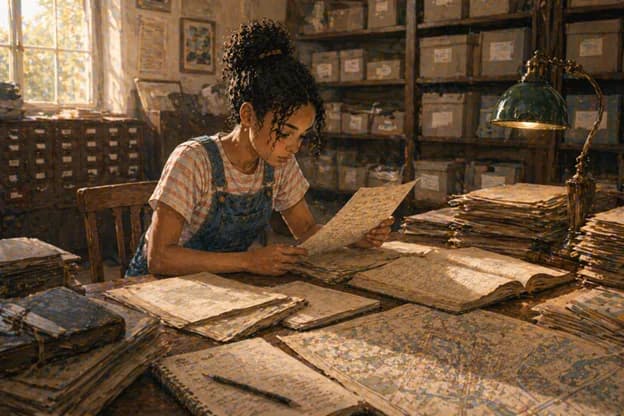
The county archive had records of the Whitmore Town Improvement Committee going back to its establishment in 1871. Iris went on the following Saturday, by herself this time, with the specific goal of understanding Thomas Harker and the 1893 to 1895 period.
What she found over three hours of careful reading was a picture that had several layers.
Thomas Harker had been a significant figure in late Victorian Whitmore: businessman, property owner, local politician. He had served on the Town Improvement Committee for eleven years and chaired it for four, including the period of the channelling project. He was described in contemporary newspaper accounts as energetic, ambitious, and controversial.
Controversial. She found this word in two separate accounts and followed both threads.
The first controversy was a planning dispute in 1889, four years before the channelling project, in which several local residents had objected to a development Harker proposed on the grounds that it would disrupt an existing watercourse. The objection had been overruled. The development had gone ahead.
The second was more interesting. In 1896, a year after the channelling project was completed and while development on the Harker Street land was underway, a local solicitor named Frederick Wray had submitted a formal objection to the Town Improvement Committee arguing that the channelling project had been approved without proper consideration of its impact on existing properties along the old river course, some of which had rights related to water access that the project had extinguished without compensation.
Wray had represented a group of smallholders and businesses whose properties had been adjacent to the old river course and who had lost water access rights that their properties had held for generations.
The objection had been dismissed. Wray had appealed. The appeal had also been dismissed.
Iris found a letter from Frederick Wray to the county council, dated 1897, which summarised his case:
The channelling project was presented as a matter of public benefit, and the flood management benefits, while real, were secondary to the primary effect: the creation of developable land along the old river course, from which the principal beneficiary has been Alderman Harker himself.
The affected smallholders have received nothing, while the Alderman's private wealth has increased substantially through the appreciation of land he acquired prior to the project's approval.
Iris read this carefully. It was not proof of wrongdoing in any legal sense. But it was a clear and detailed allegation, made by a professional person, with specific claims that could in principle be verified.
She photographed the letter and the surrounding documents.
She thought: someone in 1897 knew what had happened and tried to do something about it. He was overruled. The records of his objection had been sitting in this archive ever since.
She thought: what do I do with this?
She talked it through with her dad that evening.
He listened carefully, in the way he did when he thought something was worth his full attention.
He looked at the photographs of the documents on her phone.
"You've found evidence of what looks like a conflict of interest," he said. "A public official may have used his position to benefit his private property interests."
"A hundred and thirty years ago," Iris said.
"Yes." He looked at the letter from Frederick Wray. "This was already investigated and dismissed at the time. What are you hoping to do with it now?"
This was the question Iris had been asking herself. The people involved were long dead. The land was developed and had been for over a century. Whatever wrong had been done to the smallholders along the old river course was irreversible in any practical sense.
"I think it should be known," she said. "As a historical record. The objection was dismissed and then buried. Frederick Wray's letter is in an archive that almost nobody looks at. He tried to document what happened and nobody paid attention."
"And you want to pay attention."
"Someone should," she said.
Her dad looked at her for a moment. "Have you thought about who else might be interested in this? The hotel that was built on that land is still there. It's a significant local institution."
Iris had thought about this. "The current hotel isn't responsible for what happened in 1895," she said. "They just own a building. The history of the land before the building was built is history."
"That's a mature distinction," her dad said.
"I've been thinking about it," she said.
He handed her phone back. "You should write this up properly," he said. "As a historical account.
Document what you found and how. The local historical society, or the archive itself, might want it as a supplementary record to the existing documents."
"I thought the same thing," Iris said. "But I want to check one more thing first."
"What?"
"Frederick Wray submitted a formal objection in 1896," she said. "And an appeal in 1897. Both were dismissed. But I want to find out if he ever pursued it further. Whether anyone ever looked at this properly."
Her dad nodded. "Sounds right," he said. "Finish the thread before you write it up."