

Marcus and the Acoustic Theory
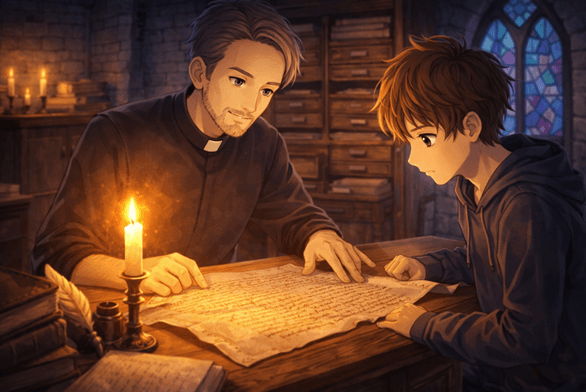
He told Marcus on Saturday afternoon, over Marcus's kitchen table, with the documents open between them.
Marcus was fourteen, studying for his Grade 5 music theory exam with the focused determination of someone who found written exams harder than practical ones, and his musical background turned out to be exactly what the investigation needed.
He looked at the Cross document and at Callum's notes and then looked up with the expression of someone who had just seen a connection.
"Acoustic architecture," he said. "It's a real thing. Ancient builders, not just medieval ones, some of the really ancient sites, understood acoustic properties of stone and used them deliberately. There are stone circles that create specific sound effects at certain times. There are chambers designed to amplify particular frequencies."
"Could someone build a resonance into a tower?" Callum asked.
"Potentially," Marcus said, with the careful qualification of someone who took accuracy seriously. "The dimensions of a space, the angles of the walls, the types of stone used, all of those affect how sound behaves inside it. If you knew what you were doing and you wanted a space to resonate at a specific frequency under specific atmospheric conditions, you could probably achieve it with enough knowledge and skill."
"In the twelfth century?"
"Medieval masons were extraordinary engineers," Marcus said. "They built things that are still standing nine hundred years later. Understanding acoustic properties of stone would not be beyond them." He paused. "The question is why. Why would they build a deliberate resonance into a bell tower?"
"They put their names into the stone," Callum said, quoting the translated document. "The sound is how they left a record of themselves."
Marcus was quiet for a moment. "So the tower is an instrument," he said. "Playing itself under certain conditions. Producing a sound that is specifically the product of those builders' knowledge and design."
"Yes," Callum said.
"And it's been doing this for nine hundred years," Marcus said.
"According to the records, yes."
Marcus looked at the documents. Then he looked at Callum with the expression of someone who had made a decision.
"I need to hear it," he said. "Tonight, if it's happening."
"I don't know when it happens," Callum said. "I've only heard it once, and it wasn't predictable."
"The Cross document said autumn evenings," Marcus said. "It's autumn. It's evening in three hours. We should be there."
Callum thought about the churchwarden's note from 1387, about the vicar from 1650 who had written that the sound increased when you were paying genuine attention. He thought about nine hundred years of builders waiting in the stone.
"Yes," he said. "We should be there."
They went to the churchyard at half past six, when the light was fully gone and the October air was cold and very clear. No wind, which Callum noted. Reverend Cole, whom Callum had messaged that afternoon, met them at the church door with a torch and his own coat done up against the cold.
"I want to hear it properly this time," the vicar said, without preamble.
They stood at the base of the north tower, the three of them, in the dark.
For a while there was nothing. The churchyard was quiet, the village beyond it quiet, the specific quality of silence that small places had at night, layered and full.
Then it began.
Low, sustained, pulsing. Coming from the stone itself, from the walls of the tower, as though the rock were vibrating at a frequency just at the edge of hearing. Callum watched Marcus's face and saw him go very still, the way musicians went still when they were listening hard.
The sound was not one tone but several, stacked and interacting, creating something more complex than a simple resonance. It rose and fell in its irregular pattern, varying in intensity, the different tones shifting in relation to each other.
"It's a chord," Marcus said quietly, after a while. "Not a simple one. Multiple frequencies, interacting. The stone is producing harmonics."
"What does it mean?" Callum asked.
"I'd need to measure it properly to be sure," Marcus said. "But it sounds like it has a fundamental frequency and at least three overtones. The pattern..." He listened for a while longer. "The pattern is not random. It's varying, but the variations are cyclic. It repeats, over a longer period than you'd notice if you weren't listening for it."
"How long?" Reverend Cole asked.
Marcus counted under his breath for a while. "Roughly seven minutes," he said. "A seven-minute cycle. Which is unusual enough to be deliberate."
They stood in the cold and listened through two full cycles. Nobody spoke. The sound continued its patient, irregular pulse, the stone speaking in the language the builders had given it nine hundred years ago.
Callum pressed his palm flat against the tower wall, the way people did when they wanted to feel something more directly than their ears alone allowed. The stone was cold. And beneath the cold, very faintly, the vibration.
He thought: they are still here. In the most literal possible sense. Their knowledge, their skill, the specific way they laid these stones and calculated these angles, it is still producing sound. They have been speaking, in the way they chose to speak, since 1140.
He thought: and we are only now, for perhaps the first time in a very long time, listening properly.