

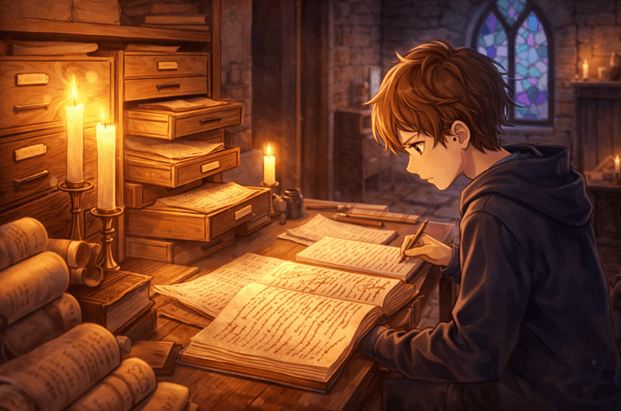
The Vestry Records
The vestry was a small room off the main body of the church, smelling of old wood and candles and the dusty specific smell of documents stored in a cool dry place for a very long time. The records were in a wooden cabinet with shallow drawers, each drawer labelled in different handwritings from different centuries.
Callum came on Thursday after school, and again on Saturday morning. He brought his notebook. He worked through the drawers systematically, starting with the oldest.
The church itself dated to the eleventh century, though the current building was largely twelfth and thirteenth century with later additions. The north tower was the oldest standing structure on the site, built in the 1140s, the records indicated, though the records for that period were fragmentary and had been summarised by later hands.
He found the first relevant reference in a document from 1387, a churchwarden's account that listed repairs to the tower and included, almost incidentally, a note about what the churchwarden called the tower's voice. The note read: The tower has spoken twice this year in the autumn manner, as is its custom in certain seasons. The ringers say this is the voice of those who built it. We do not contradict them.
The tone was matter-of-fact, not frightened, not curious. It was the note of someone recording a known and accepted feature of the building, like noting that the north wall was prone to damp.
He found another reference in the records of a vicar from the 1650s, more detailed. This vicar had clearly been interested and had written several pages about the tower sounds, which he described as occurring in autumn and occasionally in early spring, always at night or in the evening, always irregularly patterned. He had proposed several theories, all of them acoustic and structural, and had concluded without certainty that the phenomenon was produced by the interaction of the tower's particular stonework with specific atmospheric conditions.
But he had also added, almost as an afterthought: I note that the sound increases in apparent proximity when one is in a state of genuine attention. Whether this is a property of the sound itself or a property of the listener, I cannot determine.
Callum read that line twice. Then he wrote it in his notebook and underlined it.
The third reference was the most substantial. A document from 1801, written by a local schoolteacher named Samuel Cross who had apparently spent considerable time researching the tower. It was twelve pages long and covered the history of the tower in detail, drawing on earlier records and on interviews with older residents who had heard the sounds themselves.
Cross had found a tradition, going back as far as the oldest residents could trace, that the tower sounds were connected to the original builders. Not as a haunting, the tradition was clear on this point, but as a continuation: the builders had been a group of craftsmen who had worked on the tower over several years and had, according to the tradition, put something into the stonework intentionally. Not a physical object, not a hidden chamber, but something less tangible: a kind of resonance, built into the way the stones were laid, the angles at which they met, the particular dimensions of the internal spaces.
The tradition said: they built the sound into the stone, so that the stone would speak of them when the season was right.
Cross had been unable to verify this through any documentary evidence and had concluded his account with the admission that the explanation was beyond his means to confirm or deny. But he had added one more piece of information that Callum found extraordinary: he had located, in a private collection that had since been dispersed, a single document that appeared to date from the original construction period. The document was damaged and only partially legible, but Cross had transcribed what he could read. The relevant section said, in the archaic language of the twelfth century rendered into Cross's more modern translation:
We are the builders. We have put our names into the stone. Not written, not carved, but made into the manner of the building itself, so that those who come after and listen with care will hear us, as one hears the voice of a person in the room where they once lived, the shape of their presence remaining in the air.
Callum sat in the vestry with this document for a long time.
He thought: they designed it. They knew what they were building. They chose to make the tower speak.
He thought: that was nine hundred years ago.