

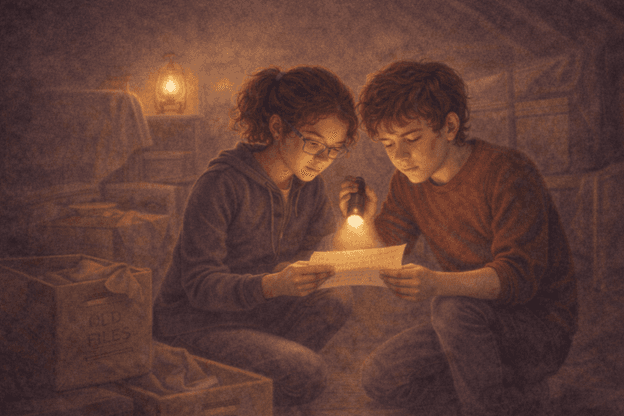
Edmund's Letter
Cecily arrived at five past eight with the punctuality of someone who had set two alarms. Theo's parents were both at the kitchen table, which was suboptimal. He introduced Cecily, who charmed them both within four minutes, which was not a surprise, and then suggested she and Theo do their homework upstairs, which was the kind of thing parents always found credible coming from Cecily.
In the hallway, Theo showed her the marks behind the photographs. She examined them closely and said nothing, which was her way of agreeing without making a production of it.
"I need something thin and flat to work along that seam," Theo said.
"Palette knife," Cecily said immediately. "Do you have one?"
"My mum does. She paints."
"Get it."
He got it without being asked what he needed it for, which he attributed to Cecily's earlier charm offensive. Back in the hallway, standing on the chair, he worked the thin blade gently along the seam in the cornice.
It was a panel. Small, roughly twenty centimetres by ten, set flush with the surrounding plasterwork and painted over so carefully that it was invisible unless you knew where to look. It came loose with almost no resistance, as though it had been designed to be opened rather than sealed.
Behind it was a cavity in the wall, about the depth of his hand.
Inside the cavity was a small tin.
He brought it down. Cecily was standing directly beneath him, her expression carefully neutral in the way it went when she was suppressing a significant reaction.
The tin was old, rectangular, the kind that might once have held tobacco or sweets. It was not locked. He opened it.
Inside, folded into a small square, was a letter. Several sheets of paper, covered in handwriting, the ink brown with age. He unfolded it carefully, hands steady, and began to read.
The handwriting was a young person's handwriting, careful but not fully formed, the letters slightly uneven in size.
To whoever finds this. My name is Edmund George Aldiss and I am fourteen years old. I am writing this because I need someone to know the truth of what happened, in case I am not able to say it myself. I am putting it here because my father built this house and I know where every secret space is, and I trust that whoever comes after will find it if they look.
The letter was four pages long. Theo and Cecily read it together on the hallway floor, passing pages between them.
Edmund had not disappeared. Edmund had run away, deliberately, with a plan. He had been witnessing something that frightened him: a dispute between his father and a local businessman named Croft, over a debt that Croft claimed George Aldiss owed him. The debt was fabricated, Edmund was certain of that, but Croft had documents, and Croft had influence, and Croft had made it clear that unless George paid, he would have him prosecuted on a false charge. Edmund had found the false documents in Croft's office, where he had gone to deliver a piece of furniture his father had made. He had taken them, meaning to show them to someone who could help. Croft had found out. Edmund, afraid of what Croft might do to him or his family, had hidden the documents, written this letter explaining everything, and left, planning to find help from a relative in another town and return.
The documents were also in the tin.
They were aged and fragile, but legible. Three sheets covered in official-looking text, with a signature at the bottom that was clearly not George Aldiss's, too different from the handwriting samples Edmund had included for comparison.
The final page of the letter said:
If my father is still in trouble, please show these to someone who can help. If enough time has passed that none of this matters to any living person, please at least know that George Aldiss was an honest man and made beautiful things and did not deserve what was done to him. And if you are whoever lives here after us, please take care of the house. It is a good house. We were happy here.
Theo set down the last page.
The hallway was very quiet.
"He came back," Cecily said, after a moment. "He must have. He went for help and came back. The dispute with Croft must have resolved somehow, because George Aldiss went on working until the 1920s."
"But he never retrieved the letter," Theo said.
"Perhaps he forgot where he'd put it," Cecily said. "Or perhaps he thought it was safer to leave it. Or perhaps he died before he got round to it." She paused. "And Edmund."
"Edmund would have grown up," Theo said. "He'd have been an adult by the time the First World War started. He might have died in the war, or lived a full life, or anything." He looked at the documents. "He wanted someone to know. He wrote it down so that someone would know, even if he couldn't say it himself."
"He got his wish," Cecily said.
Theo thought about the boy in the mirror, the serious expression, the patient pointing. Here. Look here. The message had been waiting in the wall of the house since 1908, and the person who had put it there had apparently been waiting along with it, in whatever way the person in the mirror was waiting.
He thought: the matter is closed now. Someone knows. It's been seen and read and understood.
He hoped that was enough.