The Empty Mirror
He went to the mirror that afternoon.
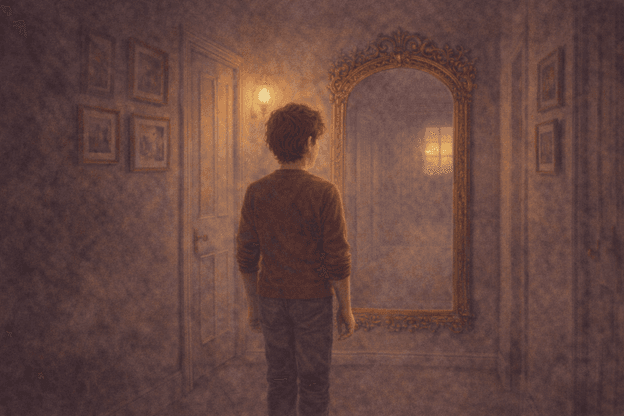
It was just after three o'clock, the house quiet, Cecily having gone home with a promise to return and help him decide what, if anything, should be done with the documents. Theo stood at the end of the hallway and looked at his reflection.
His reflection looked back. Just his reflection.
He waited for ten minutes. Nothing changed.
"Edmund," he said, quietly. "I read the letter. I know what you wanted people to know. Your father was an honest man and you were trying to help him."
The mirror showed the hallway. His reflection, the carpet, the doors, the window at the far end letting in the pale afternoon light.
"I don't know what happens next," Theo said. "I don't know if you can hear me or if you've been here all this time or how any of this works. But I wanted to tell you that someone knows now. We know."
A long moment passed.
In the mirror, the hallway looked exactly as it always had. Pale carpet, framed photographs, closed doors.
But at the edge of the frame, at the furthest visible point where the reflection stretched to, he thought he could see something. Not a figure. Not a boy. Just a quality of light, a slight warmth at the edge of the glass that might have been the afternoon sun and might have been something else entirely.
It faded quickly. It might have been nothing.
Theo decided, privately, that it had not been nothing.
He went downstairs and found Cecily's text: Have been researching Croft. His descendants still live in Whitmore. Complicated question about whether the documents are historically significant enough to donate to local archive. Thoughts?
He replied: Come over Wednesday and we'll work it out.
Then he went into the kitchen and made himself a cup of tea and thought, for a while, about Edmund Aldiss. A boy who had tried to do the right thing, who had trusted that someone would eventually find what he'd left behind, who had apparently been patient enough to wait one hundred and seventeen years for a person to stop and pay attention.
There was something in that, Theo thought, that was not entirely unlike faith. Not religious faith, but the ordinary human kind: the belief that someone, eventually, would look. Would notice. Would take the trouble to understand.
He thought: I'm glad I looked.
He thought: I'm glad he waited.
He looked out of the kitchen window at the November afternoon, the bare garden, the grey sky.
Somewhere behind him, at the end of the upstairs hallway, the mirror stood as it always had. Tall and still, with its carved vine frame and its slightly imperfect glass. Showing the hallway, empty and quiet.
Just the hallway.
Nothing else.
Which was, in its own way, exactly right.
He told his parents that evening, the whole of it, from the first morning to the letter to Edmund's explanation of events in 1908. He laid the documents on the kitchen table and watched his parents read them. His dad was quiet for longer than usual. His mum asked several careful questions.
Neither of them suggested a practical explanation. Theo appreciated this more than he could easily say.
"What do you want to do with the documents?" his dad asked, at the end.
"Donate them to the local archive," Theo said. "With a record of how they were found. Edmund wanted people to know. The archive is the best way to make sure they're kept and read."
His dad nodded slowly. "And the mirror?"
Theo looked at the ceiling, in the direction of the upstairs hallway.
"I think we should keep it," he said. "It's a beautiful thing. George Aldiss made it. It belongs in the house."
His mum smiled. "I always thought it was beautiful," she said. "I never knew the half of it."
"None of us did," Theo said.
He went upstairs to bed later, passing the mirror in the hallway. He didn't stop, didn't address it, didn't wait for anything. Just passed it, the way he always had, the way he would continue to for as long as he lived in this house.
His reflection passed with him, ordinary and normal and entirely his own.
The hallway behind him was empty.
Just as it should be.