

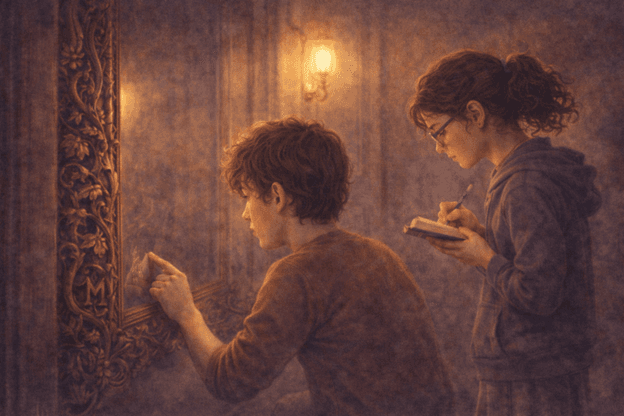
The Carved Vine Frame
He saw the boy twice more before Saturday.
The second time was Thursday evening, just after eight. Theo was passing the mirror on his way to bed and the boy was there again, same position, same serious expression. This time Theo stopped immediately and looked directly at him.
The boy looked back. Then he pointed again, but this time he didn't point at Theo. He pointed sideways, toward the wall on his left. In the reflected hallway, that would be the wall that had the framed photographs on it.
Theo looked at the actual wall. Six photographs, all family photographs: his parents' wedding, a holiday when Theo was five, his grandparents, his mum's graduation. Nothing unusual about any of them.
He looked back at the mirror. The boy was still pointing at the wall, with a kind of patient insistence, the way someone pointed at something when they were sure the other person was looking in the wrong direction.
"I'm looking," Theo said. "I can't see anything."
The boy lowered his arm. He looked, if anything, slightly frustrated.
"I don't understand yet," Theo said. "But I'm working on it."
Something in the boy's expression shifted. Not exactly relaxation, but an acknowledgement, maybe. He looked at Theo for another moment, and then the mirror was simply showing the hallway again, ordinary and empty.
The third time was Friday morning, briefer, just a few seconds. The boy appeared, pointed at the wall again, then pointed upward, toward the ceiling or the space above, and then he was gone before Theo could respond.
He wrote everything in his homework diary. Direction of pointing. Duration. Expression. Any details of the clothing or surroundings he could make out. He was building a record, the way he approached problems in physics: observations first, hypotheses second.
The antique shop on Perrin Street was called Formerly Yours, which Theo thought was either very clever or quite bad, depending on how you looked at it. It was small inside and extremely full, with furniture stacked near the ceiling and glass cases containing smaller objects and a faint smell of beeswax and old things.
The owner was a woman named Mrs Parrish, who was perhaps seventy, with sharp eyes and paint-stained fingers and a seemingly encyclopaedic knowledge of every object in the shop.
Theo had taken photographs of the mirror on his phone. He showed them to Mrs Parrish, who looked at them for a long time without speaking.
"Where did you get this?" she asked.
"It was in my house when my parents bought it," Theo said. "Left by the previous owners. I'm trying to find out its history."
Mrs Parrish handed the phone back. "That frame is the work of a craftsman named George Aldiss," she said. "He worked in this town from roughly 1890 to 1920. Very distinctive style, the vine motif. I've seen perhaps four pieces by him in my career." She looked at Theo steadily. "He made furniture and frames primarily, but he's better known locally for his personal history. His son disappeared."
Theo went still.
"When?" Cecily asked, beside him.
"1908 or thereabouts," Mrs Parrish said. "The boy was about fourteen, I believe. He went missing from the house, no trace found, and George Aldiss spent the rest of his life, twenty years or so, trying to find out what had happened. He made things, partly as a living and partly as a way of not going mad with grief, I imagine." She paused. "The mirror would have been a significant piece. He made a mirror of that description for his own home, according to some accounts. A memorial piece, of a kind."
"Do you know the boy's name?" Theo asked.
"Edmund," Mrs Parrish said. "Edmund Aldiss."
They went directly from the shop to the library, which Cecily navigated with the ease of someone who spent considerable time there. The local history section was small but well-organised, and within an hour they had found three relevant sources: a local history book from the 1960s that mentioned George Aldiss in a chapter on craftsmen of the late Victorian and Edwardian period, a collection of historical newspaper clippings, and an index of local census records.
Edmund Aldiss, born 1894, was listed in the 1901 census as living with his father George and his mother Clara at an address in Whitfield Road.
Theo looked up Whitfield Road on his phone.
It had been renamed in the 1950s. The current name of the road was Barley Close.
He lived on Barley Close.
He looked at Cecily.
Cecily looked back at him with the expression of someone confirming something they had already suspected.
"He lived in my house," Theo said.
"In 1901, yes. Whether he was still there in 1908 when he disappeared, we'd need to check."
Theo pulled the newspaper clippings toward him. The collection was indexed, and he found the relevant entry quickly: a brief article from September 1908 in the local paper.
The article reported that a boy named Edmund George Aldiss, aged fourteen, of Barley Close, had been missing from his home for eleven days. His father had made appeals for information. Police had searched the surrounding area without result. No further articles followed in the collection, which might have meant nothing had been found, or might have meant the newspaper simply hadn't kept the follow-up clippings.
Theo sat back and thought about a boy aged fourteen who had disappeared from a house in 1908 and had apparently, one hundred and seventeen years later, not entirely left.
The pointing. The wall. The upward gesture. The boy had been trying to communicate something specific. He had not seemed frightened or in distress. He had seemed, as Cecily had said, communicative. He had something to say or show, and he had been trying to find someone who would stop and pay attention long enough to understand.
"I think there's something in the house," Theo said. "Something physical. A clue, or evidence, or something he left behind. He keeps pointing at the wall and then pointing up."
Cecily was already making notes. "The walls or the ceiling. Something hidden, possibly. Old houses of that era sometimes had cavities, spaces behind panels, that kind of thing."
"I need to look at my own hallway more carefully," Theo said.
"We both do," Cecily said, closing her notebook. "I'll come over tomorrow."