The House That Belonged to Someone Else
Theo Baxter had lived in the same house his entire life, which was fourteen years, and he knew every corner of it the way you knew things that had always simply been there: without thinking about them, without questioning them, without ever once wondering if they might be different from how they appeared.
The mirror at the end of the hallway had always simply been there.
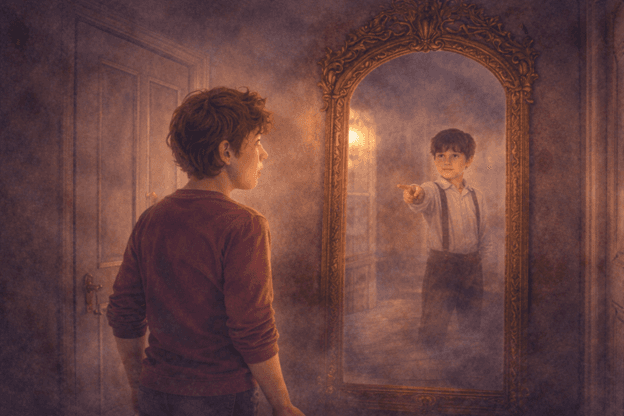
It was tall, reaching almost to the ceiling, with a dark wooden frame carved into an elaborate pattern of twisting vines. The glass was old, slightly imperfect, the kind that made reflections look marginally different from how they would appear in a modern mirror, a slight warmth to the tones, a very faint distortion at the edges. It had been in the house when his parents bought it, left by the previous owners, and his parents had liked it enough to keep it. It stood at the end of the upstairs hallway, between the bathroom door and the door to the airing cupboard, and Theo had walked past it every single day of his life without giving it any particular thought.
Until the morning he walked past it and saw someone standing behind him who was not there.
He was on his way to the bathroom, early morning, barely awake, wearing the particular autopilot of someone who had not yet had breakfast. He passed the mirror without looking at it directly, the way you didn't look directly at familiar things, and then some instinct made him stop and look back.
In the mirror, the hallway was reflected as it always was: the pale carpet, the framed photographs on the wall, the closed doors, the narrow window at the far end that let in the morning light.
And standing in the middle of the reflected hallway, looking directly at Theo through the mirror, was a boy.
Theo spun round.
The hallway was empty.
He looked back at the mirror. The boy was still there, standing quite still, watching him. He was about Theo's age, with dark hair and an expression that was not frightening but was extremely serious. He was wearing clothes that were slightly odd, a collarless shirt and braces over trousers that were too short at the ankle, the kind of clothes from a period drama. His hands were at his sides. He was not moving.
Theo stood in the hallway for a full thirty seconds, looking between the empty space behind him and the mirror showing a boy who was not there. His brain tried several explanations and discarded all of them.
Then the boy in the mirror raised one hand, slowly, and pointed at Theo.
Theo went to the bathroom, washed his face with cold water, and looked in the bathroom mirror. His own reflection looked back at him, perfectly normal, with the expression of someone who was reassessing their morning significantly.
He went back to the hallway. The mirror showed only the empty hallway. The boy was gone.
Theo stood there for a moment. Then he went downstairs and made himself toast and thought about it very carefully.
He decided three things. First, he was not imagining things, because he was not the type to imagine things and because the experience had been too specific, too detailed, to be a half-awake hallucination. Second, whatever was happening with the mirror needed investigating before he said anything to his parents, because his dad's immediate response to unexplained phenomena was to suggest a practical explanation with great confidence, and his mum's was to worry, and neither of those reactions would be useful right now. Third, he needed to know more about the mirror itself: who had owned it before, where it had come from, how old it was.
He ate his toast. He wrote the three decisions in the back of his homework diary. Then he got ready for school, pausing at the hallway mirror on the way.
Nothing but his own reflection. He looked at himself for a moment and then looked at the frame, the carved vines, the slight imperfection of the old glass.
"I'm going to find out about you," he said, quietly, to the mirror or to whoever might be on the other side of it.
His reflection looked back at him, but nothing else did.
Not yet.
He told his best friend Cecily at lunch.
Cecily was the right person to tell for several reasons. She was pragmatic, she had an excellent memory, and she was the kind of person who, when presented with something unusual, immediately started trying to understand it rather than looking for reasons to dismiss it. She had once spent three weeks researching the migration patterns of a specific type of moth because one had landed on her windowsill and she had been curious about where it came from. Theo had absolute confidence in her.
She listened to the whole account without interrupting, eating her sandwich throughout with the composure of someone processing information efficiently.
"The pointing was important," she said, when he'd finished.
"I thought so too," Theo said.
"He didn't seem threatening. He pointed at you specifically. That's communicative rather than aggressive." She took another bite. "He wanted your attention."
"He had it," Theo said. "He definitely had it."
"What do you know about the previous owners?"
"Almost nothing. My parents bought the house twelve years ago, so I was only two. I don't think they know much either. I'd have to ask carefully, without explaining why."
"Casually curious," Cecily suggested. "You're doing a local history project."
"We're not doing a local history project."
"Your parents don't know that." She held up a hand before he could object. "Not lying. Framing. You are, in a sense, investigating local history. The history of your house specifically. That's technically accurate."
Theo considered this. "You're very good at technically accurate."
"Thank you. I work at it." She folded her crisp packet into a precise square, a habit he'd never commented on in four years of friendship. "What about the frame? The carved vines. That's specific enough to research. Old mirrors with carved frames are the kind of thing antique dealers know about."
"There's an antique shop on Perrin Street," Theo said. "My mum goes in there sometimes."
"Saturday," Cecily said. "We go Saturday."