

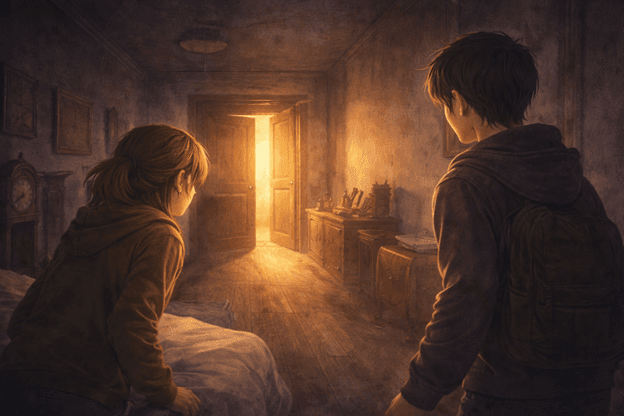
Four Days and a Door
The clock stopped at three minutes past four every time she wound it. She wound it seven times over the following four days, and seven times it stopped at exactly that position, with that same fractional degree of the minute hand. She had started thinking of it as 4:04 rather than 3:04, which felt more significant, though she couldn't have said why.
She looked up Edith Calloway on Thursday evening and found a brief obituary in a local newspaper archive, dated eight months ago. Edith Mary Calloway, 91, lifelong resident of Whitmore, retired schoolteacher, passed away peacefully at home. She is survived by her friends and former students, who remember her warmth and her insistence that paying attention was the most important skill a person could develop. No family listed, just as the letter had said.
The clockmaker's mark on the back was a small stamped symbol: two letters intertwined, what looked like an H and a V, inside a circle. She searched for it online and found nothing immediately.
On Friday afternoon she stayed late at school to use the library computers for more research, which led her to her friend Jonah, who was also in the library, doing the geography homework that was due in an hour and which he approached with the relaxed confidence of someone who had never once failed to complete things at the last minute.
Jonah was fourteen, methodical, and had a talent for taking other people's problems seriously that Mara had always valued. She told him about the clock. He put down his geography work without hesitation.
"Show me the letter," he said.
She'd photographed it on her phone. He read it carefully, then looked at the photo of the clock she'd also taken.
"It tells the truth," he repeated. "That's a specific phrase. Not 'it shows you things' or 'it's special.' Truth specifically."
"Yes," Mara said. "I noticed that too."
"And it keeps stopping at the same position."
"Every single time."
Jonah leaned back in his chair. "My grandmother has a clock like that," he said. "Not the same, obviously. But the same era, same style. She winds it every Sunday." He paused. "Have you considered that the position might not be the message? That the stopping itself might be the message?"
Mara looked at him. "What do you mean?"
"You keep focusing on what four minutes past four means. But what if the point isn't the time it shows, but the fact that it stops? As in, it's showing you a moment. A specific moment, at four minutes past four, that you should pay attention to."
Mara's notebook was in her bag. She pulled it out and wrote this down.
"Tomorrow is Saturday," she said.
"Yes," Jonah said.
"I had a dream about a corridor and a door."
Jonah considered this with the seriousness it deserved. "That could be nothing," he said. "Or it could be something. Is there any reason you'd be somewhere with a corridor and a door tomorrow?"
"I wasn't planning on going anywhere."
"Maybe you should."
She looked at her notebook. "My mum mentioned we might go to the Whitmore Antiques Fair. It's at the old Town Hall." She paused. "I've never been inside the Town Hall."
"Does it have corridors?"
"Every old building has corridors."
Jonah picked up his geography homework again, thought for a moment, then put it down once more. "I'm coming with you," he said. "To the antiques fair."
"You hate antiques."
"I'm very interested in mysterious clocks and prophetic dreams."
"We don't know that it's prophetic."
"Mara," Jonah said patiently, "you received a clock that stops at the same time every day, four days before a Saturday, and you dreamed about a door in a building you've never entered. The antiques fair is in that building. I'm coming with you."
She couldn't find a reasonable argument against this. "Fine," she said. "It starts at ten."
"I'll be there at nine fifty-five," Jonah said, and picked up his geography homework for the final time.