The Inheritance Nobody Expected
The package arrived on a Tuesday, which Mara Okonkwo had always considered the most unremarkable day of the week, and so it seemed fitting that the most remarkable thing that had ever happened to her began on one.
It was addressed to her specifically. Not to her parents, not to the household generally, but to Miss Mara Okonkwo, aged 14, in handwriting that was cramped and spidery and pressed so hard into the envelope that the letters were almost embossed on the other side. There was no return address. The postmark was smudged beyond reading.
Her mum turned it over twice before handing it across the breakfast table. "Do you know who this is from?"
"No," Mara said, which was true.
"Are you expecting anything?"
"No," Mara said, which was also true.
Her mum looked at the package for another moment, clearly weighing up the competing impulses of parental supervision and respect for her daughter's post. Respect won, narrowly. She put it on the table and went back to her coffee.
Mara took the package upstairs.
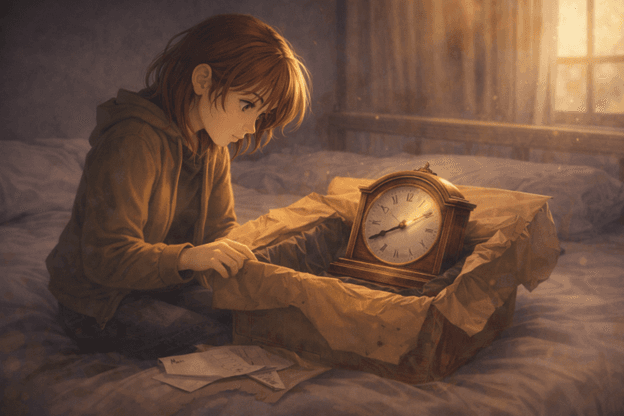
It was roughly the size of a shoebox, wrapped in brown paper, and heavier than it looked. She set it on her bed and unpicked the tape carefully, folding back the brown paper in sections the way she always opened things, the way that drove her friends absolutely mad when she opened birthday presents.
Inside the brown paper was a box, dark wood, with brass hinges and a small brass latch. Inside the box, nested in a bed of dark green velvet, was a clock.
It was not a large clock. It was the kind of clock that sat on a mantelpiece, roughly thirty centimetres tall, with a domed glass front and a dark wooden case. The face was cream coloured, with Roman numerals in black, and two hands, one for hours and one for minutes, both stopped at the same position: three minutes past four.
There was a note folded underneath it.
Dear Mara. You don't know me, but I knew your great-grandmother, Adaeze, very well. We were friends for thirty years. I am quite old now and have no family of my own, and when I thought about who should have this clock after me, I thought of her, and then I thought of you. Your great-grandmother spoke of you often, though you were very young when she passed. She said you were the one in the family who asked the right questions. This clock has been in my possession for forty years. Before me, it belonged to a woman who gave it to me with the same instruction I now pass on to you: pay attention to what it shows you, and do not dismiss it as impossible. The clock does not tell the time. It tells the truth. Yours sincerely, Edith Calloway.
Mara read the letter three times. Then she looked at the clock.
It was undeniably beautiful. The woodwork was polished and smooth, with small carved details at the corners, tiny leaves and what might have been birds. The glass face was very slightly convex, making the clock face seem to curve gently outward. The hands were delicate, the kind that looked as though they might snap if handled roughly.
She set it on her desk and looked at it for a long time.
Three minutes past four. She checked her phone. It was twenty past eight in the morning.
She wound the clock. There was a small key in a compartment at the back, and she turned it until she felt resistance, then set the hands to the correct time and placed it back on the desk. By the time she left for school, it was keeping perfect time.
She came home to find it stopped again.
At three minutes past four.
She didn't tell her parents. Not yet. Her mum would want to research Edith Calloway, and her dad would want to look up the clockmaker's mark on the back, and both of those things were reasonable and sensible and would completely derail the particular kind of thinking she needed to do first.
The note had said: the clock does not tell the time. It tells the truth.
Mara sat at her desk and looked at the stopped hands. Three minutes past four. It was currently just past seven in the evening. She had wound it again when she got home and it had ticked happily for twenty minutes and then stopped, silently and without drama, at precisely the same position.
She thought about what a clock could show you, if it wasn't showing you the time.
A date? But the clock had no date function, no additional dials or displays. Just the two hands, the hour and the minute. Three and four. Or rather, the hour hand pointing at four, and the minute hand pointing at one, making three minutes past four.
Unless.
She leaned closer. The minute hand was not pointing at one. It was pointing almost at one, but not quite. It was pointing at a position fractionally past the twelve, tilted slightly to the right. Not a full minute mark. A fraction of one.
She got a protractor from her pencil case and held it up against the clock face.
The minute hand was at approximately four degrees past the twelve.
She wrote in her notebook: Hour hand at four. Minute hand at approximately four degrees past twelve. What does that mean if not 3:04?
She stared at it.
Then she thought: what if it wasn't telling her a time of day at all? What if it was telling her a time in a different sense?
She wrote: Four days? Four hours? Four minutes from now?
She looked at the clock again. Four days from now would be Saturday. She had nothing significant planned for Saturday. She wrote Saturday in her notebook anyway and underlined it.
Then she went to bed and dreamed, quite vividly, of a corridor she had never seen in a building she didn't recognise, with a door at the end that was standing open.