

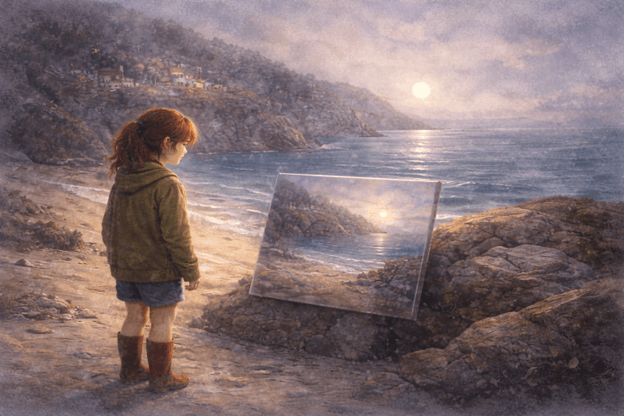
The Canvas Left by the Sea
The painting appeared on the third morning.
Juno Marsh noticed it because she was the first one up, which was unusual for a twelve year old on holiday but explained by the fact that Salcombe Cove was the kind of place that made you want to be awake early. The light came in off the water at a particular angle in the mornings, low and sideways, turning everything gold for about forty minutes before it climbed too high and became ordinary daylight. Juno had discovered this on the first morning by accident and had set an alarm for every morning since.
The cottage her family had rented sat at the top of a short path that led directly down to the cove. The cove was small and sheltered, a curved bite out of the cliff with a narrow beach of dark sand and smooth pale stones. At low tide the rock pools were exposed at both ends, full of things worth looking at. At high tide the water came almost to the base of the path.
On the third morning, at just past six, Juno came down the path in her coat and wellies and found a painting propped against the largest rock at the base of the cliff.
It was a canvas, medium sized, the kind a serious amateur might use. The painting on it was of the cove itself, the exact view from where she was standing: the curve of the cliff, the dark sand, the rock pools to the left, the open sea straight ahead. It was painted in the early morning light, the same low gold she was standing in right now, which meant it had been painted at this time of day, from this position.
She looked up and down the beach. Empty. She looked out to sea. The water was flat and grey-green, with a small fishing boat far out on the horizon. No one in the water.
She crouched in front of the painting and looked at it closely. It was good. Really good, not just competent but genuinely accomplished, the kind that made you feel you were standing in the place depicted even while you were already there. The light in particular was extraordinary, captured with a precision that suggested whoever had painted it had spent a long time studying exactly this quality of morning.
There was no signature. She checked the back of the canvas: nothing. No name, no date, no identifying marks.
She left it where it was, because it didn't seem right to move it, and sat on a nearby rock and watched the tide for a while. When she went back up to the cottage for breakfast she mentioned it to her parents.
Her dad came down and looked at it and said it was probably left by another holiday maker, someone who'd done a bit of painting on the beach and forgotten it or left it deliberately.
"At six in the morning?" Juno asked.
"Some people get up early," her dad said.
"And left a painting on a rock."
"People do strange things on holiday," her dad said, with the confidence of someone who considered this a complete explanation, and went back up for toast.
Juno went back up too. She had breakfast and spent the morning in the rock pools and helped her mum cook lunch and read for most of the afternoon. She thought about the painting intermittently, the quality of the light in it, the precision of the cove's shape.
That evening she asked the owner of the cottage, Mrs Tregenna, if she knew of any artists who worked in the cove.
Mrs Tregenna was perhaps sixty-five, compact and weathered in the way of people who spent most of their time outdoors near the sea. She had lived in the village her entire life and knew everything about it with the comfortable authority of someone who had never needed to look anything up.
She looked at Juno when she asked the question. Not an ordinary look. A considering look, the kind that evaluated whether someone was worth a real answer.
"Where did you find the painting?" she asked.
"Propped against the big rock at the bottom of the path," Juno said. "This morning, early. No one was on the beach."
Mrs Tregenna was quiet for a moment. "How many mornings have you been going down early?"
"Every morning since we arrived."
"And this is the first painting?"
"Yes."
Mrs Tregenna nodded slowly. She looked out of the window at the cove, which was visible from the cottage's sitting room, the water dark in the evening light.
"Come and find me tomorrow morning," she said. "After the painting, if there is one. I'll tell you about Lowenna."
There was another painting on the fourth morning.
Same position, propped against the same rock, as though it had been placed there with the specific intention of being found by someone coming down the path at just past six in the morning. This one was different from the first: not the cove from the base of the path but the view looking outward from the right-hand rock pool, west along the coast, the cliffs stepping away into distance and mist, a single bird hanging in the air above the water.
The bird was the detail that struck her. It was painted with extraordinary specificity, not a generic seagull shape but a particular bird in a particular moment, wings at a precise angle, light on the underside of the feathers. Whoever had painted it had looked very hard at that bird.
She went to find Mrs Tregenna.