

The Great Pancake Disaster of Doveton Close

Written by Nia Lark
Published
In the town of Doveton, where the February half term had just ended and the children had returned to school with the slightly dazed expression of people who had eaten too many biscuits and stayed up too late for a week, there lived a boy named Monty. Monty was eight years old, had a round cheerful face, ears that stuck out just enough to be interesting, and an absolute and unshakeable belief that he was an excellent cook.
He was not an excellent cook.
He was an enthusiastic cook, which is a different thing entirely. He was the kind of cook who approached every recipe with tremendous confidence and very little caution, who measured ingredients approximately rather than precisely, who considered the instruction to stir gently as more of a suggestion than a rule, and who had on three separate occasions set off the kitchen smoke alarm while attempting to make something that should, by any reasonable standard, have been impossible to burn.
His older sister Cleo, who was twelve and precise about everything, kept a private list in her room of Monty's cooking disasters. It had fourteen entries. The most recent one simply said porridge, ceiling, do not ask.
But Shrove Tuesday was different.
Shrove Tuesday, Pancake Day, was Monty's day. It had been his day for three years running. Not because anyone had officially declared it so, but because Monty had decided it was so, and once Monty decided something it tended to stay decided. Every Pancake Day he made the pancakes for the whole family, and every Pancake Day the pancakes were, in their own particular way, memorable.
Year one had produced pancakes that were crispy at the edges and completely raw in the middle, which his dad had eaten anyway with maple syrup and a diplomatic expression. Year two had been better, genuinely better, the pancakes were thin and golden and almost exactly right, except that Monty had got overexcited during the flipping and sent one onto the top of the fridge, where it sat for the rest of the day because nobody could reach it and nobody wanted to be the one to try. Year three had been excellent by any measure and Monty had accepted the family's praise with the modest satisfaction of someone who had always known it would come eventually.
This year, year four, Monty had a plan.
He was not just going to make pancakes for his family. He was going to make pancakes for everyone on Doveton Close.
He had thought about this for several days. Doveton Close was a short curved street of twelve houses and Monty knew everyone on it. There was Mrs Ogundimu at number one who always waved from her garden. There was the Fernandez family at number five with their three small children who were always outside on their scooters. There was old Mr Hapgood at number eight who had a magnificent collection of garden gnomes and took them inside every winter and back out every spring like small ceramic migratory birds. There was the young woman at number eleven called Priya who had moved in six months ago and who Monty had noticed sometimes ate her lunch alone on her front step, which seemed to him like the sort of thing that could be improved by pancakes.
He put his plan to his parents on Monday evening.
His mum listened carefully, as she always did, taking the idea seriously in the way that good parents take children's ideas seriously, which is to say not dismissing it but also not agreeing to it without thought.
"That's a lot of pancakes," she said.
"I know," said Monty. "I've done the maths."
He had not done the maths. He had thought about the maths in a general way and concluded that it was probably fine.
"How many people are we talking about?" said his dad.
"Twelve houses. Say three people per house on average. Thirty-six people. Three pancakes each. One hundred and eight pancakes."
There was a silence.
"One hundred and eight," repeated his dad.
"Roughly," said Monty.
Cleo, who was sitting at the kitchen table doing homework, looked up. "You have never successfully made more than nine pancakes in a row without something going wrong."
"This will be different," said Monty with complete certainty.
His mum and dad looked at each other over his head in the way that parents look at each other when they are having an entire conversation without words. Then his mum looked back at Monty.
"All right," she said. "But we help. And we start early."
Monty agreed to these terms, shook his mum's hand to make it official, and went to bed feeling the particular excitement of someone with a very large plan and absolute faith in their ability to carry it out.
On Tuesday morning Monty was up at seven. He came downstairs to find his mum had already laid out the ingredients on the kitchen counter with the organised precision of someone who had looked up how much batter one hundred pancakes actually required and taken it seriously. There were four bags of flour. There were eighteen eggs lined up in a row. There were four pints of milk. There was a large glass mixing bowl that Monty had not known they owned, which his mum said she had borrowed from Mrs Ogundimu, which felt appropriate given that Mrs Ogundimu was going to be eating the results.
His dad had already been out and knocked on every door on Doveton Close to invite the neighbours, which Monty thought was exactly the right approach. Most people had said yes immediately, the way people say yes to pancakes, which is to say with the wholehearted enthusiasm of someone who did not need to be asked twice. Mr Hapgood had said he would bring his griddle pan because it was larger than a normal frying pan and would speed things up considerably. The Fernandez family said they would bring chairs and a folding table. Priya from number eleven had paused on her doorstep looking surprised and then pleased and said she would bring honey, which she said was the only correct thing to put on a pancake, a view Monty respectfully disagreed with but kept to himself.
By eight o'clock the batter was made. Or rather, the first batch of batter was made. Monty had made it himself with his mum supervising, measuring the flour into the bowl, making the well in the centre, cracking the eggs in one by one. He had only got one small piece of shell in the bowl and fished it out immediately, which he considered a personal best.
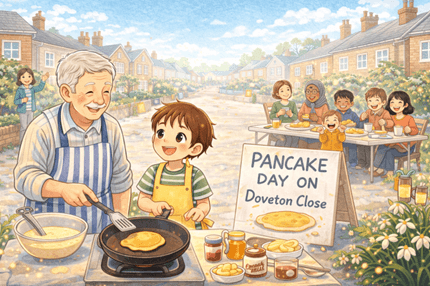
The batter was supposed to rest for thirty minutes. Monty found this the most challenging part of the morning. He reorganised the toppings twice. He made a sign on a piece of card that said PANCAKE DAY ON DOVETON CLOSE in large letters with a drawing of a pancake underneath that Cleo said looked more like a yellow moon but which Monty felt captured the spirit of the thing.
At half past eight he took his sign outside and propped it against the garden wall.
Mr Hapgood appeared from number eight almost immediately, carrying his griddle pan and wearing a large striped apron. He was eighty years old, had white hair and a white moustache and the upright posture of someone who had once been in the navy, which he had. He set his griddle pan on the garden wall and examined the sign.
"Good lettering," he said approvingly.
"Thank you," said Monty.
By nine o'clock the close was coming alive. The Fernandez family had set up the folding table on the pavement outside Monty's house and arranged six chairs around it, which was not enough chairs but a good start. Mrs Ogundimu came out in her coat and scarf carrying a flask of coffee. Priya from number eleven came down the close with her jar of honey and a slightly uncertain expression, like someone who was pleased to be invited but not quite sure where to stand, which Monty resolved by pointing her directly to a chair.
Monty's mum manned one pan on the kitchen stove. Mr Hapgood manned his griddle pan on the garden wall using a small camping stove he had produced from somewhere with the efficiency of a man who had cooked in more difficult circumstances than a February pavement. Monty moved between the two, pouring batter, watching for bubbles, directing operations with the focused energy of someone running a small but important festival.
The first pancake off the griddle was Mr Hapgood's, thin and golden and perfectly round.
The close applauded.
Mr Hapgood accepted this with a slight bow.
Monty's first pancake off the kitchen stove was less round but equally golden, with one slightly thicker edge that gave it a pleasingly rustic quality, which was what Monty told his mum when she observed this.
"Rustic," his mum repeated, smiling.
"Artisanal," said Cleo, from the doorway.
The toppings were arranged along the folding table. Lemon and sugar, the classic. Nutella in a jar with a spoon. Monty's own preference which was golden syrup, controversial in some quarters but deeply correct in his view. Strawberry jam. Banana slices that his dad had prepared. And Priya's honey in its jar, amber and clear, which caught the winter morning light beautifully.
People came out of their houses in ones and twos, wrapped in coats and scarves, carrying cups of tea they had made at home to keep their hands warm. The folding table filled up. More chairs appeared from various houses up and down the close. Someone brought out a portable speaker and put on cheerful music at a sensible volume.
Monty flipped pancakes. His dad took over at the kitchen stove so Monty could work the griddle with Mr Hapgood, who turned out to be an excellent teacher, showing him how to wait for the right moment before flipping, how to loosen the edges first with a gentle shake of the pan, how to read the surface of the batter for the small bubbles that meant it was ready.
"My mother taught me," said Mr Hapgood, turning a perfect pancake with a flick of the wrist. "Every Shrove Tuesday without fail. Same recipe for fifty years."
Monty thought about recipes lasting fifty years and felt that pancakes were perhaps more important than he had previously understood.
The great pancake disaster, when it came, was not actually a disaster.
It was Monty's attempt at flipping a pancake dramatically, the full toss-it-in-the-air-and-catch-it method that he had been building towards all morning. He had watched Mr Hapgood do it twice with complete control. He had decided he was ready.
He was not ready.
The pancake went up beautifully. High and spinning, catching the pale February sunlight, a perfect golden disc turning lazily in the cold air above Doveton Close. The entire street watched it go up. Several people made the anticipatory sound of a crowd watching something that could go either way.
It came down two feet to the left of the pan, landed on the pavement with a small flat slap, and sat there looking up at everyone.
There was a moment of silence.
Then the three small Fernandez children, who had been watching Monty's every move all morning with the devoted attention of a studio audience, burst into the most delighted laughter he had ever heard. It was the kind of laughter that is entirely without unkindness and entirely impossible not to join. It spread down the table and up the close and even reached Mr Hapgood, whose moustache twitched in a way that was definitely a smile.
Monty looked at the pancake on the pavement. Then he looked up at the street full of his neighbours laughing in the cold morning air, their breath clouding, their faces bright.
He started laughing too.
Priya at the end of the table was laughing with her whole face, not the uncertain expression of someone who was not sure where to stand, but the wide open laugh of someone who was exactly where they should be. She caught Monty's eye and raised her cup of tea to him.
Monty raised his spatula back.
They made pancakes until half past eleven, by which point everyone had eaten more than was sensible and the flour supply was fully exhausted and the February morning had warmed up enough that some people had taken their scarves off. The final count was not one hundred and eight pancakes. It was closer to seventy, which Monty's dad pointed out was still seventy pancakes, which was a remarkable number of pancakes for one morning.
Mr Hapgood washed his griddle pan at Monty's kitchen sink before carrying it home, and paused at the front door on his way out.
"Same time next year?" he said.
"Same time next year," said Monty immediately.
The close tidied itself up with the easy cooperation of people who have shared something good together. Chairs were carried back. The folding table was folded. The toppings were parcelled up and distributed among whoever wanted them.
Priya was the last to leave. She stopped on the pavement outside Monty's house and looked back at the close, quiet again now in the late morning, and then at Monty.
"Thank you for knocking on my door," she said simply.
Monty thought about her eating lunch alone on her front step and felt very glad that his dad had knocked on every door without being asked.
"Come again next year," he said. "Bring the honey."
She smiled. "I will."
That evening Monty sat at the kitchen table while his mum made actual supper, something simple and not involving pancakes, and he thought about the day. He thought about Mr Hapgood's mother and her fifty year recipe. He thought about the pancake on the pavement and the sound of the Fernandez children laughing. He thought about Priya's face when she stopped being uncertain and started being happy.
He thought that Pancake Day was possibly the best day of the year. Not because of the pancakes, though the pancakes were very good. But because of what the pancakes were for. The gathering in. The folding table and the extra chairs. The neighbours in their coats with their cups of tea. The way a simple Tuesday in February could become something that people would remember.
He got out a piece of paper and started planning next year.
Cleo looked over his shoulder. "You're already planning next year?"
"I'm thinking bigger," said Monty.
Cleo sat down beside him. "I'll help," she said, which surprised him, and then did not surprise him at all.
Outside, Doveton Close was quiet in the February evening. A light was on in Mr Hapgood's front room. Music was playing faintly from the Fernandez house. In the window of number eleven a warm yellow light glowed steadily.
Monty wrote PANCAKE DAY YEAR FIVE at the top of his paper and underlined it twice.
He was already looking forward to it.
*The End.*