

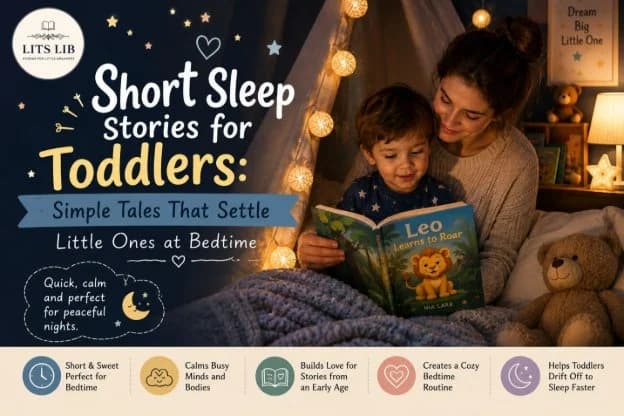
Short Sleep Stories for Toddlers: Quick and Sweet

Toddlers and long stories don’t usually mix at bedtime. By the time you’re ten minutes into an elaborate adventure, they’re either bouncing off the walls or have asked you the same question six times and forgotten your answer. What actually works for this age group is shorter, simpler, and a lot more focused than most parents expect.
Short sleep stories for toddlers earn their place not despite their brevity but because of it. A toddler’s attention span, especially a tired one, is built for something quick and satisfying with a clear beginning, a small moment of feeling, and an ending that closes things neatly. That’s it. No sprawling subplots, no cliffhangers, no vocabulary that needs explaining at nine o’clock at night.
In this post we’ll look at what makes short toddler stories actually work at bedtime, what to look for when choosing one, and a story we’d point you to that does all of this well.
Why Short Stories Work Better for Toddlers at Bedtime
A toddler who is tired is also, without fail, a toddler who is harder to manage. Emotions run higher, distractions pull more easily, and the window between ‘ready for sleep’ and ‘overtired and wired’ is much narrower than most parents wish it was. Short stories work with this reality rather than against it.
- They’re over before interest fades, so a toddler stays with the story rather than drifting mid-way through
- Simple language means no interruptions to explain words, which keeps the mood calm and the pace steady
- A clear, resolved ending gives toddlers a sense of completion before lights go out, rather than a story that feels unfinished
- They fit neatly into a rushed bedtime without the parent having to skip pages or summarise
There’s also something to be said for stories that can be read again tomorrow night, and the night after. Short, simple stories are the ones that become requests. And a story a toddler knows well, one they can almost predict word for word, is often more settling than a new one because the familiarity itself is calming.
What to Look For in a Short Toddler Bedtime Story
Not all short books are the right kind of short. Some are brief but still stimulating, full of sound effects and surprises that have a toddler more alert at the end than they were at the start. For a bedtime story specifically, the short ones that work tend to have:
- One main character, simple enough that a toddler can follow and feel for them
- A small, relatable feeling — shyness, sadness, the worry that you can’t do something the others can do
- A moment of trying, not a magic fix, but something the character does that changes things
- A warm, settled ending that wraps up rather than open-ending
- Simple, rhythmic language that reads well aloud and slows the listener down rather than speeding them up
This is the shape of Leo Learns to Roar by Nia Lark. It is a short picture book about a little lion cub named Leo who lives in the jungle with all the other animals. Leo is kind and gentle. But when everyone else roars, trumpets, and chirps with ease, Leo opens his mouth and out comes a quiet little meow. He tries. He really does. And it just does not come out right.
The Story: A Little Lion with a Big Heart
In Leo Learns to Roar, the other animals do not let Leo forget that his roar is missing. The monkey laughs. The parrot squawks. Leo feels sad and shrinks away. It is a feeling that even the youngest children recognise, the specific embarrassment of not being able to do something everyone else seems to manage easily.
Then one day a mouse gets tangled in a bush and calls for help. Nobody else comes. Leo’s heart goes strong. He takes one deep breath, and for the first time, a real roar comes out, loud and brave and completely his own. The mouse is free. The animals cheer. And from that day on, Leo roars when he needs to.
The story ends there, quietly and warmly, with Leo sitting under a starry sky. Nothing dramatic. Just a little lion who found his voice when it mattered, which is exactly the feeling you want a child to carry into sleep.
Why This Story Works So Well for Toddlers
Leo’s problem is small enough that toddlers get it immediately. They don’t need the situation explained. They’ve felt something like it before, the moment when everyone else seems to know how to do a thing and you simply don’t yet.
What the story does well is that Leo doesn’t fix the problem by practising harder or being told how. He does it because something outside himself needed him. His heart went strong, he breathed, and it happened. For toddlers, that’s a very accessible logic. Courage isn’t a skill you train, it’s something that shows up when someone needs you.
- The very short sentences and sparse text read comfortably at a slow, sleepy pace
- The animal characters and jungle setting are familiar and friendly, nothing unsettling before bed
- The emotional beat — trying, feeling sad, then succeeding when it counts — is clear enough that even a two or three year old follows it
- The ending is quiet and complete, Leo under a starry sky, which sends both the story and the child to a settled place
Tips for Reading Short Stories to Toddlers at Bedtime
A story this short reads in under five minutes, which makes it easy to fit into almost any bedtime. A few things make it land better:
- Let the illustrations do their job — this is a picture book, so pause on each page and let your toddler look before you read the text
- Give Leo a small, quiet voice for the meow moments and a warm, proud voice for the roar — the contrast lands well with toddlers
- Don’t rush the ending, the last few pages are slow and peaceful and that pace is part of what settles a child
- If your toddler wants it again straight away, go ahead and read it once more — the second read is often even calmer than the first
FAQ – Short Sleep Stories for Toddlers
Q1: What age is this kind of story best for?
Leo Learns to Roar works well for toddlers from around eighteen months upward, though children up to five often enjoy it too. The simple language and expressive illustrations make it accessible even before a child fully follows the plot.
Q2: How short should a toddler bedtime story be?
For most toddlers, five to eight minutes is the sweet spot. Short enough that attention stays, long enough that the story feels complete. Picture books with sparse, simple text like this one tend to land in that range naturally.
Q3: Is it okay to read the same story every night?
Not just okay, often ideal. Toddlers who know a story well tend to settle faster because the familiarity is itself calming. If your toddler is asking for the same book night after night, let them.
Q4: My toddler is shy. Will a story about shyness upset them or help them?
Stories that reflect a child’s own experience tend to reassure more than upset, especially when the character finds their way through it. Shy toddlers often respond very warmly to Leo because he looks like them and the story shows that being quiet is not the same as being stuck.
Conclusion
Short sleep stories for toddlers don’t need to be big or clever to do their job. They need to be the right size for a tired mind, clear enough to follow, warm enough to land, and short enough to finish before attention wanders.
Leo Learns to Roar Leo Learns to Roar is that kind of story. A small lion, a small problem, a moment of heart, and a roar that finally comes when it matters. It takes less than five minutes to read and leaves a toddler in exactly the right place for sleep.
Sometimes the simplest stories are the ones they ask for every single night. This is one of those.