

The Secret Garden Bench
Twelve-year-old Emily had always believed that every town had one place where people could feel completely at peace. In her old neighborhood in Chicago, it had been a tiny park behind the library. After moving with her family to a quiet town in North Carolina, she spent several weeks searching for a new favorite place. She finally found it behind an old community center, where a narrow garden was hidden between two brick walls.
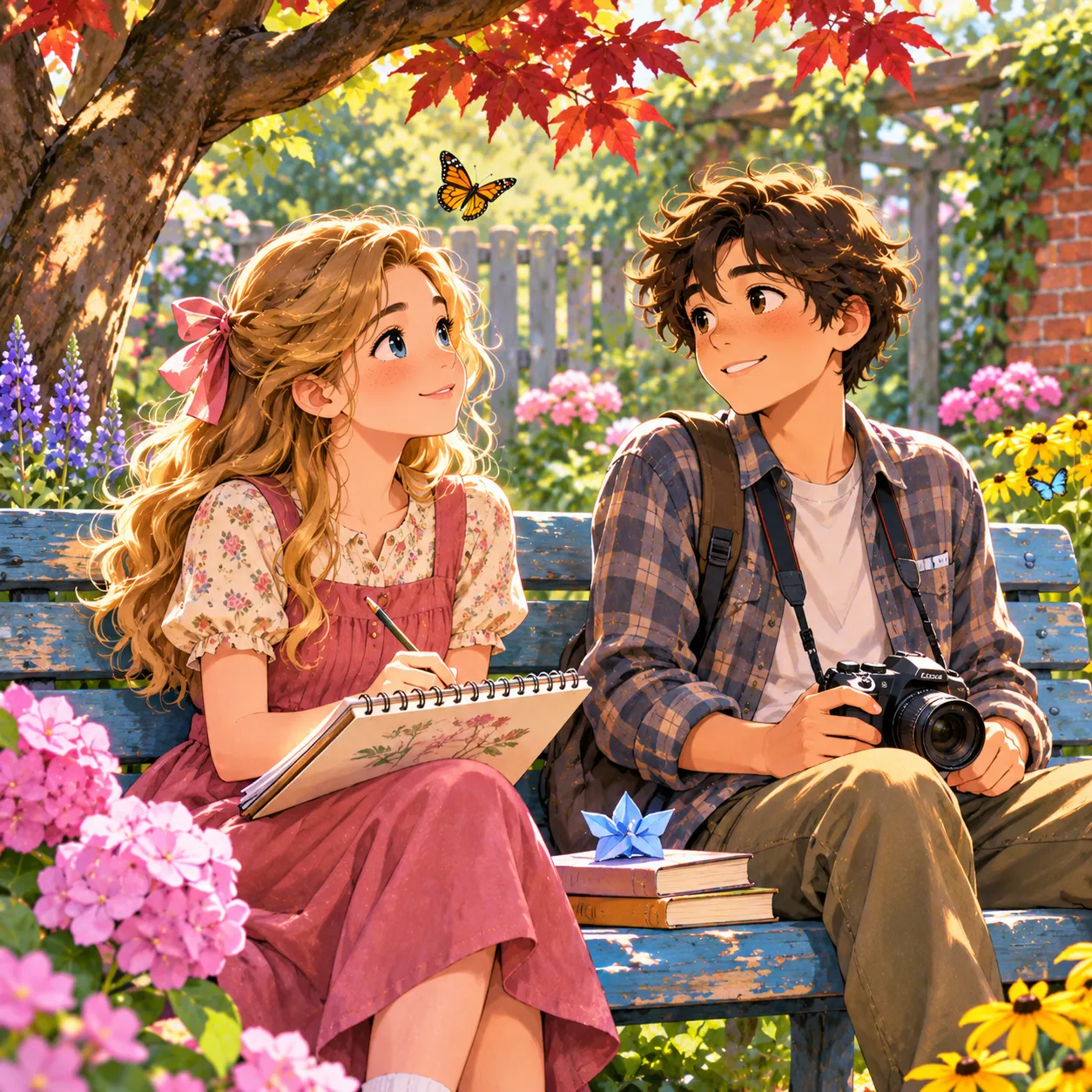
The garden was not beautiful in the usual way. Some of the flowers were overgrown, the wooden fence needed painting, and weeds had taken over one corner. But there was a small blue bench underneath a maple tree, and from that bench Emily could see butterflies moving between the flowers. She began visiting every afternoon after school, bringing her sketchbook and spending an hour drawing whatever caught her attention.
One day, Emily noticed a small paper flower tucked between the wooden slats of the bench. It was carefully folded from yellow paper, and on its back was a tiny drawing of a butterfly. She thought someone must have left it there by accident, so she placed it safely on the bench. The next afternoon, another paper flower appeared.
This time, Emily found a little drawing of the garden attached to it.
She became curious about who was leaving the flowers. Instead of taking them home, she started leaving small drawings of her own beside the bench. Soon, the mysterious exchange became a quiet part of her afternoons. She would arrive and find a paper flower, a tiny sketch, or sometimes a simple picture of something growing in the garden. She would leave something in return before going home.
Emily eventually discovered that the person behind the drawings was Noah, a boy from her school who lived two streets away. She had seen him several times in the hallway but had never spoken to him. Noah was usually carrying a camera and seemed to spend most of his free time outdoors. He had discovered the garden before Emily and had been leaving the little paper flowers there for months.
Instead of feeling embarrassed that she had been secretly exchanging drawings with him, Emily felt strangely happy. They started meeting at the garden after school, and the quiet bench became their favorite place to sit. Noah showed Emily how to take photographs of butterflies without frightening them, while Emily taught him how to draw flowers without making them look stiff and unnatural.
Their friendship grew slowly. They did not suddenly become inseparable or start acting like movie characters. They simply began looking forward to seeing each other. Noah would sometimes bring an interesting photograph to show Emily, and she would bring a new drawing for him. They discovered that they both loved old bookstores, strawberry ice cream, and rainy afternoons when they could stay inside and draw.
Then one morning, Emily arrived at school and learned that the community center planned to remove the garden. The space was going to be turned into a storage area because the center needed more room. Emily felt disappointed, especially because the garden had become one of the few places in town that truly felt like hers. Noah felt the same way.
Instead of giving up, they decided to show the community center why the garden mattered. Emily collected drawings and photographs from students, while Noah took pictures of the flowers, butterflies, and birds that visited the garden. They also asked neighbors to write down their favorite memories of the place.
By the end of the week, they had created a small display called The Garden We Remember. It included photographs, drawings, handwritten memories, and pictures of the blue bench where Emily and Noah had first exchanged their secret flowers. The display was placed in the community center's entrance. People stopped to look at it.
Older neighbors remembered bringing their children to the garden years earlier. Parents talked about how their children loved watching butterflies there. Even some students who had never noticed the garden before began asking why it had been left to become so overgrown. The community center decided not to remove it.
Instead, they turned the garden into a volunteer project. Families helped clean the flower beds, children painted the fence, and the old blue bench was repaired. Emily and Noah were invited to help choose new flowers for the garden.
A few weeks later, the garden looked completely different. It was brighter, cleaner, and filled with new plants. But Emily was happiest about one thing: the little blue bench was still underneath the maple tree.
On the first warm afternoon after the garden reopened, Emily found a paper flower waiting on the bench. This one was blue, and attached to it was a tiny photograph of the garden. Emily smiled because she knew exactly who had left it.
She sat on the bench beside Noah, and they watched a butterfly land on one of the flowers they had helped plant. Neither of them needed to say much. They had started with drawings, then shared a friendship, and together they had saved a place that had quietly become important to both of them.
Emily realized that sometimes the most special relationships did not begin with dramatic moments or grand promises. Sometimes they began with a small paper flower, a forgotten garden, and two people who simply enjoyed being around each other.
Years later, Emily would probably forget many ordinary afternoons from that summer. She might forget homework assignments, school projects, and even some of the movies she watched with her friends.
But she knew she would always remember the blue bench. It was where she had found a secret garden, a wonderful friend, and the first little feeling that someone could make an unfamiliar place feel like home.