

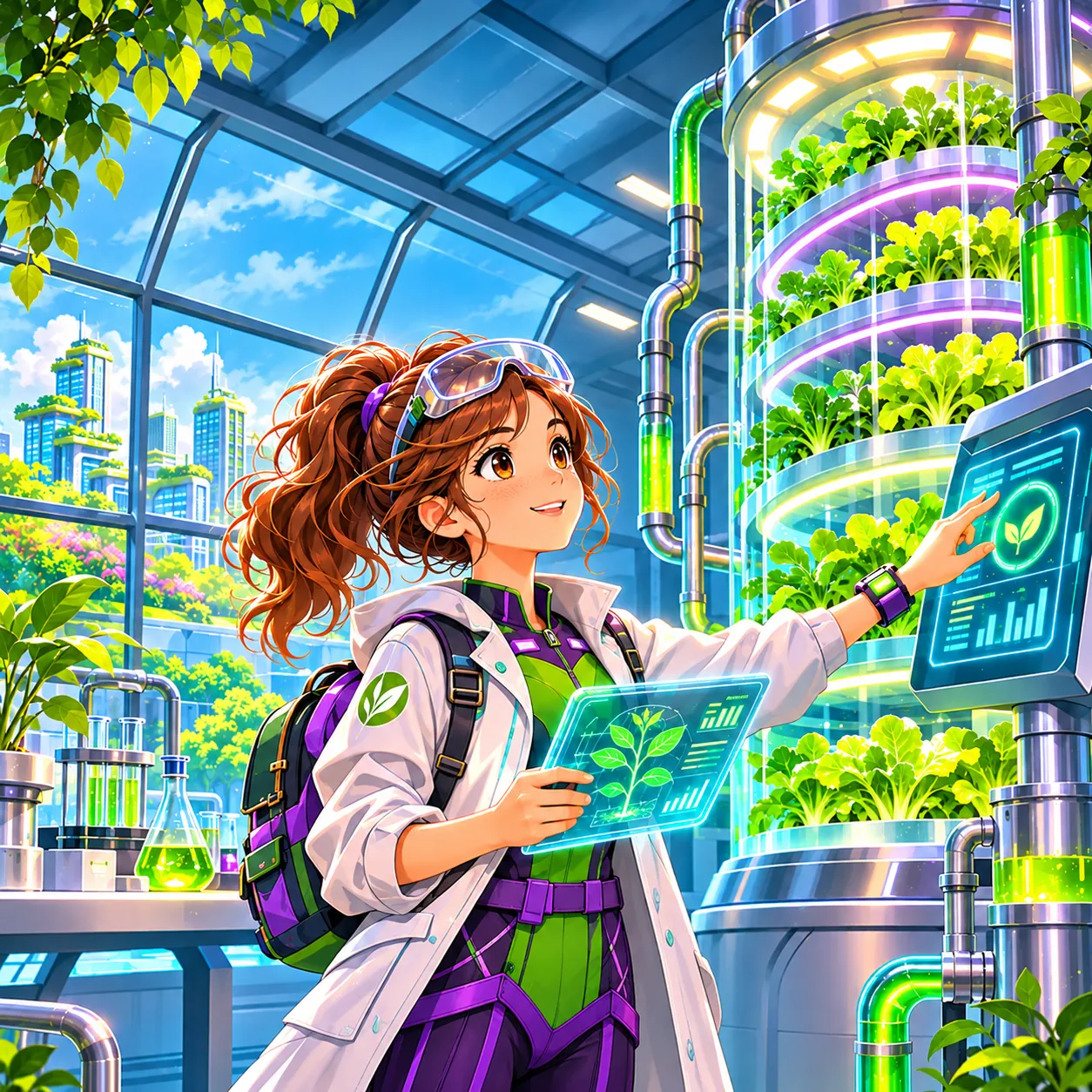
The Secret of the Invisible Garden

Written by Nia Lark
Published
Twelve-year-old Bella loved science, especially experiments involving plants and nature. She often wondered whether technology could help solve problems such as pollution, water shortages, and disappearing forests. Her school science project was about growing plants without soil, using a method called hydroponics. She had managed to grow small lettuce plants in glass jars, but she wanted to discover something much bigger.
One afternoon, while visiting her uncle's research laboratory, Bella noticed a strange green light coming from a locked room. Her uncle was an environmental scientist who worked on advanced farming technology. He had warned her not to enter the room because an important experiment was taking place. However, when he stepped outside to answer a phone call, Bella noticed that the door had been left slightly open.
Inside was a large transparent chamber filled with tiny green plants. There were no flowerpots, no soil, and no visible sunlight. Small tubes carried water through the chamber, while special lights glowed above the plants. A computer screen displayed the words PROJECT GREEN WORLD.
Bella was amazed. Her uncle had created an experimental garden that could grow plants inside an enclosed space, even in places where ordinary farming was difficult. The system used recycled water, artificial light, and carefully controlled nutrients to help plants grow. It was designed to provide fresh food in crowded cities and areas where the soil was damaged.
But something was wrong. Several plants were turning yellow, and the computer showed that the garden's oxygen levels were falling. A warning appeared on the screen, indicating that the main air circulation system had stopped working. If the problem continued, the plants could die before the experiment was completed.
Bella quickly called her uncle. He returned with his research assistant and began checking the computer system. The main ventilation fan was working, but the sensors were receiving incorrect readings. The team could not understand why the machine believed there was not enough air moving through the chamber.
While the scientists examined the control panel, Bella noticed something unusual. A small group of plants near the back wall was growing much faster than the others. Their leaves were healthy and bright green, even though the surrounding plants were struggling. She looked closely and discovered that a narrow air pipe behind them was completely covered with dust and dry leaves.
Bella pointed out the blocked pipe. Her uncle carefully removed the covering, allowing fresh air to circulate through the chamber again. The oxygen readings slowly returned to normal, and the warning lights disappeared. Within minutes, the plants began receiving the airflow they needed.
The scientists were relieved, but Bella noticed another problem. The garden's water supply was decreasing much faster than expected. The computer showed that the system was using almost twice as much water as it should. Her uncle checked the pipes and discovered a small leak hidden beneath the main growing trays.
The team repaired the damaged pipe and activated the water recycling system. This special system collected unused water, filtered it, and sent it back to the plants. Bella was surprised to learn that a small amount of water could be reused many times when it was properly cleaned and managed.
Over the next few days, the garden recovered. New leaves appeared on the plants, and the tiny seedlings grew stronger. Bella helped her uncle record the results and prepare a report about the problems they had discovered. Her observations were added to the research team's notes because she had noticed details that the computer sensors had missed.
A month later, the laboratory invited a group of students to see the completed garden. Bella explained how plants could grow without soil, how artificial lights supported photosynthesis, and why clean water and fresh air were important for healthy plant growth. The students were especially excited to see that the garden could produce vegetables in a small space.
Her uncle later revealed that the project would be tested in a school building where children could grow their own vegetables. Bella was given the responsibility of helping students understand how the system worked. She felt proud that her curiosity had helped improve an invention that could make a real difference.
That evening, Bella looked at the little lettuce plant growing in her own glass jar. It was much smaller than the plants in the laboratory, but she now understood how important even a tiny plant could be. Science was not only about making extraordinary discoveries. Sometimes, it was about noticing a small problem, asking the right questions, and finding a practical way to solve it.