
The Day the Sun Went Missing
Written by Nia Lark
Published
It was a bright Monday morning when the sun suddenly disappeared. There were no clouds, no storm, and no warning. One moment, the city was glowing in golden sunlight, and the next, everything turned dark. Streetlights switched on automatically, birds flew back to their nests, and people hurried out of their homes to discover what had happened.
Eleven-year-old Rayyan was watching the strange event from his bedroom window. Unlike everyone else, he was not frightened. His mother was a scientist who worked at the National Space Research Centre, and Rayyan had grown up hearing about satellites, solar energy, and space experiments. He knew that the sun could not simply disappear, but something was clearly wrong.
At breakfast, his mother received an urgent message from her research team. Several satellites had stopped sending data, and the instruments used to observe the sun were showing unusual readings. She had to return to the research centre immediately. Before leaving, she reminded Rayyan to stay indoors and avoid touching anything in her laboratory.
But Rayyan noticed something unusual on her tablet. A small red signal was blinking on a map of the city, pointing towards an abandoned science station near the mountains. He remembered his mother mentioning that the station once tested a powerful machine designed to collect and store solar energy. Perhaps it had something to do with the darkness.
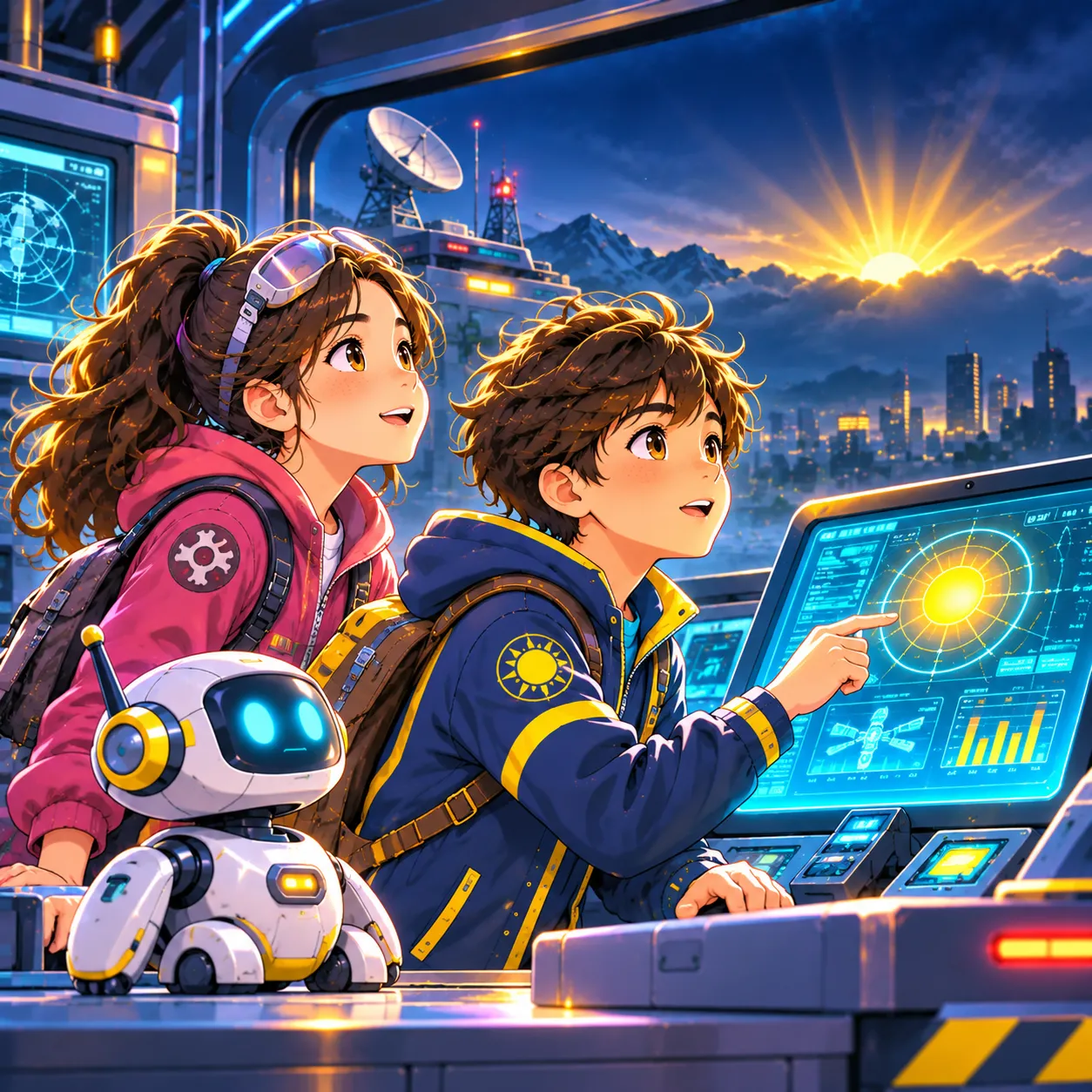
Rayyan contacted his best friend, Areeba, who loved building robots and solving puzzles. Together, they decided to investigate the signal. They packed two flashlights, a portable battery, a small first-aid kit, and Areeba's homemade robot, Bolt. After getting permission from Rayyan's mother to accompany the research team to the station, they set off with an adult scientist.
The old station stood behind a rocky hill. Its metal doors were covered in dust, and several warning lights flashed above the entrance. Inside, the walls were lined with control panels and large screens. One screen showed a strange image of the sun surrounded by a glowing blue circle. A message appeared beneath it: SOLAR ENERGY CONTAINMENT SYSTEM ACTIVE.
The scientist examined the controls and discovered that an experimental machine had accidentally created a powerful energy field around the sun's light as it travelled towards Earth. The machine was designed to store sunlight for future use, but a software error had caused it to trap the light instead of releasing it. The sun was still shining in space, but its light was not reaching the planet.
Rayyan stared at the screen. If the machine continued running, the Earth would become colder and colder. Plants would struggle to grow, animals would lose their natural warmth, and people would soon face serious problems. They needed to switch off the machine before it was too late.
Unfortunately, the main control panel was locked. The system required three separate commands to shut down, and the backup power was failing. Areeba connected Bolt to a nearby computer, hoping the little robot could help. After scanning the system, Bolt found an old maintenance route hidden inside the machine's programming.
The route led to a narrow control room below the main station. Rayyan and Areeba carefully followed the scientist through the passage. Inside, they found three large switches labelled ENERGY, RELEASE, and RESET. The problem was that the switches had to be activated in the correct order, or the machine would restart automatically.
Rayyan remembered a science lesson about stored energy. He realised that the machine first needed to stop collecting energy, then release what it had trapped, and finally reset its system. He explained the sequence to the scientist, who checked the instructions and confirmed that Rayyan was right.
The scientist switched off the ENERGY control. Areeba activated RELEASE, while Bolt connected to the final control panel. For a few seconds, nothing happened. Then the entire station began to shake, and a bright blue light spread across the room. The RESET switch finally turned green.
Outside, the darkness began to fade. A thin line of sunlight appeared above the mountains, followed by a beautiful golden glow that spread across the sky. The birds returned to the trees, the streetlights switched off, and people stepped outside to welcome the morning light.
When Rayyan returned home, his mother was waiting with a worried expression that quickly turned into a proud smile. The research team had already confirmed that the solar energy system was safely shut down. Rayyan had helped solve a problem that even experienced scientists had struggled to understand.
A few weeks later, the research centre invited Rayyan and Areeba to visit its laboratories. Their discovery inspired the scientists to develop a safer solar energy system with stronger controls and better emergency protection. Rayyan was given a small certificate for his contribution, while Bolt received a shiny new charging station.
Rayyan never forgot the day the sun went missing. He learned that science was not only about complicated machines and powerful inventions. It was also about asking questions, thinking carefully, working together, and using knowledge responsibly. Most importantly, he discovered that even young minds could help solve big problems.