

The Machine That Understood Animals
Written by Nia Lark
Published
Ten-year-old Arham was always curious about animals. He often watched birds sitting on electric wires, stray cats sleeping outside shops, and squirrels running between trees. He wondered what animals would say if humans could understand them. Was the neighbourhood cat asking for food, or was it warning other cats about danger? Did birds share secrets while sitting together on rooftops?
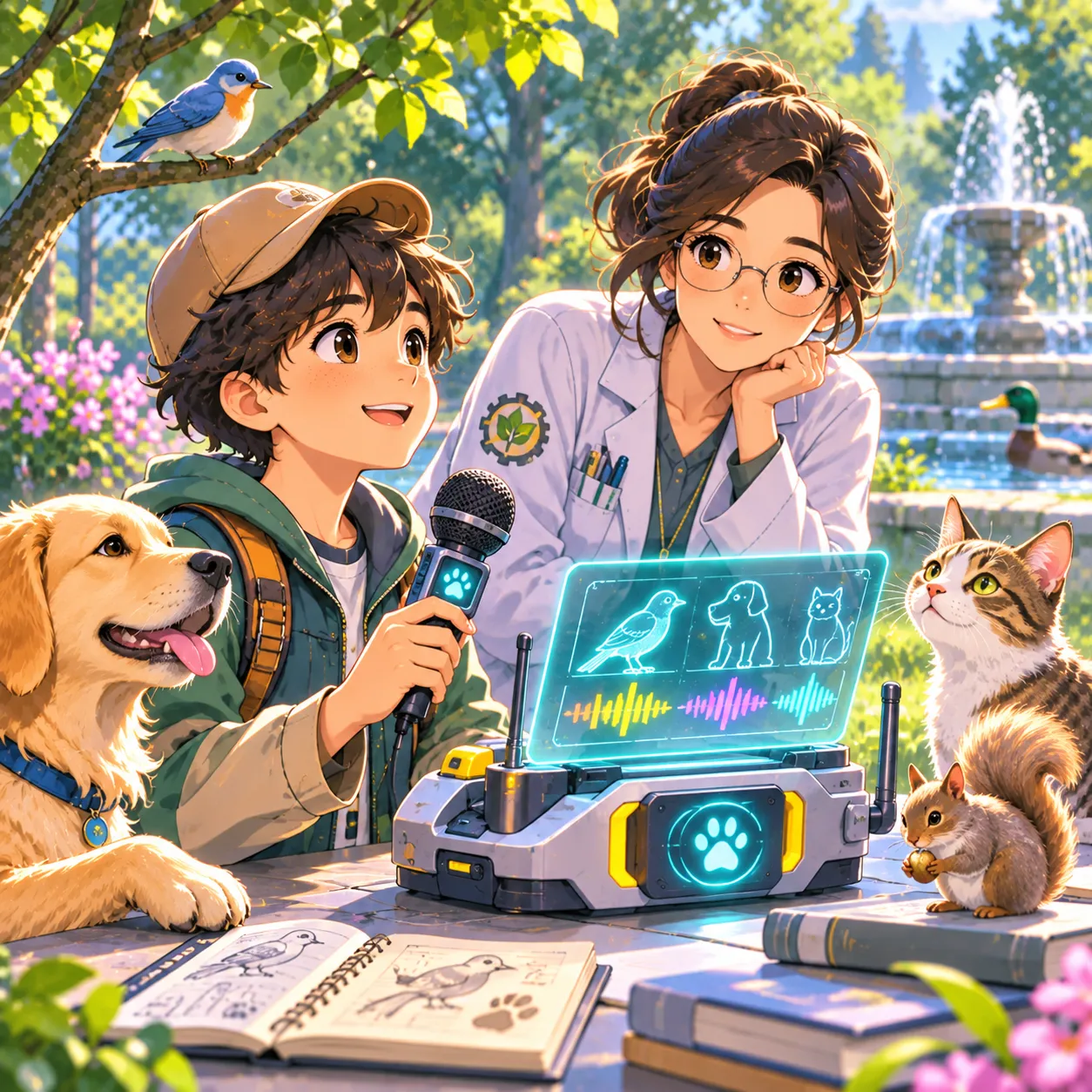
Arham's mother was an engineer who worked in a small research laboratory. One weekend, she showed him her latest invention: a compact machine called the Animal Language Translator. It was designed to study animal sounds, movements, and patterns to help scientists understand what different animals might be communicating. The machine was still being tested, so its results were not always accurate.
Arham was fascinated. His mother attached a small microphone to the device and played a recording of a sparrow. The screen displayed a simple message: Food nearby. When she played a recording of a dog barking, the machine showed: Possible warning or excitement. It was not exactly a conversation, but it was a promising beginning.
The next morning, Arham took the translator to a nearby park. He wanted to test it on the birds that gathered around an old fountain. At first, the machine displayed ordinary messages about food and movement. Then a loud series of bird calls made the screen flash red. A warning appeared: Danger near the water.
Arham looked around and noticed a small duck struggling near the edge of the fountain. A piece of plastic had become tangled around its leg, making it difficult to swim. Arham quickly called the park caretaker, who carefully freed the duck and removed the plastic. The duck swam away safely, and Arham realised that the machine might be more useful than he had imagined.
Later that afternoon, the translator picked up another unusual signal. A group of pigeons was flying in circles above a row of houses. Their sounds were repeated in a strange pattern, and the machine displayed: Nest missing. Possible disturbance. Arham followed the birds and found a fallen nest near a tree. Two tiny chicks were inside, trembling from the cold.
He called his mother, and together they contacted a local wildlife rescue volunteer. The volunteer checked the chicks and helped place them in a safe location close to where the nest had fallen. The parent birds soon returned. Arham was happy, but he also began to understand that technology alone could not solve every problem. People still needed care, patience, and expert help.
A few days later, something much more serious happened. The translator began receiving strange signals from animals across the park. Dogs were barking, birds were flying away from certain trees, and squirrels were hiding in unusual places. The machine repeatedly displayed the same warning: Unusual sound and vibration detected.
Arham informed his mother, who decided to investigate. They discovered that construction work had started near the park, and a large machine was producing strong vibrations. The workers had not realised that the noise was disturbing the animals and damaging some of their nesting areas. Arham's mother explained the problem to the park management, who arranged for the work to be carried out more carefully.
The translator had helped identify a problem that people had overlooked. Arham's mother also explained that the machine did not truly translate animal language like a human conversation. It used scientific observations and computer patterns to make educated guesses about animal behaviour. Some messages could be wrong, so the information always needed to be checked.
Inspired by these discoveries, Arham suggested improving the machine so it could help wildlife researchers monitor animals in forests and parks. His mother agreed that it was a wonderful idea. They added a feature that recorded unusual animal activity and shared alerts with trained wildlife experts.
A few months later, their improved invention was tested in a nature reserve. It helped researchers notice changes in bird activity and identify areas where animals needed protection. Arham was invited to present the project at his school science exhibition. His classmates were amazed by the idea that technology could help humans understand nature more carefully.
Arham placed the translator on his exhibition table beside a photograph of the rescued duck. He explained that animals could not always tell us directly when they were in danger, but their sounds and behaviour often gave important clues. By observing them closely and protecting their habitats, humans could make the world safer for all living creatures.
From that day onward, Arham never looked at a bird, a cat, or even a tiny ant in quite the same way. He had discovered that understanding nature did not always require a magical machine. Sometimes, it simply required people to pay attention.